


#1478 🩸 RedBloodJournal.com
🩸Lithium: The Essential Mineral Hidden in Plain Sight
One Doctor’s Challenge to Modern Medicine
By: Red Blood
For most people, the word lithium immediately brings two images to mind: psychiatric medication and rechargeable batteries. According to Dr. Michael Nehls, however, that perception represents only a small part of lithium’s story.
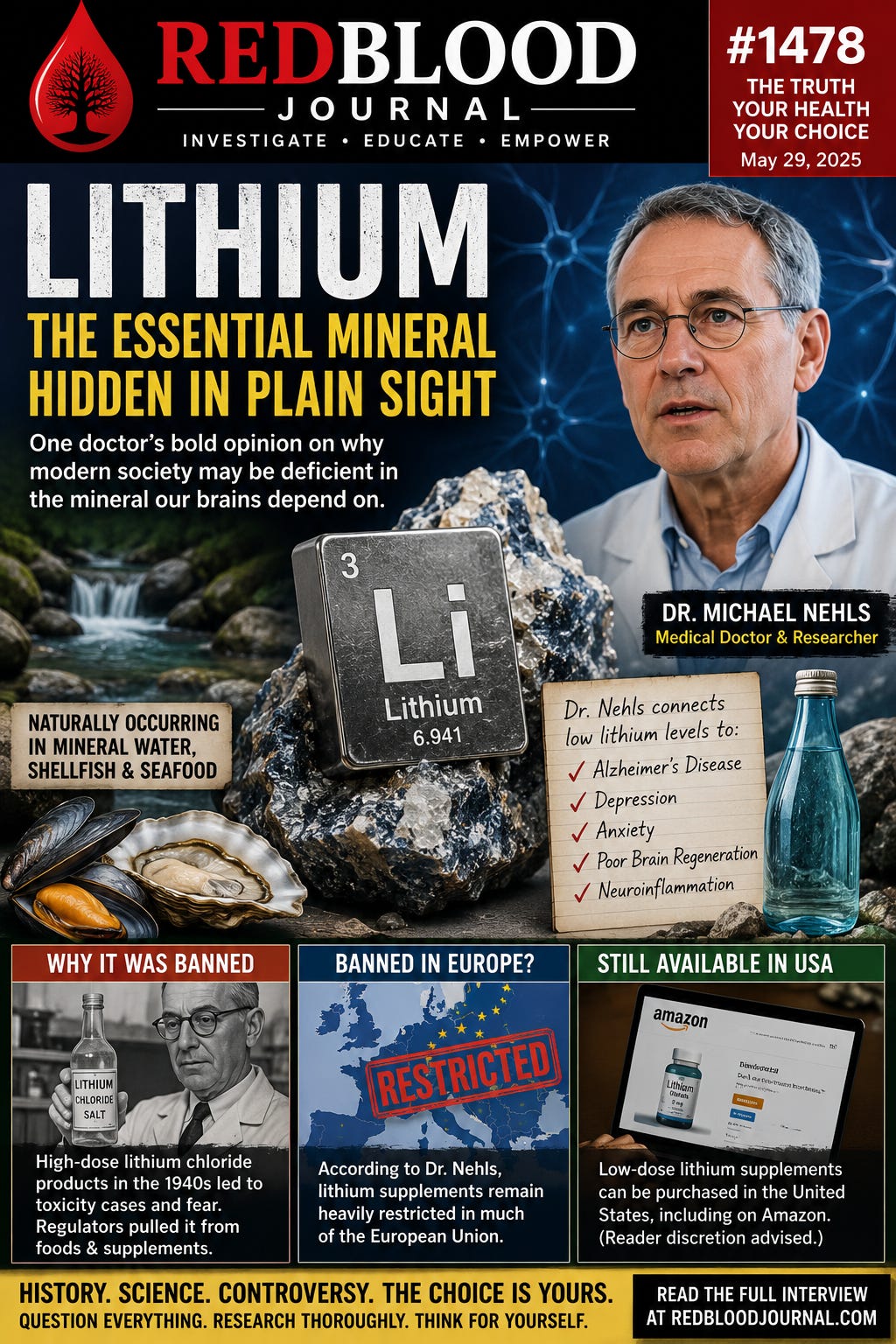
During a recent interview, Dr. Nehls argued that lithium should be viewed not only as a medication used in psychiatry but also as an essential trace mineral that humans have naturally consumed for thousands of years through food and drinking water. In his opinion, modern society has largely forgotten this nutritional role, focusing almost exclusively on lithium’s pharmaceutical applications.
A Different Perspective
Dr. Nehls presents the hypothesis that the human brain requires extremely small amounts of lithium throughout life to support normal neurological function. Unlike the much larger doses prescribed for certain psychiatric disorders, he is referring to tiny quantities that naturally occur in mineral water, shellfish, seafood, and some groundwater sources.
According to Dr. Nehls, modern diets contain significantly less naturally occurring lithium than those of our distant ancestors. He believes this gradual reduction may contribute to declining brain health and increasing rates of neurological disorders.
Why Does Lithium Carry Such a Different Reputation?
One of the most controversial parts of Dr. Nehls’ interview concerns the history of lithium regulation.
According to Dr. Nehls, during the late 1940s several medical experiments and products used very large quantities of lithium chloride as a substitute for table salt. He argues that these doses were dramatically higher than the trace amounts naturally found in food and water. Following reports of serious toxicity associated with those high-dose products, regulators removed lithium from foods and supplements, causing the public to associate lithium primarily with psychiatric medicine rather than nutrition.
Dr. Nehls contends that this historical turning point permanently changed lithium’s public image.
Europe and the United States
Dr. Nehls further argues that this regulatory history continues to influence policy today.
According to him, nutritional lithium supplements remain heavily restricted in much of Europe, while consumers in the United States can purchase low-dose lithium supplements through various retailers, including online marketplaces such as Amazon. He views this difference as evidence that the subject deserves renewed scientific and public discussion.
The Brain and the Hippocampus
Throughout the interview, Dr. Nehls repeatedly returns to one structure of the brain: the hippocampus.
He argues that this region continuously produces new brain cells throughout life and that this process is essential for memory, curiosity, emotional resilience, learning, and long-term cognitive health. According to his hypothesis, inadequate nutritional support—including insufficient lithium—may gradually reduce this regenerative capacity.
Dr. Nehls extends this theory further, suggesting that reduced brain regeneration may contribute to conditions including Alzheimer’s disease, depression, anxiety, and other neurological disorders.
A Question Rather Than a Conclusion
The interview raises questions that extend far beyond lithium itself.
If Dr. Nehls is correct, then lithium may represent one of the most overlooked trace minerals in modern nutrition. If he is mistaken, then his hypotheses will ultimately be challenged and tested through continued scientific research.
Either way, his interview encourages readers to examine the evidence for themselves rather than relying solely on decades of public perception.
Scientific progress has often begun with questions that challenged accepted thinking. Whether Dr. Nehls’ ideas become part of future medical understanding remains for the scientific community to determine.
For readers, the value of the interview lies not in accepting or rejecting his conclusions outright, but in carefully considering the evidence, comparing differing viewpoints, and reaching their own informed conclusions.
🧠 Lithium:
The Forgotten Trace Mineral for Cognitive Vitality
Jul 3, 2026
The provided text highlights a specialized perspective on lithium, repositioning it from a high-dose psychiatric drug to a vital nutritional trace mineral. Dr. Michael Nehls argues that modern humans are deficient in this element because it has been stripped from our food and water supply following historical regulatory shifts. This deficiency may impair the hippocampus, a brain region responsible for memory and emotional resilience, potentially contributing to the rise of neurological disorders. The source contrasts international regulations, noting that while Europe restricts access, the United States allows low-dose supplementation. Ultimately, the text encourages a scientific reevaluation of lithium’s role in maintaining long-term cognitive vitality and brain regeneration.


