


🩸 #1475 🩸 RedBloodJournal.com
July 4, 2026
By: Red Blood
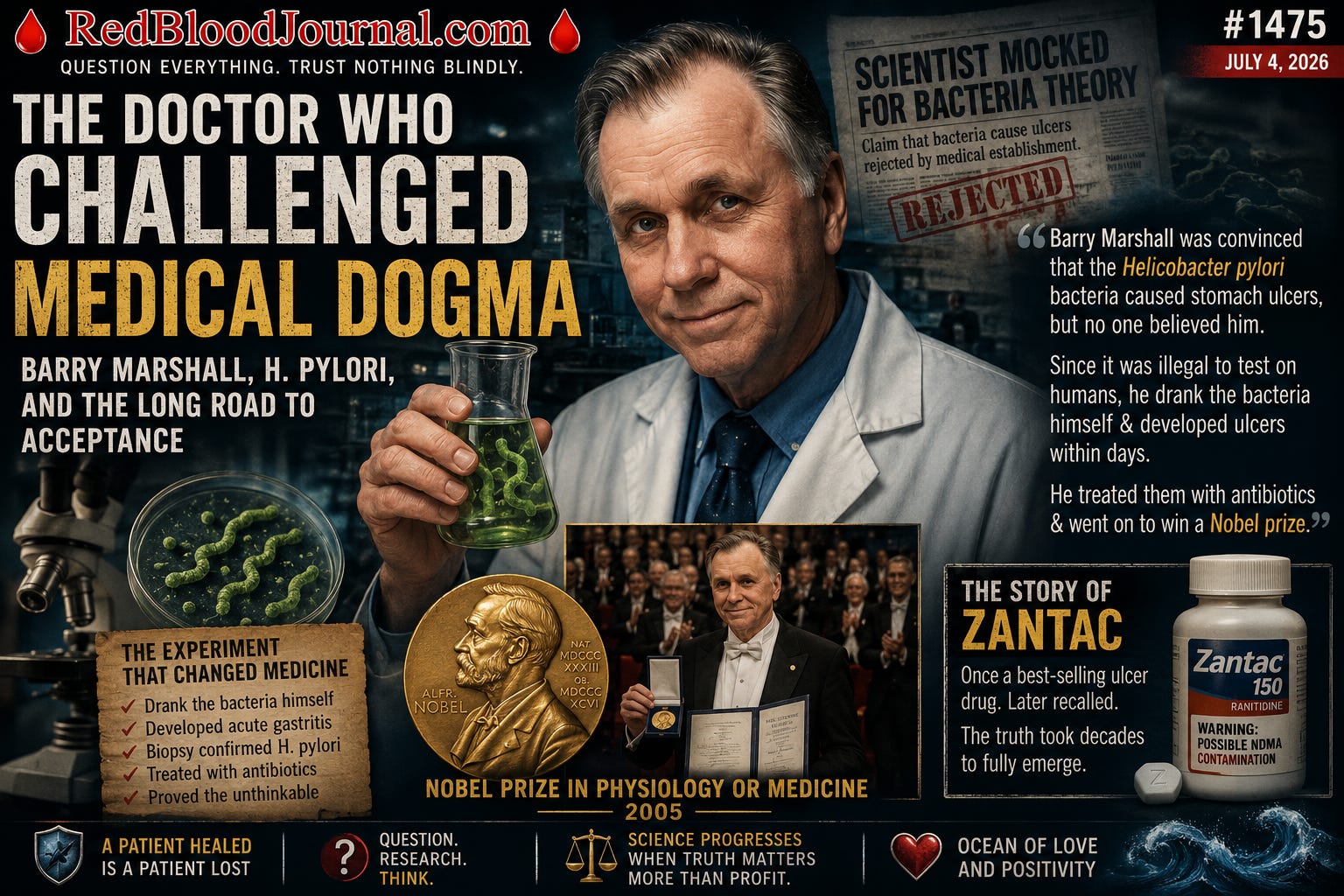
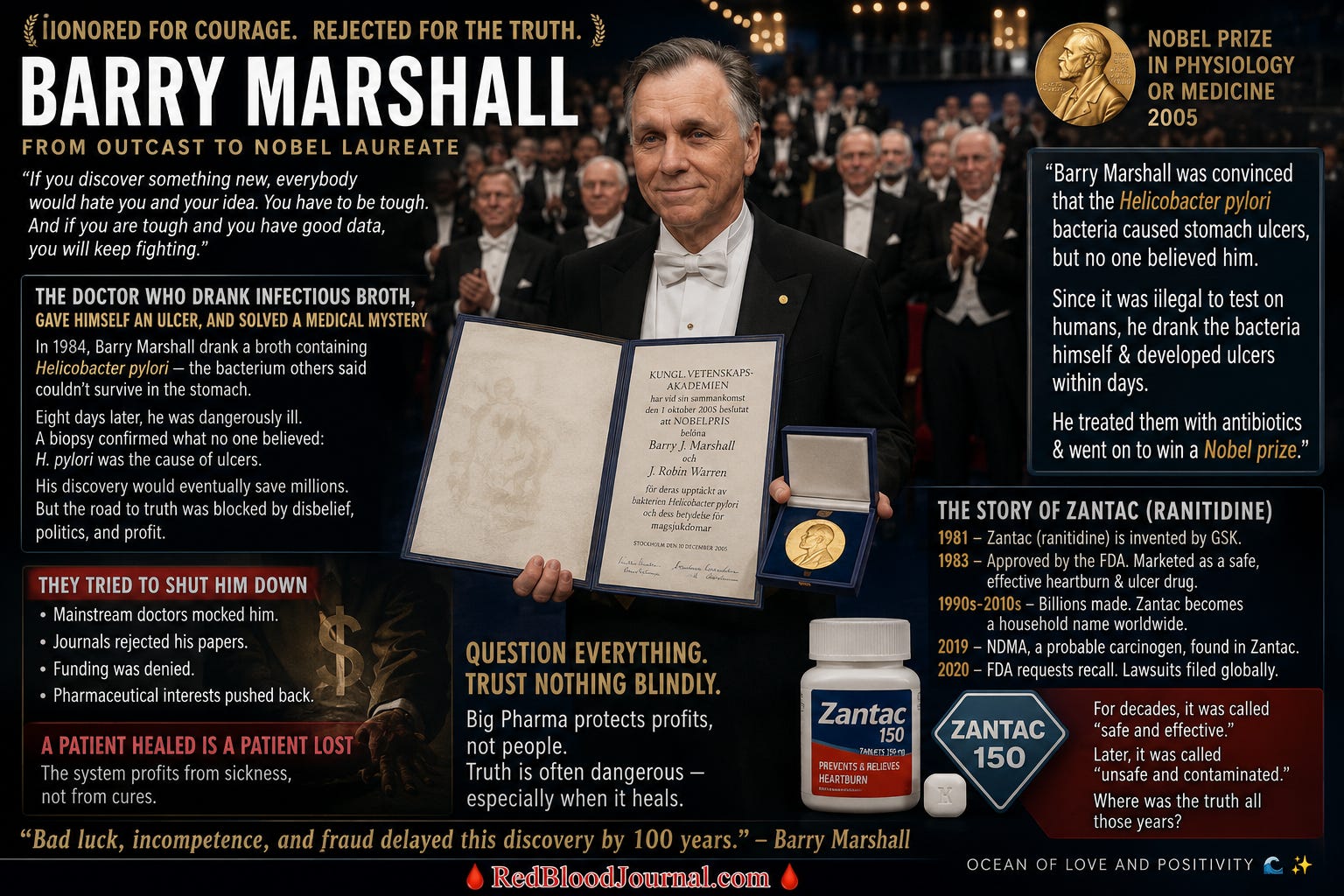
🩸 The Doctor Who Challenged Medical Dogma:
Barry Marshall, Helicobacter pylori, and the Long Road to Acceptance
Introduction
History repeatedly demonstrates that scientific breakthroughs are not always welcomed. Some of the greatest discoveries have initially been ridiculed, rejected, or ignored before eventually becoming accepted.
One of the most remarkable examples is the work of Australian physician Dr. Barry Marshall, whose research fundamentally changed medicine’s understanding of stomach ulcers and gastric cancer.
This report examines the historical events surrounding that discovery, the resistance it encountered, and the broader questions it raises about scientific institutions, pharmaceutical incentives, and the importance of questioning accepted knowledge.
Readers are encouraged to examine the evidence themselves and draw their own conclusions.
The Accepted Belief
For much of the twentieth century, medical textbooks taught that stomach ulcers were primarily caused by:
Stress
Anxiety
Excess stomach acid
Spicy foods
Lifestyle factors
Patients were commonly treated with:
Acid-reducing medications
Dietary restrictions
Long-term maintenance drugs
Surgery in severe cases
Very few scientists believed bacteria could survive inside the highly acidic environment of the human stomach.
That assumption became accepted as medical fact.
An Unexpected Discovery
During the early 1980s, Dr. Barry Marshall began working with Australian pathologist Dr. Robin Warren.
Together they repeatedly observed spiral-shaped bacteria living inside the stomach lining of ulcer patients.
The organism would later become known as:
Helicobacter pylori (H. pylori)
Marshall became convinced that these bacteria—not stress alone—were responsible for many peptic ulcers.
Today this idea seems obvious.
At the time it was considered highly controversial.
Resistance from the Medical Community
According to Marshall’s own lectures, the scientific community initially rejected the findings.
Among the obstacles described were:
Journal rejections
Professional skepticism
Difficulty obtaining research funding
Widespread adherence to established theories
Marshall has also argued that poor research design, bad timing, and even instances of scientific misconduct delayed recognition of the discovery.
In a 2023 lecture, he summarized the experience by saying that if someone discovers something truly new, many people may initially reject both the discovery and the scientist.
The Experiment That Changed Medicine
Unable to prove the theory using animal models and unable to conduct conventional human trials, Marshall chose an extraordinary course of action.
He became his own research subject.
He deliberately drank a broth containing Helicobacter pylori.
Within days he developed acute gastritis.
Subsequent biopsies demonstrated that the bacteria had colonized his stomach.
He later treated himself with antibiotics.
Although this single experiment did not by itself prove every aspect of ulcer disease, it provided powerful evidence supporting the bacterial hypothesis and became one of the most famous examples of scientific self-experimentation.
A Revolution in Treatment
As additional evidence accumulated, the medical community gradually accepted the new understanding.
Today many peptic ulcers are treated by eradicating H. pylori using combinations of antibiotics and acid-suppressing medications.
The discovery also transformed understanding of gastric cancer, since chronic H. pylori infection is now recognized as an important risk factor for certain stomach cancers.
Millions of patients worldwide have benefited from this change in medical practice.
Recognition
In 2005, Barry Marshall and Robin Warren were awarded the Nobel Prize in Physiology or Medicine.
Their work is now regarded as one of the most important medical discoveries of the twentieth century.
Ironically, the same idea that was once widely dismissed eventually became accepted scientific knowledge.
Questions About Scientific Institutions
Marshall’s story is often cited as a reminder that scientific progress can encounter resistance.
There are many reasons why new ideas may face opposition:
Established medical theories
Institutional inertia
Professional reputations
Funding priorities
Demands for strong evidence before changing clinical practice
These factors do not necessarily imply misconduct, but they can slow the acceptance of genuinely important discoveries.
Marshall himself has argued that scientists must remain willing to challenge assumptions while supporting their conclusions with rigorous evidence.
The Story of Zantac
The ulcer story also invites reflection on the history of medications used before the bacterial cause became widely recognized.
One of the best-known drugs was Zantac (ranitidine).
For many years it became one of the world’s best-selling medications for ulcers and acid reflux by reducing stomach acid rather than addressing bacterial infection.
Decades later, regulators identified contamination concerns involving NDMA, a probable human carcinogen, in certain ranitidine products, leading to recalls and market withdrawals in several countries.
The history of Zantac illustrates how medical treatments, regulatory decisions, and scientific understanding can evolve over time as new evidence emerges.
Lessons Beyond Ulcers
Barry Marshall’s experience highlights several broader lessons:
Accepted scientific ideas can sometimes be incomplete.
Strong evidence is essential when challenging established beliefs.
Scientific progress often requires persistence.
Independent verification remains central to medical advancement.
Patients benefit when research remains open to revising previous assumptions.
His work also reminds researchers that skepticism should apply not only to new ideas but also to long-standing doctrines.
Conclusion
The story of Barry Marshall is not simply about stomach ulcers.
It is about the process of scientific discovery itself.
It illustrates how evidence can overturn deeply held assumptions, how perseverance can change medical practice, and how today’s controversial hypothesis may become tomorrow’s accepted knowledge if supported by reproducible data.
Rather than encouraging blind trust or blanket distrust of any institution, Marshall’s journey encourages something more valuable: careful questioning, critical thinking, and a willingness to examine evidence wherever it leads.
Scientific progress has often depended on individuals willing to challenge consensus responsibly, while allowing the strength of the data—not popularity—to determine the outcome.
🩸 RedBloodJournal.com
Ocean of Love and Positivity 🌊✨
🧪 The Pathogen of Progress: Barry Marshall’s Ulcer Revolution
Jul 4, 2026
The provided text chronicles the medical revolution led by Dr. Barry Marshall and Dr. Robin Warren, who discovered that Helicobacter pylori bacteria cause stomach ulcers. For decades, the medical establishment incorrectly blamed stress and lifestyle factors, leading to a reliance on long-term acid-reducing drugs like Zantac. To overcome professional skepticism and prove his theory, Marshall famously performed a self-experiment by consuming the bacteria to induce gastritis. This persistence eventually shifted global clinical practices toward using antibiotics, earning the researchers a Nobel Prize in 2005. Ultimately, the source uses this historical breakthrough to emphasize the importance of critical thinking and the challenging of established scientific dogmas.


