


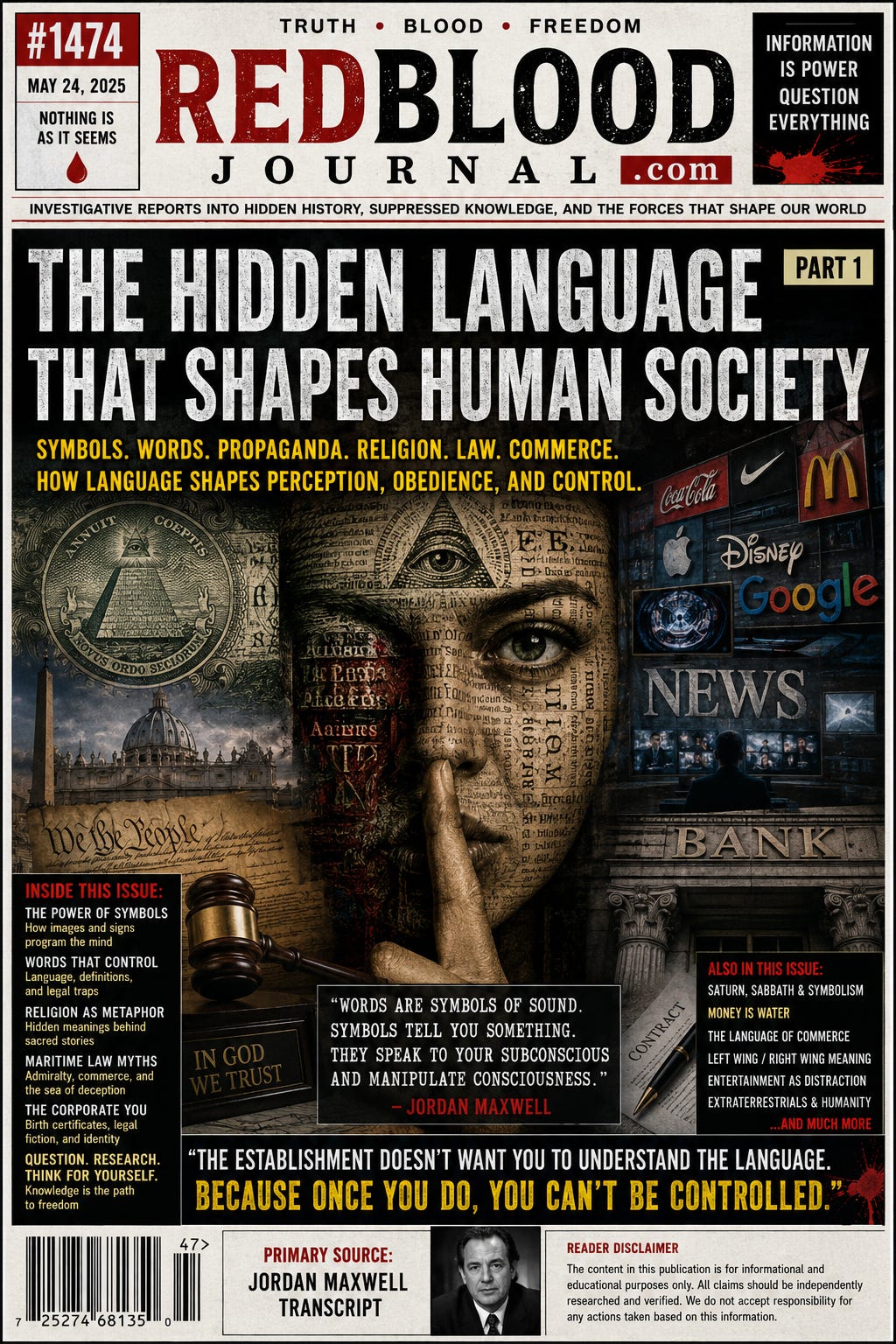
#1474 🩸 RedBloodJournal.com 🩸
The Hidden Language That Shapes Human Society
By Red Blood
Introduction
Every civilization is built on language.
Words, symbols, flags, logos, ceremonies, legal documents, religious imagery, and political slogans all serve one common purpose: they communicate ideas. They allow millions of strangers to cooperate, establish laws, conduct commerce, and preserve history.
But language also possesses another characteristic that is often overlooked.
It has the ability to shape perception.
Throughout history, governments, religions, businesses, militaries, advertisers, and educators have understood that the way information is presented often influences how it is received. The symbols surrounding an idea can become just as powerful as the idea itself.
This report examines the relationship between symbols, language, psychology, and power. It also explores the interpretations presented by researcher Jordan Maxwell, whose work argues that many modern institutions contain layers of symbolic meaning hidden beneath ordinary language. His interpretations remain controversial and are not universally accepted by historians, linguists, or legal scholars. They are presented here as viewpoints for readers to examine critically and research independently.
Every Symbol Speaks
A stop sign immediately causes a driver to slow down.
A national flag can inspire patriotism.
A company logo may create trust before a single product is purchased.
A wedding ring communicates commitment without a single spoken word.
Military uniforms establish authority instantly.
Religious symbols evoke centuries of tradition.
None of these reactions occur because the object itself possesses power.
The power comes from the meaning that society has attached to it.
Human beings communicate not only with language but also with visual shorthand that bypasses lengthy explanations.
Symbols compress ideas.
Words Shape Reality
Language is more than communication.
It organizes thought.
Every society develops vocabulary that defines acceptable behavior, political structures, legal systems, economics, morality, and religion.
When enough people accept particular definitions, those definitions become reality within that culture.
Entire civilizations have risen around shared words such as:
Freedom
Justice
Democracy
Security
Faith
Property
Law
Each carries emotional weight far beyond its dictionary definition.
Different cultures—and different generations—may interpret those same words very differently.
Education or Conditioning?
One of the central themes discussed by Jordan Maxwell is the difference between education and conditioning.
Education encourages questioning.
Conditioning discourages it.
Children naturally accept information presented by parents, teachers, governments, and religious institutions because they have little experience by which to evaluate competing claims.
As adults, many continue accepting those early assumptions without revisiting their origins.
Whether discussing politics, economics, science, religion, or history, questioning foundational assumptions has historically been one of the engines of intellectual progress.
Propaganda Does Not Always Look Like Propaganda
Many people imagine propaganda as wartime posters or political speeches.
Modern persuasion is often far more subtle.
Advertising.
Entertainment.
News selection.
Social media algorithms.
Political branding.
Corporate marketing.
Even repeated phrases can gradually influence public perception.
The more often an idea is repeated, the more familiar it becomes.
Familiarity is frequently mistaken for truth.
This psychological effect has been extensively studied and is one reason repetition remains one of the oldest communication techniques in history.
The Power of Definitions
Legal systems depend upon precise language.
Medical systems depend upon precise language.
Scientific research depends upon precise language.
A single word can completely alter the interpretation of a contract, law, or treaty.
This explains why governments, courts, corporations, and legislatures devote enormous resources to defining terms carefully.
Words establish authority.
Definitions establish boundaries.
The Search for Hidden Meaning
Jordan Maxwell spent decades researching symbolism, comparative religion, etymology, and historical institutions.
Among his most well-known claims are interpretations connecting modern legal terminology, financial language, religious traditions, and symbolic imagery to much older historical systems.
Many of these interpretations—including those involving maritime law, banking symbolism, and hidden meanings in legal terminology—remain subjects of debate and are not generally accepted as established legal or historical fact.
Nevertheless, his broader message is less controversial:
People should investigate the origins of the words, symbols, and institutions that shape their daily lives rather than accepting them uncritically.
Reading Beneath the Surface
Every civilization develops narratives.
Some become history.
Some become tradition.
Some become law.
Some become marketing.
Some become ideology.
The challenge is distinguishing documented fact from interpretation, evidence from assumption, and observation from speculation.
That process requires patience.
It requires reading original sources.
It requires comparing multiple viewpoints rather than relying upon a single authority.
The Responsibility of the Individual
Whether one agrees with Jordan Maxwell’s conclusions or rejects them entirely, one principle remains valuable:
Think independently.
Question respectfully.
Verify carefully.
Avoid accepting extraordinary claims without evidence.
Equally, avoid dismissing unfamiliar ideas without investigation.
Knowledge advances when curiosity outweighs certainty.
Final Thought
Language is one of humanity’s greatest inventions.
It can educate.
It can unite.
It can inspire.
It can manipulate.
The responsibility for distinguishing between those possibilities ultimately belongs to each individual.
Perhaps the greatest freedom is not merely freedom of speech, but the freedom to understand the language that shapes the world around us.
The purpose of this report is not to persuade the reader to accept any particular interpretation, but to encourage independent research, careful thinking, and open discussion. In an age of constant information, the ability to examine words, symbols, and ideas critically may be one of the most valuable skills a person can develop.
The investigation continues.
🩸 RedBloodJournal.com 🩸
👁️ The Hidden Grammar of Power and Persuasion
Jul 4, 2026
This text explores how language and symbols serve as the foundational tools used to construct human society and influence public perception. The author emphasizes that common symbols, such as flags or logos, derive their immense power not from physical traits but from the shared meanings civilizations assign to them. While highlighting the research of Jordan Maxwell, the source examines how institutional conditioning can lead individuals to accept legal, religious, and political structures without questioning their origins. It warns that modern propaganda often operates through subtle repetition, using precise definitions to establish authority and establish social boundaries. Ultimately, the source advocates for independent thinking and rigorous personal research to distinguish between objective truth and manufactured narratives. By understanding the hidden meanings behind everyday communication, individuals can better navigate a world shaped by complex psychological influences.


