


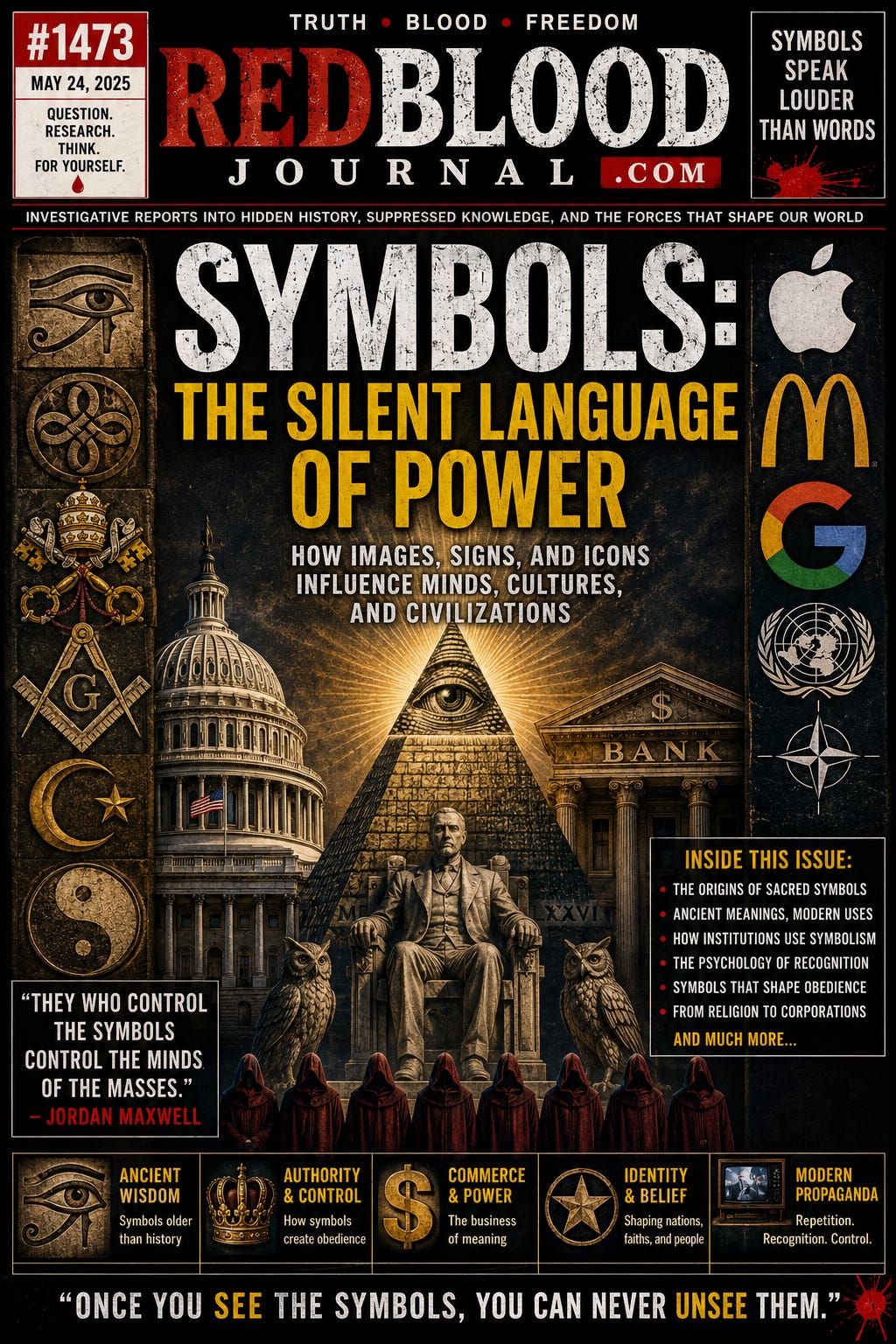
#1473 🩸 RedBloodJournal.com 🩸
Symbols: The Silent Language of Power
By Red Blood
Introduction
Long before human beings developed written language, they communicated through symbols.
A raised hand could signal peace.
A fire on a distant hill could warn of danger.
An animal carved into stone could represent an entire tribe.
A simple mark scratched into clay could identify ownership, trade, or authority.
Symbols became humanity’s first universal language.
Unlike spoken words, symbols cross barriers of language, education, and geography. They can communicate an idea in an instant, evoke emotion without explanation, and remain recognizable for thousands of years.
This report examines how symbols have shaped civilizations, influenced institutions, and become one of the most powerful forms of communication ever developed. It also considers the interpretations of researcher Jordan Maxwell, who argued that many modern symbols preserve meanings inherited from ancient cultures. His interpretations remain controversial and are not universally accepted by historians or scholars, and they are presented here for readers to examine critically and research independently.
The First Language
Before alphabets...
Before books...
Before governments...
There were symbols.
Archaeologists have discovered symbolic markings dating back tens of thousands of years.
Ancient cave paintings.
Stone carvings.
Solar circles.
Animals.
Hands.
Geometric designs.
These images communicated ideas long before written history.
They helped people remember stories, identify communities, and pass knowledge from one generation to another.
Why Symbols Work
The human brain processes images remarkably quickly.
A familiar symbol often communicates faster than an entire paragraph.
Consider how instantly people recognize:
A national flag.
A medical cross.
A police badge.
A corporate logo.
A religious emblem.
A traffic sign.
No explanation is necessary.
The image itself carries meaning.
Symbols allow enormous amounts of information to be compressed into a single visual form.
The Evolution of Meaning
One of the remarkable characteristics of symbols is that their meanings change over time.
The same image may represent one idea in one civilization and something entirely different centuries later.
History provides many examples.
Ancient religious emblems become national symbols.
Royal insignia become corporate trademarks.
Military imagery becomes fashion.
Traditional symbols are adopted by political movements.
Perhaps the best-known example is the swastika, which existed for centuries in several cultures as a symbol associated with prosperity or good fortune before becoming overwhelmingly associated with Nazi Germany in the twentieth century. Today, for many people, that later association dominates public perception.
Institutions Understand Symbolism
Governments carefully design flags, seals, architecture, uniforms, and ceremonies.
Corporations spend billions developing logos and brand identities.
Religious traditions preserve centuries-old imagery.
Universities maintain crests and ceremonial dress.
Military organizations use medals, ranks, insignia, and colors.
These choices are rarely accidental.
Symbols communicate continuity.
Authority.
Trust.
Tradition.
Identity.
Jordan Maxwell’s Perspective
Jordan Maxwell argued that many familiar symbols carry historical layers that most people no longer recognize.
According to his interpretation, ancient civilizations transmitted symbolic ideas into religion, government, law, banking, and commerce through architecture, emblems, ceremonial clothing, and language.
Some researchers find these connections compelling.
Others argue that many proposed links rely upon speculative interpretations rather than documented historical evidence.
Regardless of where one stands, Maxwell consistently encouraged readers to investigate the historical origins of symbols rather than accepting modern explanations alone.
The Psychology of Recognition
A symbol gains influence through repetition.
The more often people encounter it, the more familiar it becomes.
Over time, familiarity produces trust.
That is one reason branding has become one of the most valuable assets in modern commerce.
Consumers frequently recognize a symbol long before they remember a company name.
The same psychological principle applies to politics, religion, entertainment, and public institutions.
Recognition creates comfort.
Comfort often encourages acceptance.
Beyond Conspiracy
Discussions of symbolism frequently become polarized.
Some dismiss every symbolic interpretation as coincidence.
Others assume every symbol conceals a secret message.
Reality is often more complex.
Many symbols genuinely possess documented historical origins.
Others accumulate new meanings over centuries.
Some are intentionally designed to communicate authority or identity.
Others simply survive because they have become culturally familiar.
Distinguishing between documented history and speculative interpretation requires careful research rather than assumptions.
Seeing the World Differently
Once people begin paying attention to symbols, they often notice them everywhere.
Government buildings.
Corporate advertising.
Entertainment.
Religious architecture.
Currency.
National monuments.
Courtrooms.
Military ceremonies.
Public art.
The question is not whether symbols exist.
The question is what they communicate—and whether their meaning today is the same as when they first appeared.
Final Thought
Symbols are silent.
Yet they influence memory, emotion, identity, and perception every day.
Some preserve history.
Some inspire unity.
Some advertise products.
Some establish authority.
Some become controversial as their meanings evolve across generations.
Understanding symbols does not require accepting every interpretation offered about them.
It requires curiosity.
It requires historical investigation.
It requires the willingness to ask where an image came from, how its meaning changed, and why it continues to endure.
Perhaps the greatest power of a symbol is not that it speaks...
but that it can communicate without saying a single word.
The investigation continues.
🩸 RedBloodJournal.com 🩸
👁️ The Silent Language:
The Universal Power of Symbols
Jul 4, 2026
This text explores how visual signs function as humanity’s most enduring and universal form of communication, predating the written word. It emphasizes that icons and emblems possess the unique ability to convey complex information instantly while crossing cultural and linguistic boundaries. The author highlights how major institutions, including governments and corporations, utilize specific imagery to establish authority, identity, and trust. Furthermore, the report discusses the evolution of meaning, noting that the significance of a single image can shift dramatically over centuries. It also introduces the theories of Jordan Maxwell, who suggested that modern society remains deeply influenced by ancient symbolic traditions hidden in plain sight. Ultimately, the source encourages readers to critically investigate the historical origins of the visual world to better understand the silent forces shaping human perception.


