


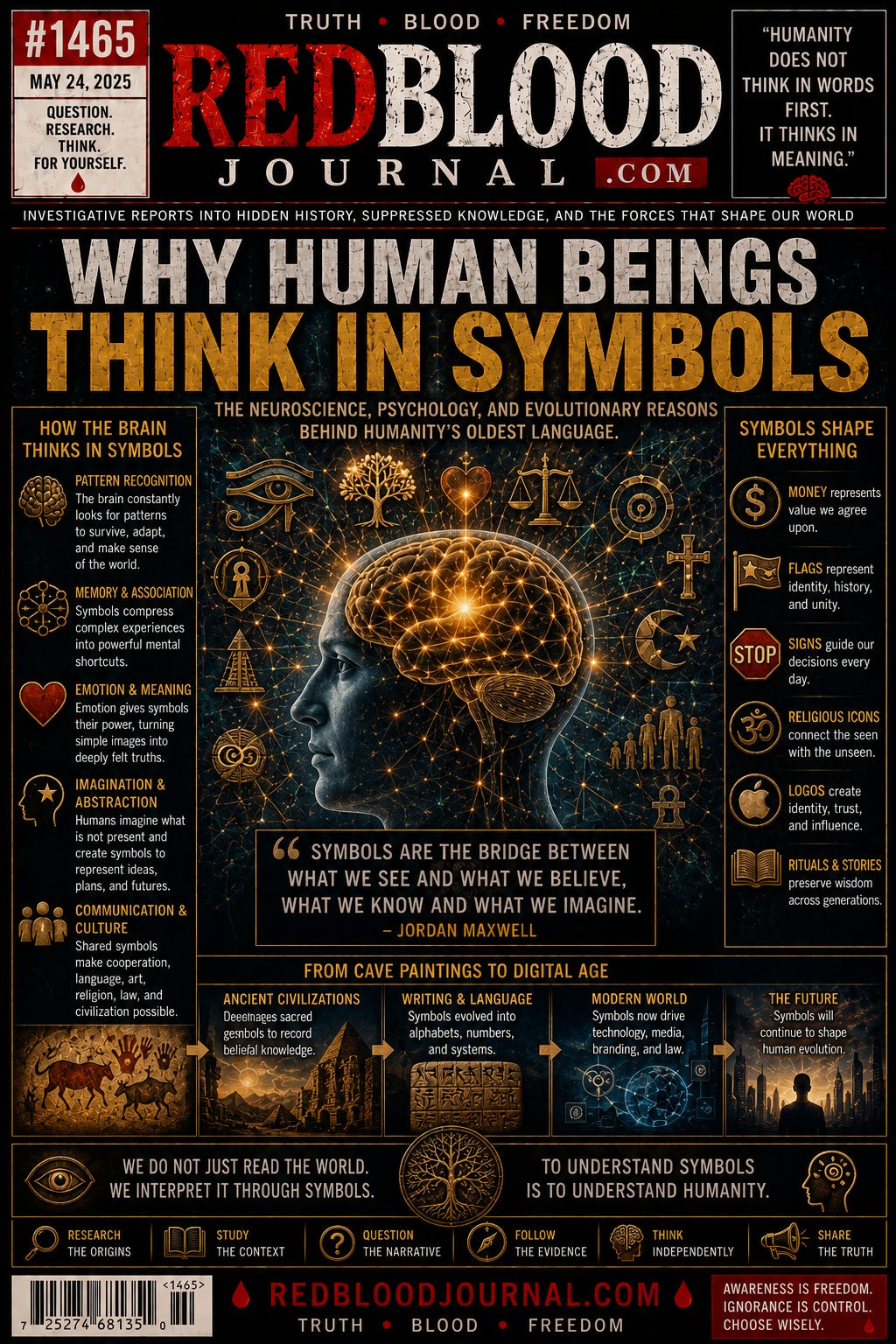
#1465 🩸 RedBloodJournal.com 🩸
Why Human Beings Think in Symbols
By Red Blood
Introduction
Why can a child recognize a smile before learning to speak?
Why does a red light immediately tell us to stop?
Why can a flag bring tears to someone’s eyes?
Why can a simple wedding ring represent a lifetime of commitment?
The answer is not found in the object itself.
It is found in the human mind.
Human beings do not merely think with words.
They think with images.
With memories.
With emotions.
With patterns.
With symbols.
Long before humanity created writing, our ancestors learned to recognize meaning through observation. That ability became one of the greatest evolutionary advantages our species ever developed.
This report explores why symbolic thinking appears to be a natural part of human cognition and how it became one of the foundations of civilization.
The Brain Is a Pattern-Seeking Machine
Every moment, the human brain processes enormous amounts of information.
Colors.
Movement.
Faces.
Voices.
Shadows.
Expressions.
Rather than analyzing every detail individually, the brain looks for patterns.
Pattern recognition allows people to make rapid decisions.
A familiar face.
A dangerous animal.
A safe path.
A storm approaching.
Without this ability, survival would have been far more difficult.
Symbols Are Mental Shortcuts
A symbol is an efficient way to store meaning.
Instead of remembering thousands of individual experiences, the mind compresses them into recognizable images.
A heart becomes associated with affection.
A scale with justice.
A dove with peace.
A crown with authority.
Whether these associations are learned through culture or personal experience, symbols allow the brain to organize complex ideas quickly.
Imagination Builds Symbols
Unlike most other species, humans possess a remarkable ability to imagine things that are not physically present.
We picture the future.
We remember the past.
We invent stories.
We create mathematics.
We imagine civilizations that do not yet exist.
Symbols make this possible.
They transform abstract ideas into visible forms that can be shared with others.
Emotion Gives Symbols Their Power
A symbol without emotion is simply a shape.
Its influence begins when it becomes connected to experience.
A national flag seen during a celebration may evoke pride.
The same flag seen during a tragedy may evoke grief.
A family photograph becomes precious because of memory, not because of paper and ink.
Emotion gives symbols their lasting significance.
Learning Through Symbols
Children naturally learn through symbolic play.
A stick becomes a sword.
A cardboard box becomes a spaceship.
A drawing represents a family.
A stuffed animal becomes a friend.
Long before formal education begins, symbolic thinking is already shaping imagination, creativity, and problem-solving.
This ability continues throughout adulthood in art, literature, science, engineering, religion, and culture.
Civilization Depends Upon Shared Symbols
Money functions because people collectively recognize its symbolic value.
Maps represent places.
Mathematical notation represents relationships.
Musical notation represents sound.
Written language itself is a symbolic system.
Civilization depends upon millions of people agreeing that particular symbols carry shared meaning.
Without that agreement, organized society would become nearly impossible.
Jordan Maxwell’s Perspective
Jordan Maxwell often suggested that understanding symbols is essential to understanding civilization itself.
He argued that governments, religions, financial systems, and legal institutions all rely heavily upon symbolic communication.
While many of his broader historical interpretations remain debated, his central observation reflects an important reality:
Human beings continuously communicate through symbols—often without consciously recognizing how much they rely upon them.
Symbols Are Tools
Symbols are neither inherently truthful nor deceptive.
They are tools.
A mathematical equation is symbolic.
A medical warning label is symbolic.
A religious icon is symbolic.
A company logo is symbolic.
A road sign is symbolic.
Their value depends upon how they are used and how accurately people understand them.
Knowledge comes not from fearing symbols, but from learning to interpret them responsibly.
Seeing Beyond the Surface
Once we recognize that symbolic thinking is natural, the world begins to look different.
Architecture becomes communication.
Flags become history.
Art becomes memory.
Logos become identity.
Rituals become shared stories.
The ordinary becomes meaningful.
Not because hidden messages suddenly appear everywhere...
But because we begin noticing the language our minds have understood since the earliest days of humanity.
Final Thought
Human civilization did not begin with books.
It began with observation.
It did not begin with dictionaries.
It began with recognition.
Before there were alphabets, humanity already understood symbols.
Before there were governments, people recognized identity.
Before there were laws, communities understood shared meaning.
The ability to think symbolically is one of humanity’s greatest achievements.
It allows us to preserve knowledge, build civilizations, transmit ideas across generations, and imagine futures that do not yet exist.
Perhaps symbols do not control humanity.
Perhaps they simply reveal one of the oldest ways the human mind has always understood the world.
The investigation continues.
**🩸 RedBloodJournal.com 🩸
👁️
👁️ The Symbolic Architecture of the Human Mind
Jul 29, 2026
This text explores the fundamental role of symbolic thinking in the development of human cognition and global civilization. It argues that the human brain acts as a pattern-seeking machine, using symbols as efficient mental shortcuts to process complex information and emotions. These visual representations allow individuals to transform abstract concepts into shared meanings, which facilitates everything from childhood play to the creation of financial and legal systems. The author suggests that symbols are neutral tools whose power is derived from the emotions and collective agreements we assign to them. Ultimately, the source posits that understanding this ancient language of imagery is essential for interpreting how humanity preserves knowledge and imagines the future.


