


#1463 🩸 RedBloodJournal.com 🩸
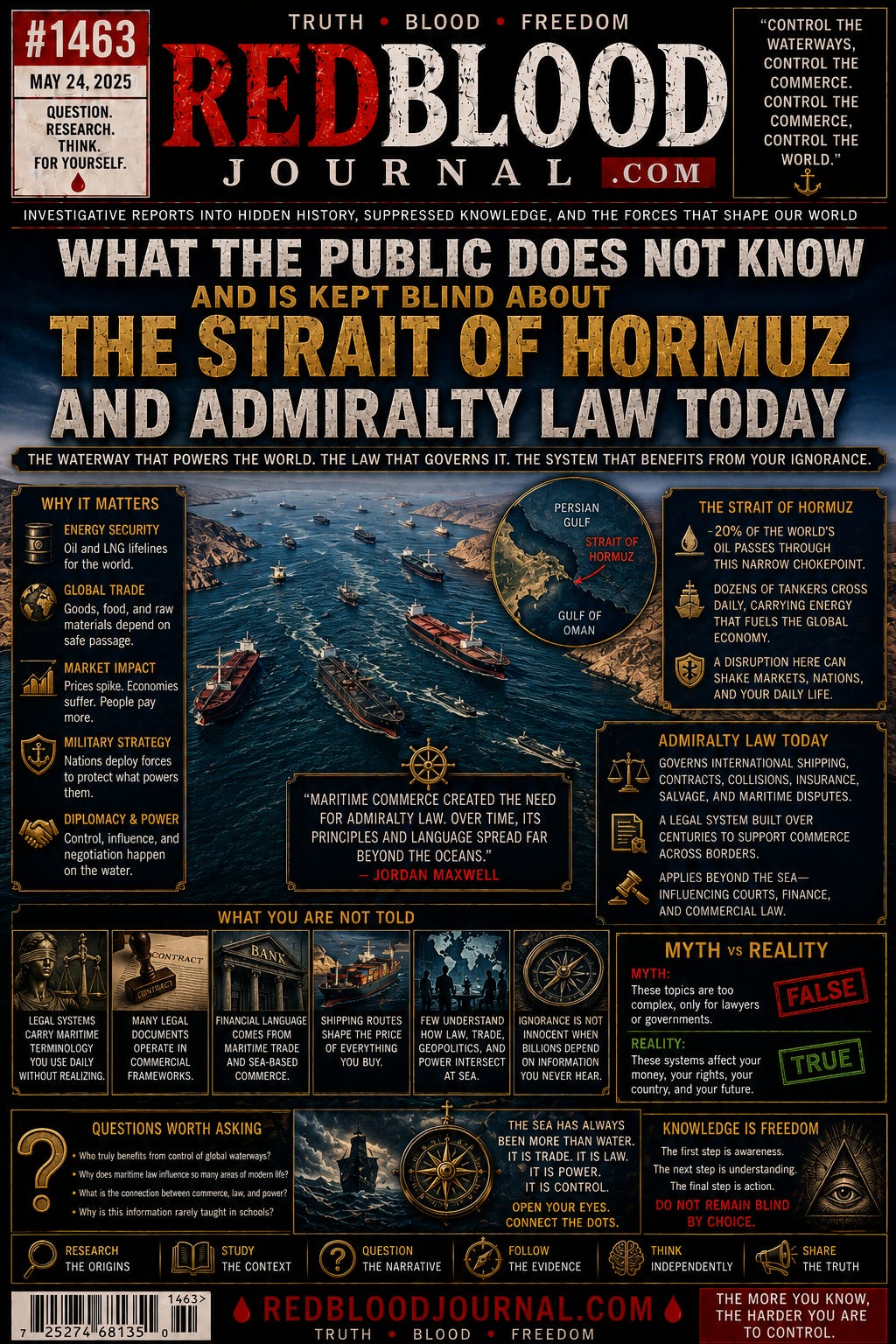
What the Public Does Not Know About the Strait of Hormuz and Admiralty Law Today
By Red Blood
Introduction
Every day, millions of people purchase gasoline, receive imported products, invest in financial markets, or rely upon goods that have crossed oceans.
Few stop to consider the narrow waterways that make this global system possible.
One of the most strategically important is the Strait of Hormuz.
Located between the Persian Gulf and the Gulf of Oman, this narrow passage serves as one of the world’s most significant maritime chokepoints. A substantial share of globally traded oil and liquefied natural gas passes through it, making the waterway a central concern for governments, energy markets, shipping companies, and military planners.
This report explores why the Strait of Hormuz matters, how maritime law governs international shipping through such waterways, and why independent researchers—including Jordan Maxwell—have argued that maritime commerce has had a profound influence on the development of modern legal and financial systems. Readers are encouraged to distinguish documented geopolitical realities from broader interpretive theories.
A Narrow Waterway With Global Consequences
The Strait of Hormuz is only a relatively narrow passage, yet it connects the Persian Gulf with the open ocean.
Oil produced by several Gulf states reaches international markets through this route.
Commercial shipping depends upon it.
Insurance companies monitor it.
Navies patrol it.
Financial markets react whenever its security is threatened.
A disruption lasting only days can influence global energy prices and international trade.
Why It Matters
Modern civilization depends upon maritime commerce.
Energy.
Food.
Raw materials.
Manufactured goods.
Container shipping remains one of the foundations of the global economy.
Because so much trade moves by sea, strategic waterways such as the Strait of Hormuz, the Suez Canal, and the Panama Canal have become critical points in world commerce.
Their importance extends far beyond the countries that border them.
Admiralty Law and International Shipping
Maritime law exists because international trade requires common rules.
Ships regularly cross national boundaries.
Cargo changes ownership.
Insurance disputes arise.
Accidents occur.
Environmental issues emerge.
Without a shared legal framework, international shipping would become far more difficult.
Modern admiralty law helps regulate these activities through treaties, national laws, and long-established legal principles.
Jordan Maxwell’s Perspective
Jordan Maxwell argued that maritime commerce influenced not only shipping law but also the language of finance, legal traditions, and commercial institutions.
He pointed to recurring nautical terminology, historical courtroom customs, and commercial vocabulary as evidence of enduring maritime influence.
While the historical importance of maritime trade is well documented, many of Maxwell’s broader conclusions about modern legal systems remain debated and are not accepted as established legal doctrine.
His work nevertheless encouraged people to examine the historical origins of legal terminology rather than accepting it without question.
The Hidden Importance of Shipping
When people hear about the Strait of Hormuz, discussion often centers on military tensions.
Yet the larger story is economic.
Every tanker passing safely through the strait represents international contracts, insurance agreements, financing arrangements, shipping regulations, navigation systems, and legal responsibilities.
The movement of one vessel involves thousands of interconnected decisions made across multiple countries.
The waterway is not simply a geographic location.
It is part of a global commercial network.
Law Follows Commerce
Throughout history, wherever trade expanded, legal systems evolved alongside it.
Ancient merchants needed agreements.
Ports required standardized procedures.
Disputes demanded impartial resolution.
As shipping routes connected civilizations, maritime law developed to reduce uncertainty and encourage commerce.
In that sense, admiralty law reflects centuries of practical experience rather than a single political invention.
Public Awareness
Many people understand that the Strait of Hormuz is important.
Far fewer understand why.
Its significance extends beyond regional politics.
It influences:
Global energy supplies.
Shipping costs.
Marine insurance.
Commodity prices.
Financial markets.
International diplomacy.
Naval strategy.
Its continued operation affects billions of people who may never see it on a map.
Separating History From Interpretation
Responsible investigation requires careful distinction.
It is historically documented that:
Maritime trade shaped civilizations.
Admiralty law developed to govern ocean commerce.
Strategic waterways remain essential to global trade.
Beyond these points, researchers differ.
Some view maritime influence as extending deeply into modern legal and financial systems.
Others argue that many of those broader claims rely on symbolic interpretation rather than legal evidence.
Understanding both perspectives allows readers to evaluate the evidence independently.
Final Thought
The Strait of Hormuz is more than a narrow passage between two bodies of water.
It is a reminder that geography can influence economics, politics, diplomacy, and law on a global scale.
Maritime commerce has connected civilizations for thousands of years.
The legal systems that developed around that commerce continue to evolve today.
Whether one studies international shipping, energy security, or Jordan Maxwell’s interpretations of maritime symbolism, one lesson remains constant:
The sea has never been merely water.
It has always been one of humanity’s greatest highways—and one of the greatest influences on the development of civilization.
Understanding that history begins not with speculation...
but with learning how trade, law, geography, and human cooperation became permanently connected.
The investigation continues.
**🩸 RedBloodJournal.com 🩸
🚢
🚢 The Maritime Engine:
Hormuz, Admiralty Law, and Global Commerce
Jul 29, 2026
The provided text examines the Strait of Hormuz as a vital maritime chokepoint that underpins the stability of global energy markets and international trade. It explains how admiralty law emerged as a necessary legal framework to manage the complexities of cross-border shipping, insurance, and commercial disputes. Beyond documented geopolitics, the source introduces the theories of Jordan Maxwell, who suggested that maritime traditions deeply influenced the language and structure of modern financial and legal systems. While acknowledging Maxwell’s controversial interpretations, the article emphasizes that strategic waterways are more than geographic features; they are the foundation of a global network connecting economics, law, and diplomacy. Ultimately, the text argues that understanding the history of ocean commerce is essential to grasping how modern civilization functions.


