


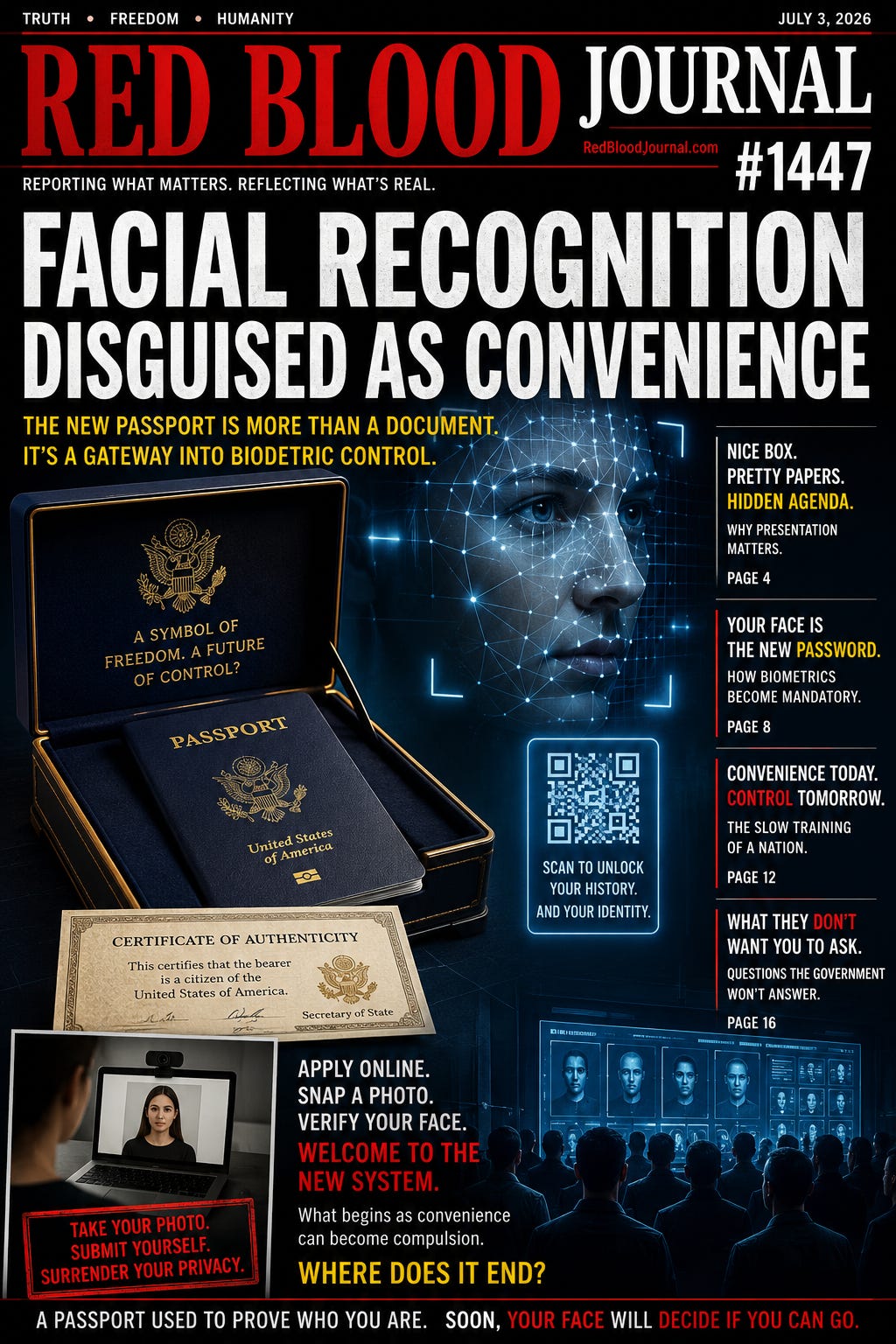
#1447 — Facial Recognition Disguised as Convenience
🩸 RedBloodJournal.com
By Red Blood
July 3, 2026
The new passport presentation is being sold as pride, speed, comfort, and modernization. A nicer box. A certificate. A QR code. A smoother online process. A photo taken from a laptop instead of CVS.
But hidden inside the word convenience is the real transformation: the passport is no longer only a document. It is becoming a gateway into biometric identity verification.
In the official remarks, the public was told that future applicants may be able to take their passport picture directly from their device, and the system would verify the facial ID in real time through government security systems.
That sounds harmless when presented as saving time.
No long lines.
No appointments.
No passport photos.
No waiting.
But every system of control is first introduced as a service.
The camera becomes the clerk.
The face becomes the password.
The government database becomes the judge.
The public is told: this is easier.
The hidden message is: this is mandatory normalization.
The official passport renewal system already supports online renewal and digital photo uploads through the State Department’s official platform. (Travel.state.gov) The State Department also instructs applicants to face the camera directly, keep both eyes visible, remove face coverings unless medically or religiously documented, and submit an unaltered image. (Travel.state.gov)
On the surface, these are normal passport-photo rules.
But in the larger direction of society, they train the human being to accept a new reality: access to movement, travel, banking, government services, airports, and eventually everyday life may depend on whether a machine accepts the face.
This is the danger.
Not because passports need no security.
Not because identity should never be verified.
But because the public is rarely told where the line is.
Where is the limit?
Who stores the face?
Who audits the system?
Who corrects false rejection?
Who protects the citizen when convenience becomes compulsion?
The same pattern is appearing everywhere: digital wallets, biometric checkpoints, online identity systems, facial scans, and app-based verification. Apple’s Digital ID feature, for example, lets users add U.S. passport information to Apple Wallet and verify identity at TSA checkpoints using passport-chip data and selfie-based verification. (AP News)
Again, the language is convenience.
But convenience can become the velvet glove on the iron hand.
A society that once required a paper document may soon require a living biometric match. The citizen will not simply present identification. The citizen will be scanned, compared, accepted, delayed, flagged, or rejected.
That is not just technology.
That is a change in the relationship between the human being and the state.
The passport used to say: this person belongs to this nation.
The biometric passport system may soon say: this person is permitted only if the machine agrees.
The danger is not the box.
The danger is not the QR code.
The danger is not even the camera.
The danger is the slow training of the public to surrender the face as the final key to freedom of movement.
Once the face becomes the key, losing access to the system can become worse than losing the passport itself.
A lost passport can be replaced.
A rejected identity can become a prison without bars.
🩸🌊✨ Fantastic — Ocean of Love and Positivity
👤 The Velvet Glove of Biometric Surveillance
Jul 3, 2026
The provided text argues that the transition toward biometric passport verification is a strategic move to mask increased government surveillance under the guise of technological convenience. While digital renewals and smartphone photo uploads offer a faster user experience, the author warns that these systems normalize the use of facial recognition as a mandatory tool for basic freedoms. By replacing physical documents with digital identity scans, the state shifts the power of movement from the individual to an automated machine algorithm. The source highlights a growing trend where private tech companies and federal agencies collaborate to create a world where one’s face serves as a permanent, trackable password. Ultimately, the passage suggests that this shift risks turning personal identity into a tool of state control, where a technical error could result in a total loss of civil liberty.


