


🩸 RedBloodJournal.com 🩸
Report #1443
The Balfour Declaration: How It Started, How It Is Going
By: Red Blood
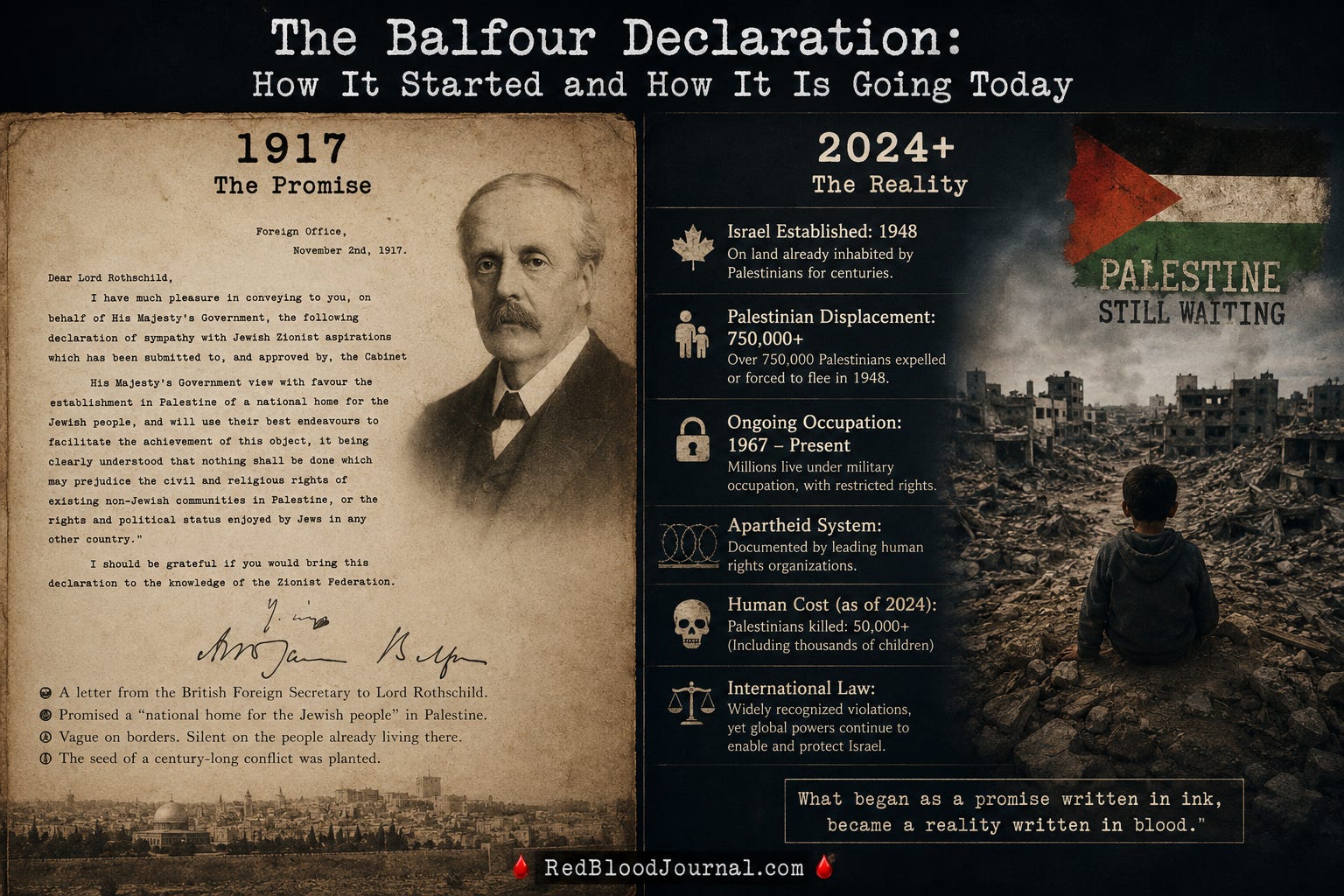
On November 2, 1917, a single letter only a few paragraphs long altered the course of modern Middle Eastern history.
Addressed by British Foreign Secretary Arthur James Balfour to Lord Walter Rothschild, the letter expressed Britain’s support for the establishment of “a national home for the Jewish people” in Palestine while also stating that nothing should prejudice “the civil and religious rights of existing non-Jewish communities in Palestine.” (Avalon Project)
More than a century later, supporters and critics continue to debate whether those two promises were ever capable of existing together.
1917: The Beginning
At the time of the declaration:
Palestine was still part of the Ottoman Empire.
Jews and Arabs had lived in the region for centuries, although Arabs formed the overwhelming majority of the population.
Britain was fighting World War I and was already negotiating multiple, sometimes conflicting, promises regarding the future of the Middle East. (Wikipedia)
The Balfour Declaration became the first major international endorsement of the Zionist movement’s goal of establishing a Jewish national home in Palestine.
The declaration itself was intentionally brief and ambiguous.
It supported a Jewish national home, but did not define borders or specify what political structure that home would ultimately become.
The British Mandate
Following the collapse of the Ottoman Empire, Britain received the League of Nations Mandate for Palestine.
Jewish immigration increased throughout the following decades.
At the same time, Arab opposition also increased, leading to repeated outbreaks of violence during the 1920s and 1930s.
Britain found itself trying to balance promises that many historians argue were difficult, if not impossible, to reconcile. (United Nations)
1948: The Birth of Israel
After the Second World War and the Holocaust, international support grew for establishing a Jewish state.
In 1948:
Israel declared independence.
Neighboring Arab states invaded.
Hundreds of thousands of Palestinians fled or were displaced during the war, an event Palestinians refer to as the Nakba (”catastrophe”).
Israel survived and expanded beyond the borders proposed in the UN partition plan.
For Israelis, this represented the realization of national self-determination after centuries of persecution.
For Palestinians, it marked the loss of homes, land, and the beginning of a prolonged refugee crisis.
Both historical narratives continue to shape the conflict today. (Wikipedia)
1967 and Beyond
The Six-Day War dramatically changed the geopolitical landscape.
Israel captured:
the West Bank,
East Jerusalem,
Gaza,
the Golan Heights,
and Sinai (later returned to Egypt).
Since then, disputes over settlements, borders, refugees, security, sovereignty, and the status of Jerusalem have remained unresolved.
Numerous peace initiatives have been attempted.
None has produced a lasting settlement.
How It Is Going Today
Today, more than a century after the Balfour Declaration:
Israel is an internationally recognized sovereign state.
Palestinians continue seeking internationally recognized statehood.
Millions of Palestinians live under varying legal and political circumstances in the West Bank, Gaza, East Jerusalem, neighboring countries, and across the global diaspora.
Repeated wars, terrorist attacks, military operations, rocket fire, hostage-taking, and humanitarian crises have deepened mistrust on all sides.
The conflict remains one of the most contentious geopolitical issues in the world.
The declaration’s promise that existing non-Jewish communities would not have their civil and religious rights prejudiced remains a central point of historical and political debate. Different governments, historians, legal scholars, and advocacy organizations interpret Britain’s responsibility and the declaration’s legacy in different ways. (Avalon Project)
A Century of Consequences
Looking back, the Balfour Declaration can be viewed from multiple perspectives:
To many Jews, it represented long-awaited international recognition of the aspiration for a homeland after centuries of exile and persecution.
To many Palestinians, it symbolized a colonial power making commitments regarding a land whose majority population was not consulted.
These perspectives are not mutually exclusive—they reflect different historical experiences arising from the same document.
Final Observation
Sometimes history does not change because of armies.
Sometimes it changes because of a letter.
One page, signed in London in 1917, helped shape a century of diplomacy, migration, war, hope, displacement, nation-building, and unresolved conflict.
Whether history ultimately remembers the Balfour Declaration as a diplomatic breakthrough, a strategic wartime decision, a colonial mistake, or some combination of these depends largely on which chapter of history one begins reading first.
The document remains a reminder that words written by governments can influence generations long after the ink has dried.
🩸 RedBloodJournal.com 🩸
✉️ The Balfour Legacy:
A Century of Promises and Conflict
Jul 2, 2026
The provided text examines the Balfour Declaration, a brief 1917 letter from the British government that fundamentally transformed the Middle East by supporting a Jewish national home in Palestine. This source analyzes how the document’s ambiguous language attempted to balance Zionist aspirations with the rights of the existing Arab majority, a duality that many historians find irreconcilable. Following the end of the Ottoman Empire and the subsequent British Mandate, the region saw a dramatic rise in immigration and violence, eventually leading to the 1948 creation of Israel and the Palestinian Nakba. The narrative details how major turning points like the Six-Day War expanded the territorial disputes that remain central to the modern geopolitical crisis. Ultimately, the text illustrates that the declaration is viewed simultaneously as a diplomatic milestone for Jewish self-determination and a colonial injustice that triggered over a century of displacement and unresolved warfare.


