


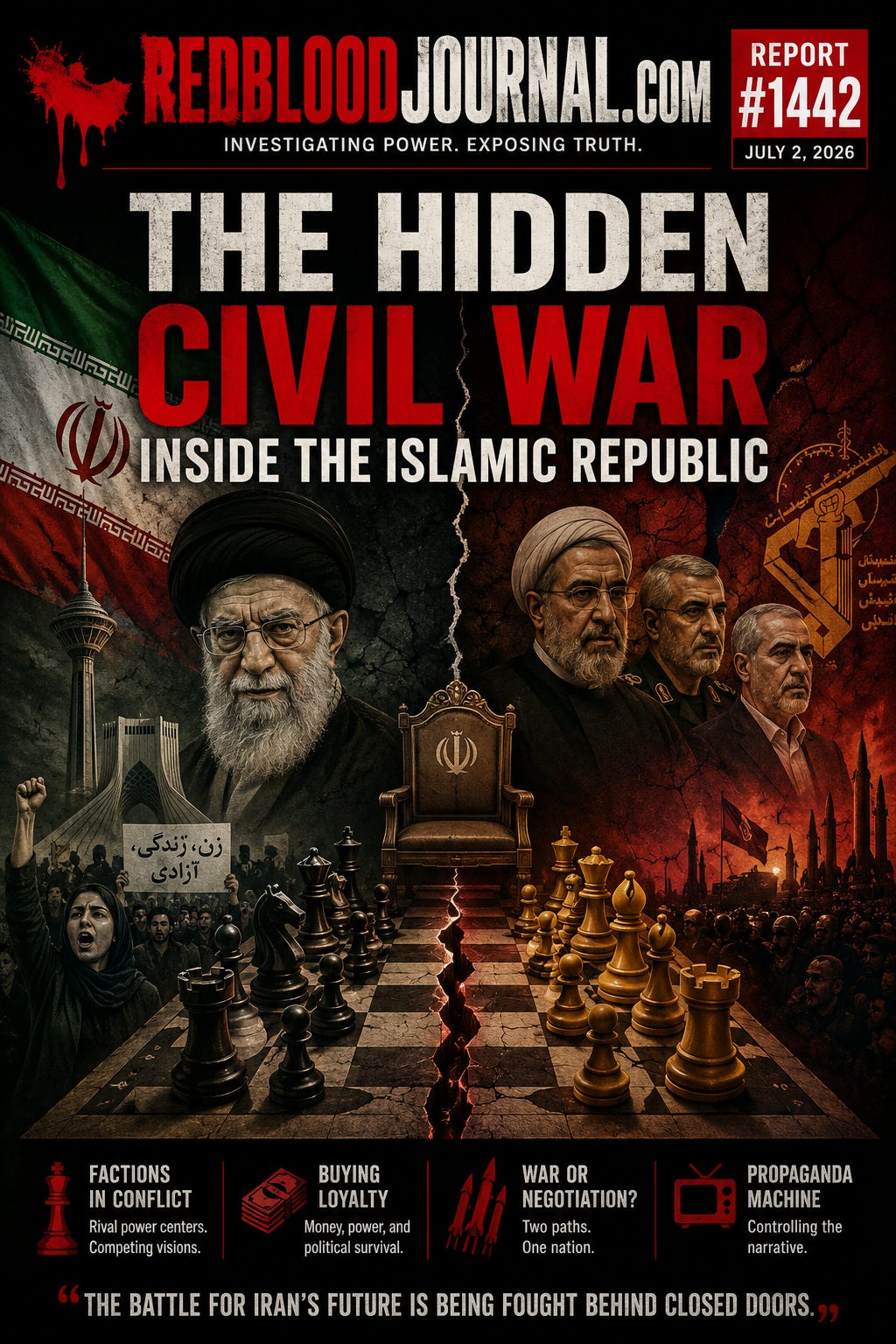
🩸RedBloodJournal.com | Report #1442
The Hidden Civil War Inside the Islamic Republic
🩸 July 2, 2026
For decades, observers outside Iran have tended to view the Islamic Republic as a single, unified political system speaking with one voice. Yet history has repeatedly shown that governments often contain competing factions with different priorities, methods, and visions for survival.
Recent reporting, political commentary, and public statements have once again raised questions about whether Iran is experiencing another period of intense internal competition.
Whether these events represent ordinary political maneuvering or a deeper struggle for influence remains uncertain. However, when examined together, they reveal a pattern worthy of careful observation.
Beyond the Headlines
The dominant international narrative continues to focus on negotiations between Washington and Tehran.
Behind those negotiations, however, another contest may be unfolding.
Rather than a simple confrontation between Iran and the United States, the more significant struggle may be taking place inside the Islamic Republic itself.
Multiple public statements and media reports suggest that different political currents may hold sharply different views regarding diplomacy, confrontation, and the country’s future direction.
Some appear to favor negotiations as a means of preserving stability.
Others appear convinced that confrontation remains the preferred course.
Whether these divisions are temporary or structural remains impossible to determine with certainty from public information alone.
A Government Under Competing Pressures
The recent arrival of additional U.S. military assets to the region, combined with reports of continued diplomatic negotiations, has intensified speculation regarding Tehran’s internal decision-making.
Every external crisis forces governments to answer fundamental questions:
Compromise or confrontation?
Preserve existing institutions or reshape them?
Centralize power or redistribute it?
Accept political concessions or continue resistance?
These choices rarely produce unanimous agreement inside any government.
Iran appears no different.
Rumors Reflect Uncertainty
One of the most discussed developments has been conflicting reports concerning senior judicial officials and possible leadership changes.
Some reports suggested changes were imminent.
Others reported that existing officials would remain in place.
Neither outcome alone proves an internal conflict.
What the contradictory reporting does demonstrate is uncertainty—both inside and outside official circles.
Periods of political stability usually produce consistent messaging.
Periods of internal competition often produce contradictory narratives.
The Negotiation Divide
The transcript also reflects a broader political debate.
One current reportedly argues that negotiations reduce the likelihood of another destructive war.
Another believes compromise risks weakening the state’s ideological foundations.
Whether these descriptions accurately represent organized factions cannot be independently verified.
Nevertheless, the public discussion itself reveals differing assessments of national strategy.
That alone is significant.
Public Messaging as Political Competition
Political disagreements are not always expressed through official votes or public declarations.
Sometimes they emerge through speeches.
Media appearances.
Selective interviews.
Competing narratives.
Religious events.
National celebrations.
Even sporting events.
Every public appearance can become part of a larger effort to influence opinion—not only among citizens, but also among rival power centers.
The Cost of Internal Rivalry
History demonstrates that internal political competition often intensifies during periods of external pressure.
Examples can be found in many countries across different eras.
External threats frequently expose disagreements that remain hidden during calmer periods.
If different centers of power begin pursuing separate strategies, uncertainty increases—not only for political leaders but also for ordinary citizens.
Markets react.
Institutions hesitate.
Rumors multiply.
Confidence declines.
Reading Events Carefully
Periods like this invite strong conclusions.
Yet responsible analysis requires restraint.
Military deployments do not automatically indicate imminent war.
Political rumors do not automatically indicate a coup.
Conflicting reports do not automatically confirm institutional collapse.
The challenge is to distinguish between observable developments and interpretation.
That distinction is essential.
Looking Ahead
Whether current negotiations ultimately succeed or fail, the more enduring question may not concern foreign policy alone.
It concerns the future balance of power inside the Islamic Republic.
Who shapes policy?
Who controls institutions?
Who determines the country’s direction after today’s crisis passes?
Those questions may ultimately prove more consequential than any single negotiation or military deployment.
History often remembers wars.
It just as often overlooks the internal political struggles that determined how those wars began—or how they ended.
Final Observation
The most significant political battles are not always fought on visible front lines.
Many unfold quietly inside institutions, where competing visions struggle to define a nation’s future.
Whether today’s events represent routine political disagreement or a deeper realignment remains uncertain.
What is clear is that careful observers should continue distinguishing verified facts from speculation while recognizing that internal dynamics can shape history just as profoundly as external conflict.
🩸 RedBloodJournal.com
Observe carefully. Verify patiently. Think independently.
⚖️ The Internal Power Struggle of the Islamic Republic
Jul 2, 2026
The provided text explores the hidden political friction occurring within the Iranian government, suggesting that the nation is far from a unified monolith. While global attention remains fixed on international diplomacy and military tensions, an internal struggle persists between factions favoring strategic compromise and those committed to ideological confrontation. This domestic rivalry is marked by contradictory public messaging and rumors regarding leadership changes, which signal deep-seated uncertainty within the state’s hierarchy. The report emphasizes that external pressures often exacerbate these institutional cracks, forcing a difficult choice between preserving the status quo or undergoing structural shifts. Ultimately, the source argues that the internal distribution of power may be more influential in shaping Iran’s future than any external treaty or conflict. Knowledgeable analysis requires distinguishing these complex domestic dynamics from the more visible headlines of foreign policy.


