


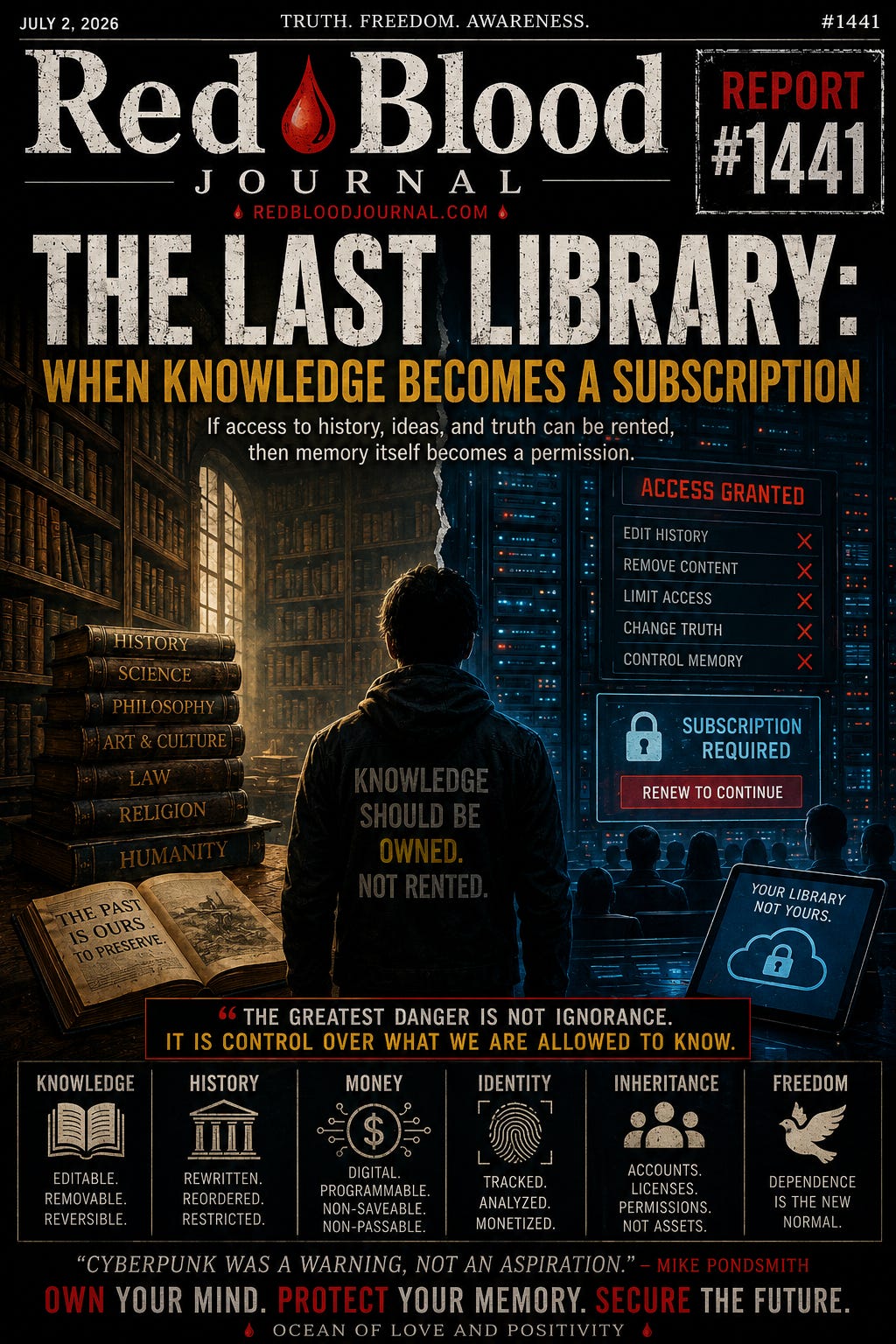
🩸 #1441 – The Last Library: When Knowledge Becomes a Subscription
By: Red Blood
🩸 RedBloodJournal.com 🩸
For thousands of years, humanity preserved its knowledge in forms that could outlive kings, governments, corporations, and even civilizations.
Stone tablets survived empires.
Papyrus crossed continents.
Books endured revolutions.
Private libraries protected ideas that powerful institutions sometimes wished to erase.
Knowledge was imperfectly preserved, but once enough physical copies existed, no single authority could easily rewrite every page.
Today, civilization stands at the threshold of a different model.
Increasingly, information no longer resides on bookshelves.
It resides on servers.
The question is no longer simply how knowledge is stored.
The question is who ultimately controls access to it.
From Ownership to Permission
The transition from physical ownership to digital licensing has been unfolding quietly for years.
Music became streaming.
Movies became streaming.
Software became subscriptions.
Video games are rapidly becoming digital licenses.
Photographs are stored in cloud accounts.
Personal documents are increasingly saved on remote servers.
Each individual change appears practical.
Collectively, however, they reveal a larger transformation.
Instead of owning copies, society is becoming accustomed to renting access.
The distinction may appear minor today.
History suggests it may become significant tomorrow.
The Library That Can Be Edited
A printed book cannot be silently rewritten after it reaches millions of homes.
A digital document can.
A physical encyclopedia remains exactly as it was printed.
An online encyclopedia can change continuously.
Most updates improve accuracy and reflect new discoveries. That ability is one of the great strengths of digital publishing.
Yet the very same technology also creates a new possibility.
When information exists primarily on centralized platforms, it may become easier for revisions, removals, prioritization changes, or access restrictions to occur than when millions of independent physical copies exist.
Whether those changes are beneficial, harmful, accidental, or intentional depends entirely on the institutions managing them.
The technology itself is neutral.
Its governance determines its impact.
History Written in Real Time
Every generation rewrites history to some degree.
New evidence emerges.
Previously classified documents become public.
Old assumptions are challenged.
This process is part of historical scholarship.
The concern raised by some observers is different.
It is the possibility that future history could become increasingly dependent upon systems that possess the technical ability to modify, suppress, reorder, or limit access to information on an unprecedented scale.
The issue is not whether this will occur.
The issue is that the capability increasingly exists.
When Memory Lives on a Server
Imagine a world where nearly every book exists only digitally.
Every photograph is stored remotely.
Every personal journal is kept in cloud storage.
Every newspaper exists behind an online subscription.
Every educational resource requires ongoing authorization.
Convenience reaches levels previous generations could scarcely imagine.
Yet convenience also creates dependence.
If access becomes the product, then permission becomes the gatekeeper.
Money Follows the Same Path
A similar discussion surrounds the future of money.
Many countries are researching or developing digital forms of national currency.
Depending on their design, these systems may provide faster payments, lower transaction costs, and improved security.
Some analysts have also discussed hypothetical features such as programmable payments, spending conditions, expiration dates for certain funds, or other policy-driven capabilities. Whether such features are adopted would depend on future laws, regulations, and public decisions rather than the technology alone.
The broader pattern remains familiar.
Physical assets gradually become digital systems.
Digital systems often require ongoing authorization.
Authorization ultimately rests with institutions.
Inheritance in the Digital Age
For centuries, families passed wealth in tangible forms.
Land.
Homes.
Books.
Letters.
Photographs.
Collections.
These objects became bridges between generations.
Increasingly, future generations may inherit something different.
Accounts.
Passwords.
Licenses.
Subscriptions.
Cloud storage.
Digital permissions.
An inheritance dependent upon continued authorization differs fundamentally from an inheritance that exists independently of any institution.
It raises new legal, technological, and philosophical questions that societies are only beginning to confront.
The Forgotten Value of Physical Copies
A book sitting on a shelf asks nothing of its owner.
It requires no password.
No monthly payment.
No software update.
No authentication server.
No internet connection.
No acceptance of revised terms of service.
Its existence depends only upon preservation.
Perhaps that simple independence explains why civilizations invested enormous effort in protecting libraries throughout history.
Knowledge preserved outside centralized control possesses a resilience that digital systems alone cannot fully replace.
The Question Before the Future
Technology continues to expand human capability.
Artificial intelligence will accelerate discovery.
Digital archives will preserve information at scales unimaginable only decades ago.
These achievements deserve recognition.
Yet every technological advancement carries a corresponding responsibility.
As society embraces digital convenience, it must also consider how to preserve independent ownership, historical integrity, intellectual freedom, and intergenerational memory.
The discussion is not about rejecting technology.
It is about ensuring that technology remains a servant rather than becoming the sole gatekeeper.
Perhaps the defining question of the coming decades will not be:
“How much information can humanity create?”
It may instead become:
“Who decides which information future generations are allowed to keep?”
Ocean of Love and Positivity
Knowledge is one of humanity’s greatest inheritances. Every generation receives it from those who came before and carries the responsibility of preserving it for those yet to come. Technology can become one of the greatest tools ever created if it strengthens wisdom instead of replacing it, expands freedom instead of narrowing it, and protects truth instead of making it dependent upon permission. The future belongs not to those who possess the largest servers, but to those who ensure that knowledge, curiosity, and independent thought remain available to every human being. That is how civilizations grow—not only in intelligence, but in wisdom.
📚 The Subscription of Civilization:
Permission to Remember
Jul 2, 2026
The text explores the societal shift from permanent physical ownership to temporary digital access, highlighting how modern knowledge is increasingly stored on centralized servers rather than in tangible books. This transition introduces a reliance on institutional permission, as digital content can be edited, restricted, or deleted in ways that physical objects cannot. The author warns that centralized control over information may compromise historical integrity and the ability to pass down an independent inheritance to future generations. Beyond media and documents, this pattern extends to digital currencies and programmable financial systems, further deepening human dependence on technical gatekeepers. Ultimately, the source calls for a balance between digital convenience and the preservation of intellectual freedom, ensuring that technology serves humanity rather than dictating what information remains accessible. This transformation raises critical questions about who will govern the collective memory of our civilization in the coming decades.


