


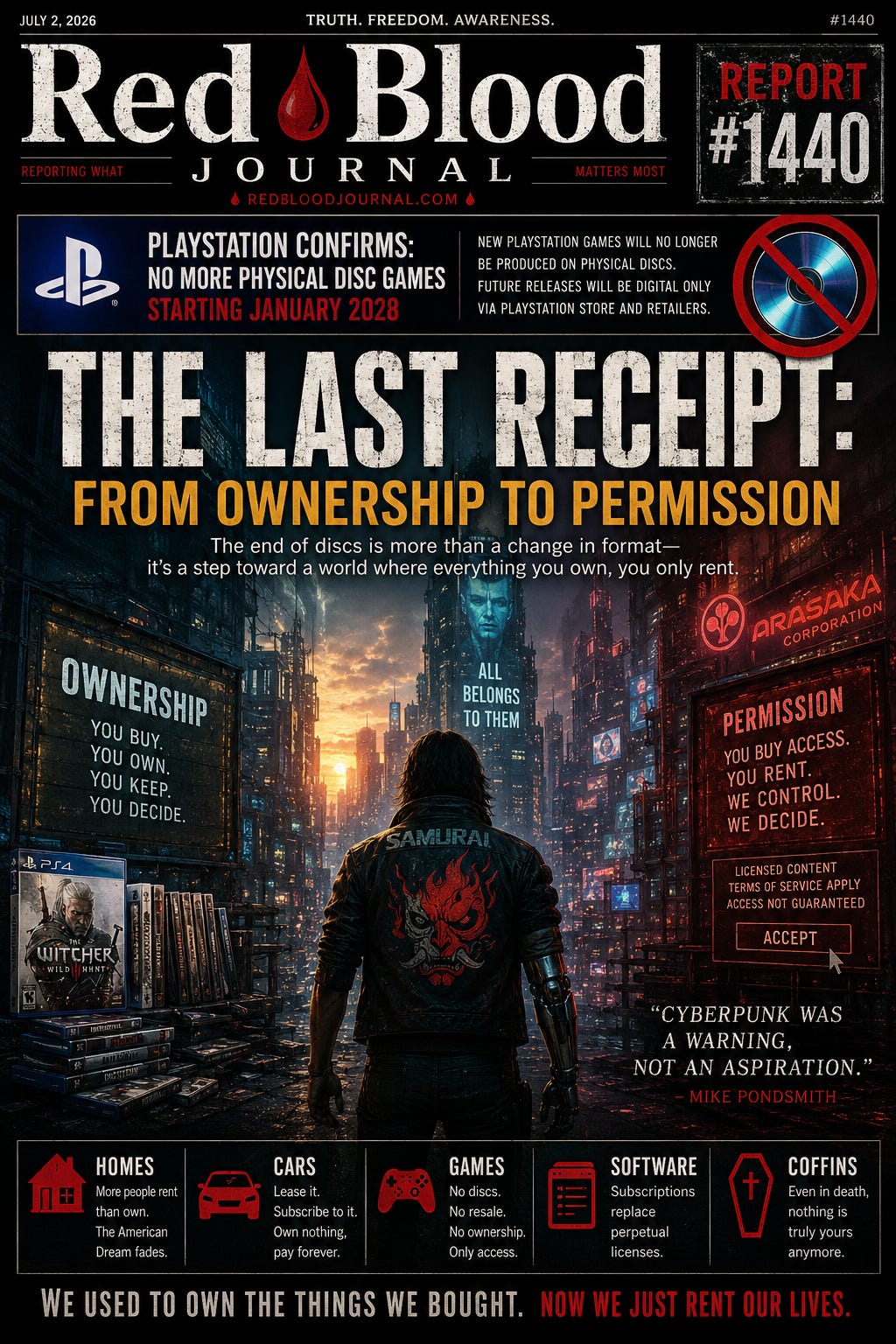
🩸#1440 – The Last Receipt: From Ownership to Permission
By: Red Blood
🩸 RedBloodJournal.com 🩸
For generations, ownership represented independence.
You worked, saved your money, and bought something. Once it was yours, it belonged to you. You could keep it, lend it to a friend, sell it years later, pass it on to your children, or simply place it on a shelf as part of your personal history.
That principle is quietly changing.
Sony’s announcement that all new PlayStation games released beginning in January 2028 will no longer be produced on physical discs is another milestone in that transformation. Future titles will exist only as digital purchases distributed through the PlayStation Store and participating retailers. Existing games and titles released before that date are unaffected. (PlayStation.Blog)
To many people, this sounds like nothing more than technological progress.
To others, it represents something much larger.
Ownership Becomes Access
The modern economy is steadily replacing ownership with permission.
Music became streaming.
Movies became streaming.
Software became subscriptions.
Books became digital licenses.
Video games are becoming downloads tied to online accounts.
The physical object disappears, leaving behind a digital agreement that can often be modified according to the platform’s terms of service.
Instead of owning the product itself, consumers increasingly purchase permission to access it.
The difference may seem small until the day access changes.
The Disappearing Shelf
A shelf filled with books, DVDs, CDs, and video games tells a story.
Those objects can survive decades.
A digital library exists only as long as servers remain online, accounts remain active, and licensing agreements continue.
Technology has made entertainment more convenient than ever before.
It has also concentrated more control into fewer hands.
More Than Video Games
The discussion extends far beyond gaming.
In many cities, home ownership has become increasingly difficult to attain.
Cars are often leased rather than purchased outright, and many modern vehicles rely on software for features that can be enabled or disabled through digital systems.
Software that was once purchased permanently is now rented monthly.
Media that once occupied a bookshelf now occupies a cloud server.
The trend is unmistakable:
Ownership is gradually giving way to continuous access.
Cyberpunk as a Warning
Game designer Mike Pondsmith once remarked:
“Cyberpunk was a warning, not an aspiration.”
Whether one agrees with that interpretation or not, the statement captures a concern shared by many observers.
The fear is not technology itself.
The fear is becoming dependent upon systems controlled by organizations that determine what remains available, what disappears, what can be transferred, and what can no longer be accessed.
The Final Receipt
Perhaps the greatest question raised by this transition is philosophical rather than technological.
If nearly everything becomes rented, licensed, or subscription-based, what does ownership ultimately mean?
Some would argue that society is entering an age where people increasingly own less while paying more over time.
Others view it simply as the natural evolution of convenience.
History will decide which interpretation proves more accurate.
One thing, however, is difficult to ignore.
The journey appears to be moving from ownership toward permission.
The physical disc may simply be another receipt placed on that long road.
The future may not ask, “What do you own?”
It may instead ask, “What are you still allowed to access?”
Ocean of Love and Positivity
Technology itself is neither friend nor enemy. Like every tool humanity creates, its value depends on how it is used and how wisely people protect their freedoms while embracing innovation. Progress and liberty do not have to be opposing forces. The greatest safeguard has never been a plastic disc, a title deed, or a digital license—it has always been an informed, thoughtful, and compassionate population that understands the difference between convenience and independence. The future belongs to those who continue asking questions while meeting change with wisdom rather than fear.
🔑 The Transition From Ownership to Permission
Jul 2, 2026
This text explores the systemic shift from traditional personal property to a model based on digital licensing and permission. Using Sony’s decision to phase out physical media by 2028 as a primary example, the author argues that the modern economy is replacing permanent ownership with temporary subscription services. This transition spans various sectors, including music, software, and even housing, suggesting that consumer independence is being traded for technological convenience. The narrative warns that reliance on cloud-based access grants corporations ultimate control over what individuals can keep or use. Ultimately, the source encourages readers to remain critically informed about how these changes impact personal freedom and the long-term meaning of private assets.


