


🩸RedBloodJournal.com🩸
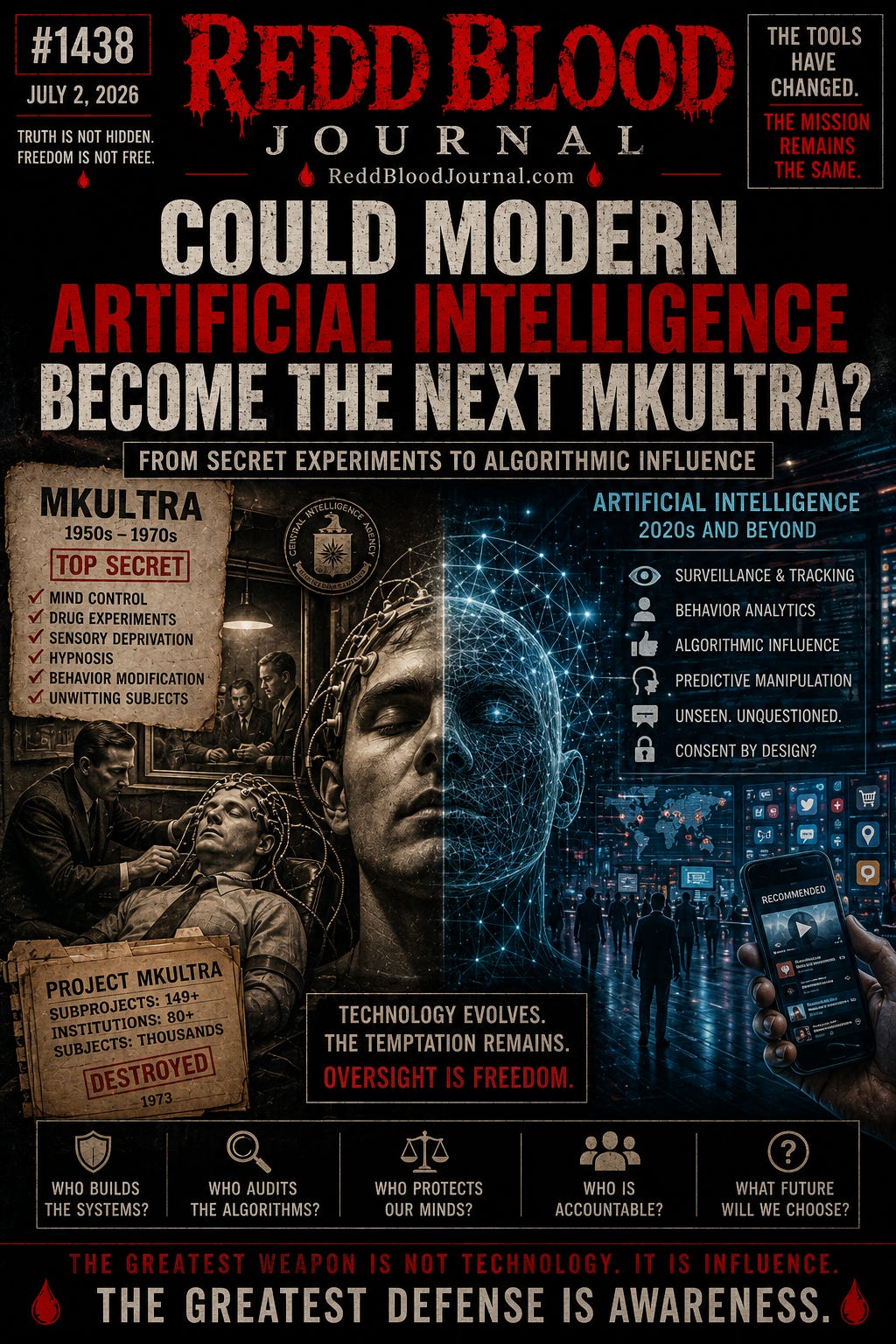
#1438 – Could Modern Artificial Intelligence Become the Next MKUltra?
July 2, 2026
🩸 By Red Blood
Every generation develops tools that transform civilization.
The printing press transformed communication.
Radio transformed mass broadcasting.
Television transformed culture.
The internet transformed access to information.
Artificial intelligence may become the next transformation.
Like every powerful technology before it, AI itself is neither good nor evil.
The question is not whether artificial intelligence is dangerous.
The question is who controls it, how it is used, and what safeguards exist to prevent abuse.
The Lesson of MKUltra
Project MKUltra remains one of history’s most controversial intelligence programs because it sought to understand and influence human behavior through secret experimentation.
The technologies available during the 1950s were primitive compared to today’s standards.
Researchers explored hypnosis, psychoactive drugs, sensory deprivation, and behavioral conditioning in an effort to understand the human mind.
Many historians now view those efforts as a reminder of how governments can cross ethical boundaries when secrecy replaces accountability.
The greatest lesson of MKUltra may not be the methods that were used.
It may be the mindset behind them.
The belief that extraordinary circumstances justify extraordinary experiments.
A Different Kind of Intelligence
Artificial intelligence does not need hypnosis to influence people.
It studies patterns.
It recognizes habits.
It predicts behavior.
It recommends information.
It learns preferences.
Every search, every click, every purchase, every conversation, and every digital interaction contributes to a growing understanding of human behavior.
Unlike the technologies of the Cold War, AI does not require a laboratory filled with volunteers.
People willingly carry connected devices throughout their daily lives.
The laboratory has become the digital world itself.
Influence Without Force
Modern influence rarely depends on coercion.
Instead, it often depends on attention.
Algorithms determine which articles appear first.
Which videos receive recommendations.
Which opinions become visible.
Which advertisements follow individuals across the internet.
Which information remains largely unseen.
Most of these systems were designed to improve convenience and user experience.
Yet they also demonstrate an important reality.
Influencing choices no longer requires controlling minds.
Sometimes it requires only controlling information.
Intelligence Beyond Government
Unlike MKUltra, artificial intelligence is not confined to intelligence agencies.
Private companies, universities, healthcare organizations, financial institutions, researchers, and individuals all contribute to its development.
That diversity creates remarkable opportunities.
It also creates new responsibilities.
Ethical questions no longer belong solely to governments.
They belong to everyone developing systems capable of influencing millions of people simultaneously.
Transparency Must Keep Pace
Artificial intelligence has already begun transforming medicine, education, engineering, scientific research, accessibility, and countless other fields.
Its potential benefits are extraordinary.
Precisely because of that potential, transparency becomes increasingly important.
Who trains these systems?
What information shapes their responses?
How are decisions audited?
Who is accountable when mistakes occur?
These questions are not obstacles to innovation.
They are essential components of responsible innovation.
The Greatest Difference
There is one fundamental difference between MKUltra and modern artificial intelligence.
MKUltra largely operated in secrecy.
Artificial intelligence is being developed in the open by governments, universities, companies, researchers, and independent developers across the world.
That openness creates opportunities for public discussion, ethical review, academic criticism, and international cooperation.
Whether those safeguards remain sufficient as AI grows more capable will depend upon the choices society makes today.
The Real Question
History does not repeat itself exactly.
Technology changes.
Governments change.
Institutions change.
Human nature changes far more slowly.
The greatest risk may not be artificial intelligence itself.
It may be allowing powerful technologies to evolve faster than public oversight, ethical reflection, and democratic accountability.
Artificial intelligence can become one of humanity’s greatest achievements.
Or it can become another reminder that knowledge without wisdom often creates problems more quickly than solutions.
The future will not be determined by the intelligence of machines.
It will be determined by the wisdom of the people who choose how those machines are used.
History has already shown what can happen when powerful tools operate beyond meaningful oversight.
Whether future generations describe artificial intelligence as humanity’s greatest breakthrough—or its greatest missed opportunity—will depend not on the technology itself, but on the principles that guide it.
🩸 Fantastic.
🤖 Digital MKUltra:
The Ethics of Algorithmic Influence
Jul 2, 2026
The provided text explores the ethical parallels between historical mind-control experiments like MKUltra and the modern capabilities of artificial intelligence. While past programs relied on secrecy and physical coercion, contemporary AI influences human behavior by monitoring digital patterns and curating information through algorithms. The author argues that because people voluntarily engage with these technologies, the digital landscape has become a vast, unregulated laboratory for behavioral influence. Unlike government-run projects of the past, AI development is driven by a diverse range of private and public entities, shifting the burden of responsibility to society as a whole. Ultimately, the source emphasizes that the danger lies not in the technology itself, but in the potential for innovation to outpace oversight. Ensuring a beneficial future requires transparency, accountability, and wisdom to prevent AI from becoming a tool for invisible manipulation.


