


🩸RedBloodJournal.com🩸
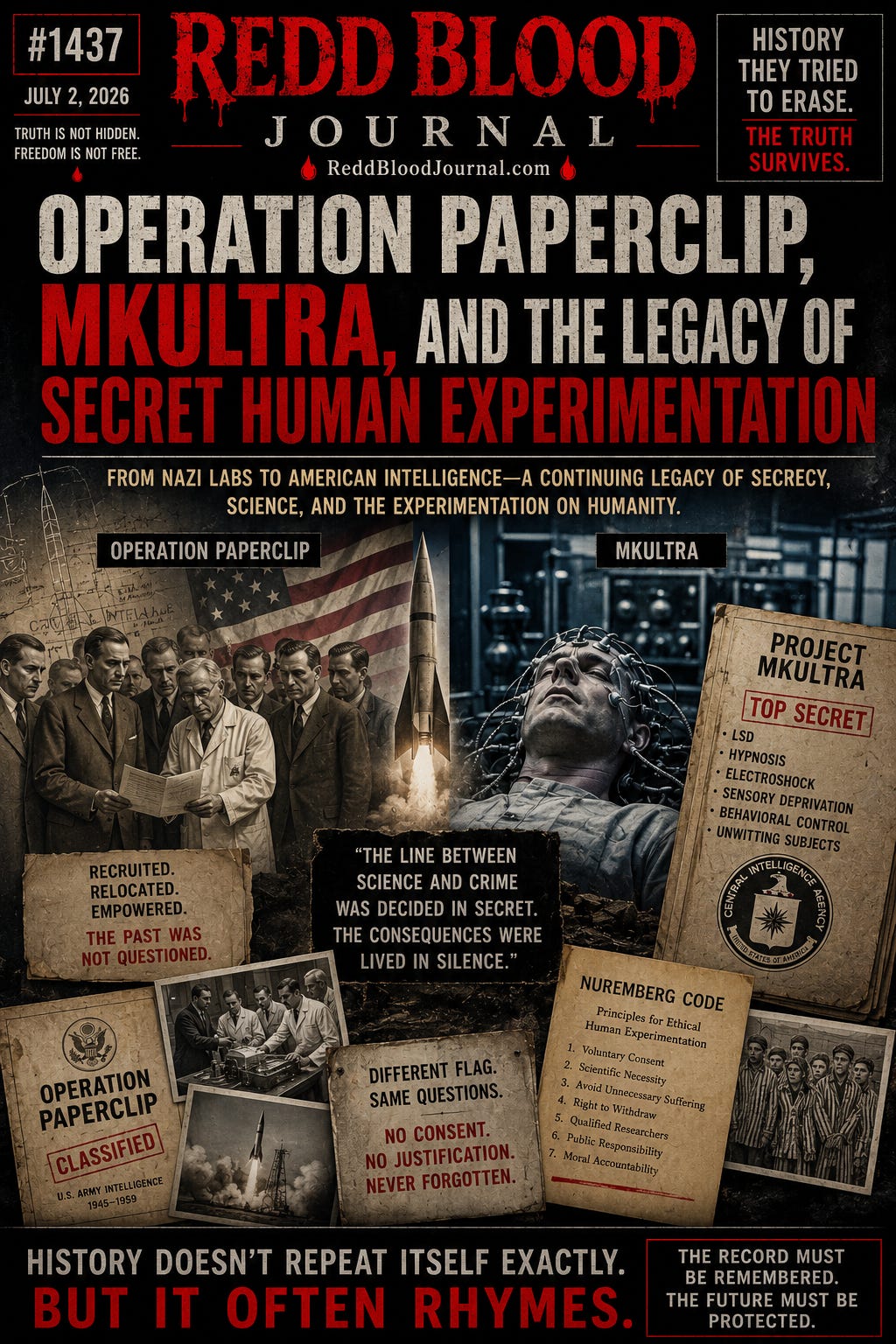
#1437 – Operation Paperclip, MKUltra, and the Legacy of Secret Human Experimentation
July 2, 2026
🩸 By Red Blood
History is often presented in separate chapters.
One chapter ends.
Another begins.
But sometimes the chapters overlap.
One of the most debated historical questions surrounding Project MKUltra is not simply what occurred during the Cold War—it is how knowledge, personnel, and scientific methods evolved after the Second World War.
At the center of that discussion is Operation Paperclip, the U.S. government program that brought hundreds of German scientists, engineers, physicians, and technical specialists to the United States following the defeat of Nazi Germany.
Many contributed to aerospace, medicine, rocketry, and national defense. Others have remained subjects of historical controversy because of allegations regarding their activities during the war.
The question raised by historians is not whether scientific expertise arrived in America.
It is whether ethical boundaries arrived with it.
A Race Against the Soviet Union
Following World War II, the United States and the Soviet Union entered a competition unlike any the world had previously experienced.
Military technology.
Rocket science.
Chemical research.
Biological research.
Intelligence gathering.
Every field became part of the Cold War.
American officials feared that if highly trained German scientists were not recruited by the United States, they would instead contribute to Soviet programs.
National security became the overriding priority.
Within that atmosphere, difficult ethical questions were often overshadowed by geopolitical urgency.
Knowledge Without Context
Scientific knowledge is neither moral nor immoral by itself.
Its value depends upon how it is used.
The same discoveries that produce life-saving medicines can also produce chemical weapons.
The same neuroscience that helps treat mental illness can also be explored for interrogation or behavioral manipulation.
History repeatedly demonstrates that technology advances faster than ethics.
Operation Paperclip became one example of that tension.
Its supporters viewed it as a strategic necessity.
Its critics questioned whether governments could separate scientific expertise from the ethical conduct of those who produced it.
The Congressional Discussion
During the recent House hearing examining MKUltra, lawmakers questioned witnesses about historical connections between Operation Paperclip and later intelligence research.
Witnesses discussed historical evidence indicating that some former German scientists eventually worked with or advised American programs after the war. Testimony also explored similarities between certain experimental methods investigated during the Cold War and techniques previously documented in wartime research.
The hearing did not claim that every participant in Operation Paperclip became involved in MKUltra.
Rather, it examined whether ideas, experience, and methods developed during one era may have influenced another.
That distinction remains important.
Historical investigation seeks documented evidence, not assumptions.
The Lessons of Nuremberg
After World War II, the Nuremberg Code established internationally recognized ethical principles governing human experimentation.
Among its most important foundations was voluntary informed consent.
Participants must understand the experiment.
They must choose freely.
They must be able to withdraw.
These principles became cornerstones of modern medical ethics.
Much of the criticism surrounding MKUltra stems from allegations that many experiments involving unwitting subjects failed to meet those standards.
Whether viewed legally, medically, or morally, informed consent remains one of the defining differences between ethical research and unethical experimentation.
Fear Changes Decisions
History repeatedly shows that societies often make extraordinary decisions during periods of fear.
War changes priorities.
National emergencies expand government authority.
Perceived existential threats encourage policies that might never be accepted during ordinary times.
The Cold War produced an environment in which intelligence agencies sought every possible advantage over perceived adversaries.
Some projects remained within accepted boundaries.
Others became the subject of decades of investigation and public debate.
Understanding that historical environment does not excuse controversial actions.
It helps explain how they became possible.
The Responsibility of Future Generations
The purpose of revisiting these chapters is not simply to judge the past.
It is to understand how democratic societies balance security, scientific progress, and individual rights.
Modern technologies—including artificial intelligence, neuroscience, genetic engineering, biometric surveillance, and brain-computer interfaces—offer remarkable opportunities for medicine and science.
They also raise new ethical questions that previous generations could scarcely imagine.
History reminds us that powerful technologies require equally powerful oversight.
Looking Forward
Operation Paperclip and MKUltra remain subjects of continuing historical research because they challenge simple narratives.
They remind us that scientific progress and ethical responsibility must advance together.
Knowledge alone is never enough.
Wisdom determines how knowledge is applied.
The greatest safeguard against repeating history is not forgetting difficult chapters.
It is studying them honestly, preserving the historical record, encouraging open inquiry, and ensuring that future discoveries serve humanity without compromising the principles that define it.
History cannot choose for us.
But it can teach us what questions are worth asking before the next generation inherits technologies even more powerful than those of the last.
🩸 Fantastic.
📜 The Ethics of Power:
Science, Security, and Human Rights
Jul 2, 2026
The provided text examines the historical and ethical links between Operation Paperclip and the subsequent development of Project MKUltra. It describes how the Cold War climate of fear led the United States to recruit German scientists for strategic advantage, prioritizing national security over moral scrutiny. The source highlights a recent congressional hearing exploring how the research methods from this era may have influenced later intelligence programs. Central to the discussion is the violation of the Nuremberg Code, specifically the failure to obtain informed consent from human subjects. Ultimately, the author argues that historical transparency and government oversight are essential to ensure that modern scientific advancements do not repeat past ethical failures.


