


🩸RedBloodJournal.com🩸
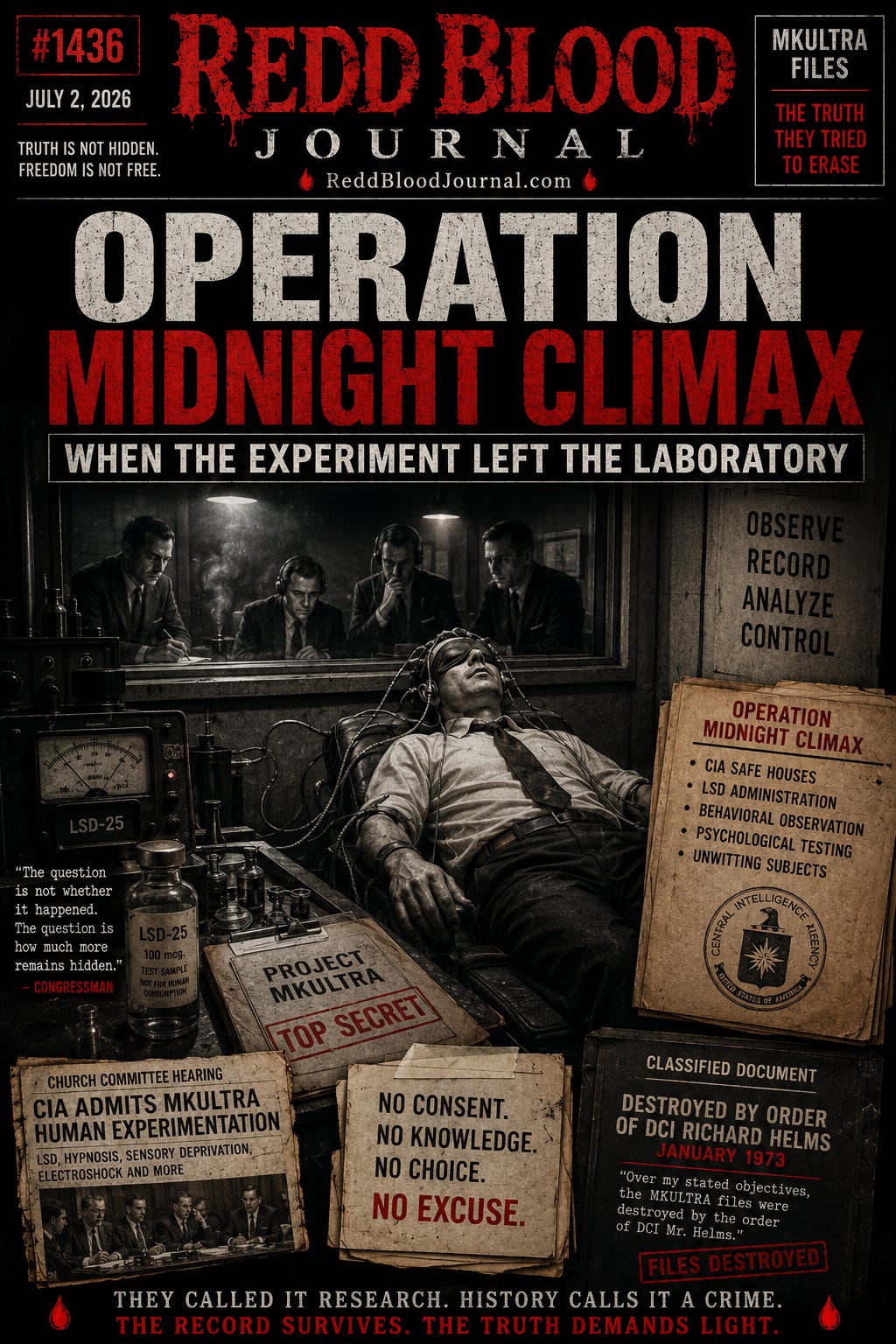
#1436 – Operation Midnight Climax: When the Experiment Left the Laboratory
July 2, 2026
🩸 By Red Blood
History often remembers Project MKUltra as a program centered on laboratories, universities, and classified research. Yet one of its most unusual and controversial chapters unfolded far from scientific institutions.
According to historical records discussed in congressional investigations and recent testimony before the House Oversight Committee, the CIA operated a program known as Operation Midnight Climax. Unlike traditional laboratory research, this operation reportedly used apartments and safe houses where unwitting individuals were observed after being secretly administered LSD and other substances.
The program has become one of the most widely discussed examples of how Cold War intelligence operations blurred the boundaries between scientific research, covert activity, and human experimentation.
A Different Kind of Laboratory
The stated purpose of Operation Midnight Climax was to study human behavior under altered states of consciousness.
According to historical accounts, CIA-operated safe houses were established where individuals entered without knowing they were participating in government-sponsored experiments. Behind one-way mirrors, agency personnel reportedly observed and documented reactions while various techniques were tested.
Whether viewed through the lens of intelligence gathering, behavioral research, or ethics, the operation remains one of the most controversial chapters associated with MKUltra.
Consent Was Missing
Modern medical research is built upon informed consent.
Participants are expected to understand the nature of an experiment, its potential risks, and their right to decline participation.
Much of the criticism surrounding Operation Midnight Climax stems from testimony and historical documentation indicating that many subjects were unaware they were part of any experiment at all.
That distinction has become central to nearly every later discussion of the program.
Without informed consent, even legitimate scientific objectives raise profound ethical questions.
The Cold War Mindset
To understand how such programs emerged, historians often point to the atmosphere of the early Cold War.
American intelligence agencies feared that rival nations had developed advanced techniques for interrogation, psychological manipulation, and coercion. In that environment, extraordinary programs were sometimes justified as defensive measures intended to prevent the United States from falling behind perceived adversaries.
Whether those fears were accurate or exaggerated remains the subject of historical debate.
What is less disputed is that fear can become a powerful force in expanding the boundaries of what governments are willing to authorize.
The Human Question
Operation Midnight Climax raises questions that extend far beyond one intelligence program.
How far should governments be permitted to go in the name of national security?
When does secrecy become incompatible with democratic accountability?
Can scientific curiosity justify experimentation on individuals who never agreed to participate?
These questions continue to resonate because they concern principles rather than a single historical event.
Why Congress Is Looking Again
The recent congressional hearing revisiting MKUltra demonstrated that interest in these programs has not disappeared.
Lawmakers questioned whether all relevant records have been released, whether previously destroyed documents can be partially reconstructed, and whether newly discovered files may provide additional historical clarity.
The discussion was not limited to assigning blame for decisions made decades ago.
It also focused on ensuring that democratic oversight keeps pace with the extraordinary capabilities of modern technology.
Lessons Beyond MKUltra
Today’s world is very different from the 1950s.
Artificial intelligence, neuroscience, biometric data, behavioral analytics, and digital platforms have transformed humanity’s ability to understand—and potentially influence—human behavior.
Most of these technologies serve legitimate and beneficial purposes.
Yet history reminds us that every powerful tool carries ethical responsibilities.
The lesson of Operation Midnight Climax is not simply about one intelligence operation.
It is about the importance of maintaining transparency, accountability, and meaningful oversight whenever governments or institutions acquire new capabilities that affect the human mind.
History cannot be changed.
But it can be examined honestly.
Doing so may be the best safeguard against repeating mistakes that future generations would once again be forced to uncover decades later.
🩸 Fantastic.
👁️ The Midnight Climax:
Ethics and the Architecture of Deception
Jul 2, 2026
This source examines Operation Midnight Climax, a clandestine subproject of the CIA’s MKUltra program that involved testing psychedelic substances on unsuspecting citizens. By establishing safe houses and using one-way mirrors for observation, the agency bypassed ethical standards and the fundamental requirement of informed consent. The text highlights how the intense pressure of the Cold War led officials to prioritize national security over individual rights and democratic transparency. Recent congressional inquiries suggest a renewed interest in uncovering lost records to ensure such human experimentation never recurs. Ultimately, the article serves as a cautionary tale about the need for government oversight as modern technologies like artificial intelligence and neuroscience continue to evolve.


