


🩸RedBloodJournal.com🩸
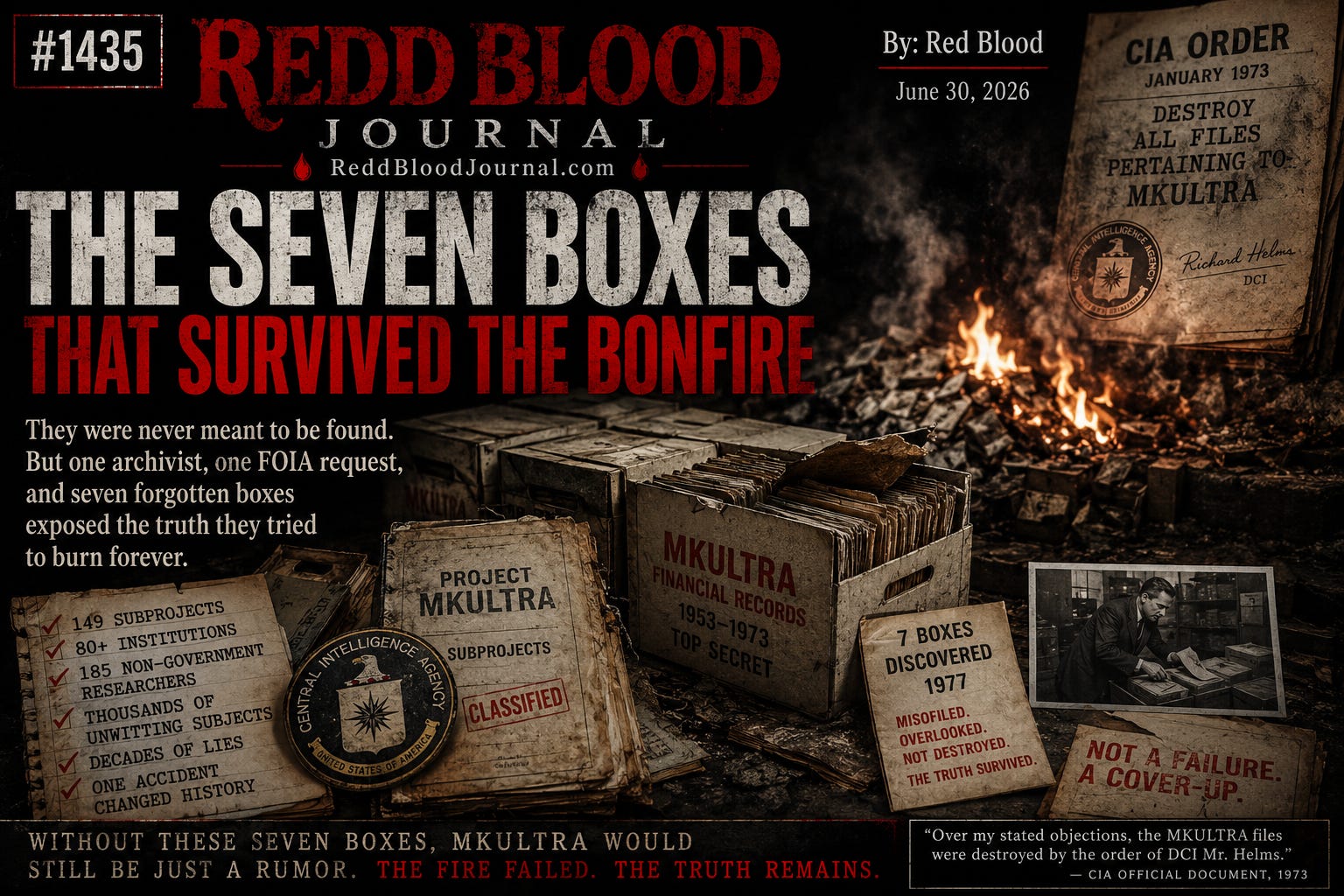
#1435 – The Seven Boxes That Survived the Bonfire
July 2, 2026
🩸 By Red Blood
History is often written by what survives.
Sometimes the most important story is not what was preserved—but what someone tried to destroy.
One of the most remarkable moments in the history of Project MKUltra did not occur during the program itself. It occurred years later, after the program had officially ended.
In 1973, according to historical testimony presented before Congress, senior CIA officials ordered the destruction of the agency’s MKUltra files. Decades of records documenting one of the most controversial intelligence programs in American history were reportedly burned, shredded, or otherwise eliminated before investigators could examine them.
Had that destruction been complete, the public might never have known the scope of the program.
Yet history sometimes has a way of refusing to disappear.
The Seven Forgotten Boxes
Several years after the destruction order, an archivist responding to a Freedom of Information Act request reportedly discovered seven boxes of financial records that had been misfiled and overlooked during the purge.
They were never intended to survive.
They were not preserved because someone chose transparency.
They survived because someone made a mistake.
Those forgotten boxes became one of the most significant historical discoveries related to MKUltra.
Instead of finding detailed operational files, investigators found financial records—payments, grants, institutional names, project numbers, contractors, and administrative documentation.
Sometimes financial records tell a larger story than narrative reports ever could.
Money leaves a trail.
Reconstructing a Hidden Program
The surviving records helped researchers reconstruct portions of a program that otherwise would have vanished from history.
According to testimony discussed during the recent congressional hearing, the documents pointed toward:
At least 149 subprojects
More than 80 institutions
Approximately 185 non-government researchers
Universities, hospitals, prisons, laboratories, and research organizations connected through covert funding
Numerous projects operating under front organizations rather than direct CIA sponsorship
Without those records, many of these connections might never have entered the public record.
The seven boxes did not answer every question.
They simply proved there were many more questions worth asking.
The Importance of One Archivist
History often celebrates presidents, generals, scientists, and famous investigators.
Far less attention is given to archivists.
Yet in this case, one archivist performing a routine search may have preserved an important piece of American history.
No dramatic raid.
No whistleblower carrying briefcases.
No secret vault.
Just someone carefully examining government records while responding to a legal request.
Sometimes history changes because someone simply refuses to stop looking.
When Records Disappear
Governments destroy records for many reasons.
Some destruction follows legal retention schedules.
Some protects classified information.
Some protects privacy.
But whenever records connected to controversial events disappear, questions naturally follow.
What was removed?
Why those records?
What can never be reconstructed?
The destruction itself often becomes part of the historical story.
Sometimes the absence of documents becomes evidence that something important once existed.
The Value of Transparency
The recent congressional hearing also revealed that additional MKUltra-related material has reportedly been located and is undergoing declassification.
Whether those newly discovered records significantly change the historical understanding remains unknown.
But every recovered document adds another piece to a puzzle that many believed had been permanently erased.
History becomes stronger when records remain available for scholars, journalists, citizens, and future generations to examine independently.
Transparency does not erase difficult chapters.
It allows societies to learn from them.
The Bonfire Failed
The story of the seven boxes is larger than MKUltra.
It reminds us that history rarely disappears completely.
Documents can be burned.
Files can be shredded.
Names can be redacted.
Witnesses can pass away.
But fragments remain.
Sometimes those fragments become enough to reconstruct an entire chapter that others hoped would never be read again.
The greatest lesson may not be what was found inside those seven forgotten boxes.
It may be that truth has an unusual habit of surviving.
Even after the fire.
🩸 Fantastic.
📦 The Seven Boxes: Truth Beyond the Bonfire
Jul 2, 2026
This report examines the accidental survival of seven boxes of financial records that exposed the hidden scale of Project MKUltra after the CIA attempted to incinerate all related documentation in 1973. While narrative files were destroyed to hide controversial activities, these misfiled administrative documents provided a paper trail linking the program to over 80 institutions and nearly 150 subprojects. The text highlights how a single archivist responding to a legal request inadvertently saved these materials, proving that monetary records can reconstruct history even when official reports are erased. Ultimately, the source serves as a meditation on the importance of transparency and the difficulty of completely suppressing the truth once a physical record exists. These surviving fragments allowed investigators to map a covert network of universities and hospitals that otherwise would have remained entirely secret.


