


🩸 RedBloodJournal.com
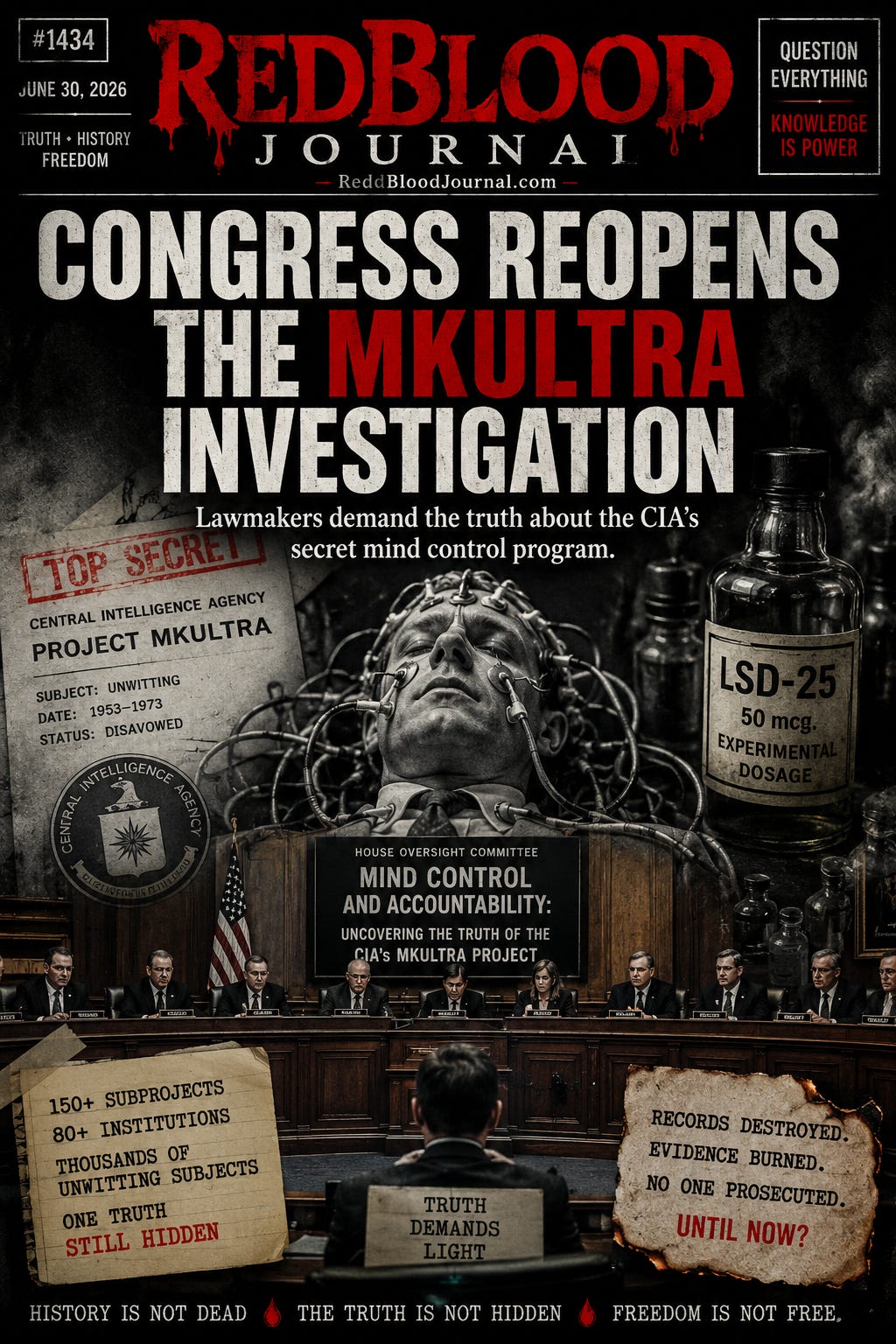
#1434 – Congress Reopens the MKUltra Investigation
June 30, 2026
🩸 By Red Blood
When History Refuses to Stay Buried
More than seventy years after the CIA launched one of the most controversial intelligence programs in American history, members of Congress have once again opened the door to an investigation into Project MKUltra. The hearing was presented as an effort to uncover what happened, determine what remains hidden, and examine whether the public has ever received the full story.
The significance of the hearing was not simply that MKUltra was discussed again. It was that lawmakers publicly questioned whether decades of official disclosures have been incomplete, whether critical records were intentionally destroyed, and whether additional documents remain classified today.
For many Americans, MKUltra has long occupied the uncertain space between documented history and public skepticism. The hearing sought to move the discussion back toward documented evidence.
More Than a Failed Experiment
During the hearing, committee members described MKUltra not as an isolated policy mistake but as a long-running intelligence program involving experiments on unwitting human subjects.
Witnesses discussed historical records indicating that individuals were exposed to substances such as LSD, hypnosis, sensory deprivation, electroshock, and other experimental techniques without informed consent. According to testimony, the program extended through numerous subprojects involving universities, hospitals, prisons, research institutions, and contractors.
Several speakers emphasized that many participants were never aware they had become subjects of government-sponsored experimentation.
The Destruction of the Evidence
One of the most striking portions of the hearing centered on the destruction of MKUltra records.
Lawmakers cited historical documentation indicating that, shortly before leaving office in 1973, senior CIA officials ordered the destruction of large portions of the program’s files. According to testimony, this action severely limited later investigations and prevented Congress from obtaining a complete record.
Ironically, much of what is publicly known today exists only because several boxes of financial records were reportedly overlooked during the destruction process and were later discovered through a Freedom of Information Act request.
Without those surviving records, many details of the program might never have become public.
Accountability Without Consequences
A recurring theme throughout the hearing was accountability.
Committee members questioned why no criminal prosecutions followed despite decades of investigations, congressional inquiries, and official reports acknowledging unethical human experimentation.
The discussion highlighted a broader question that extends beyond MKUltra itself:
What happens when government agencies investigate themselves?
The hearing did not provide a definitive answer, but it demonstrated that this question continues to resonate decades after the events occurred.
New Documents
Lawmakers also revealed that additional MKUltra-related material has recently been located and is currently undergoing declassification.
Although few details were released during the hearing, members indicated that newly discovered files could provide additional insight into activities that remain poorly understood.
If released, these documents may help historians clarify portions of the historical record that have remained incomplete for generations.
Looking Forward Instead of Backward
The hearing also shifted toward the future.
Several witnesses noted that while the original MKUltra program belonged to the Cold War era, modern technology has advanced dramatically.
Artificial intelligence, neuroscience, brain-computer interfaces, advanced behavioral analytics, large-scale digital surveillance, and sophisticated psychological profiling have created capabilities that did not exist during the 1950s and 1960s.
Rather than arguing that similar programs exist today, the hearing raised a broader public policy question:
How should democratic societies ensure that rapidly advancing technologies remain subject to meaningful oversight?
That question extends well beyond intelligence agencies. It applies equally to governments, private corporations, research institutions, and any organization capable of influencing human behavior through emerging technologies.
Why This Hearing Matters
Regardless of political affiliation, the reopening of congressional examination into MKUltra represents something larger than revisiting history.
It reflects an enduring principle that democratic governments depend upon transparency, oversight, and accountability.
When records disappear, trust erodes.
When questions remain unanswered, speculation grows.
When history is hidden, future generations lose the opportunity to learn from it.
Whether the newly discovered documents ultimately change the historical understanding of MKUltra remains to be seen. But the decision to reopen the discussion signals that some chapters of history are never completely closed until the public believes the record is complete.
As Congress continues examining newly declassified material, the central issue may no longer be what happened decades ago.
It may be whether democratic institutions are willing to confront difficult chapters of their own history openly—and ensure that future generations inherit greater transparency than those who came before.
🩸 Fantastic.
📂 Unearthing the Shadows: The Resurgence of MKUltra Oversight
Jul 2, 2026
Recent congressional hearings have officially reopened the investigation into Project MKUltra, a Cold War-era intelligence program involving unethical human experimentation. Lawmakers are currently scrutinizing the intentional destruction of records by the CIA in 1973, which previously prevented a full understanding of the program’s scope. The discovery of newly located documents undergoing declassification suggests that the public record regarding non-consensual testing of hypnosis and chemical substances may soon be expanded. Beyond historical accountability, the inquiry addresses modern concerns about how emerging technologies like artificial intelligence and neuroscience require rigorous democratic oversight. Ultimately, the proceedings emphasize that government transparency and the recovery of hidden history are essential for maintaining public trust. This resurgence of interest signals a commitment to ensuring that past institutional failures inform the ethical boundaries of future scientific research.


