


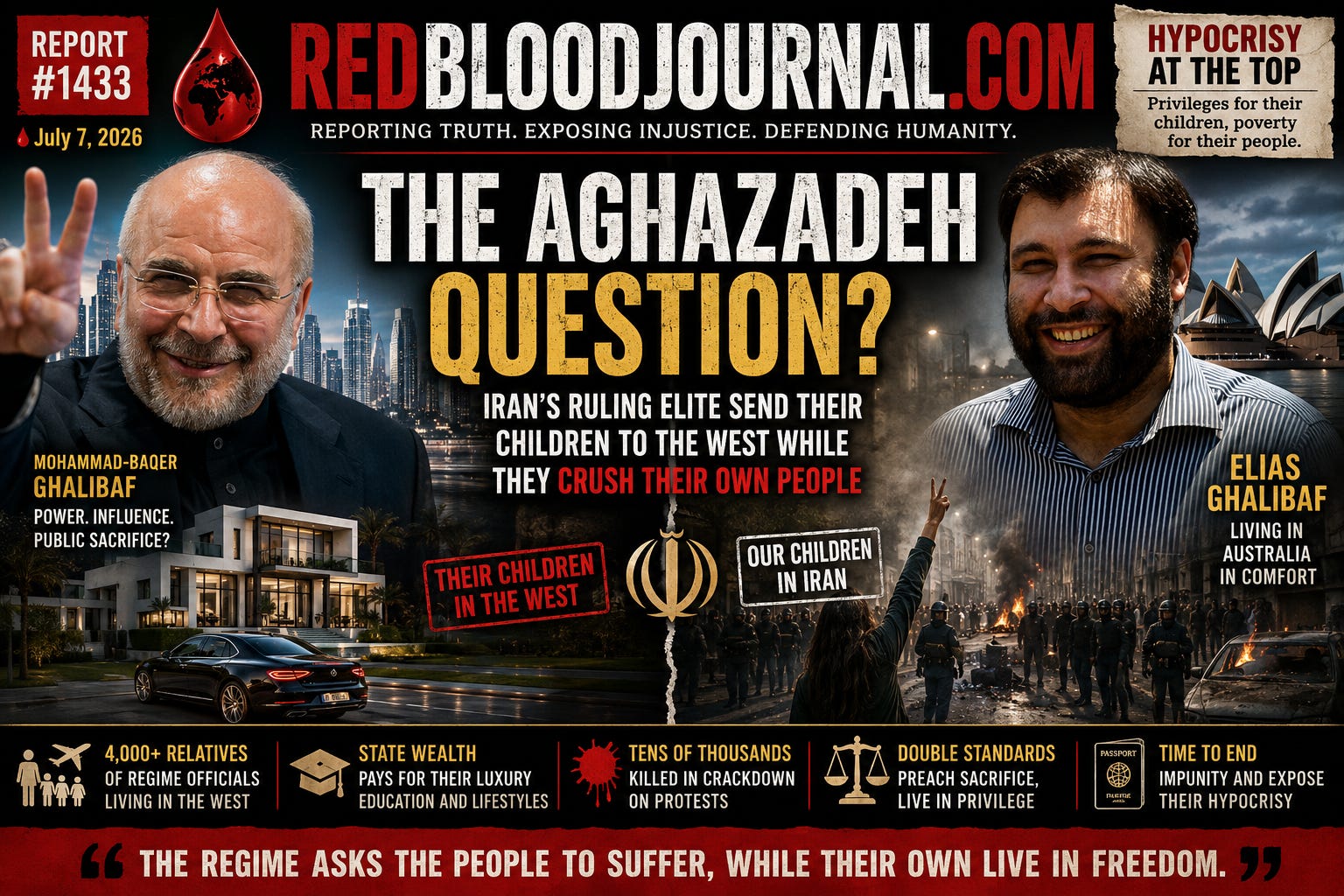
🩸 Report #1433
The Aghazadeh Question: When the Elite’s Families Live the Life They Condemn
RedBloodJournal.com
One of the oldest criticisms directed at authoritarian governments is not simply corruption—it is hypocrisy.
A recent article published by The Guardian examines accusations by opposition campaigners that some members of Iran’s ruling elite have enabled their adult children and relatives to live in Western democracies while publicly condemning those same societies at home.
The article highlights several examples, including relatives of senior Iranian political, military, and religious figures reportedly living, studying, or working in countries such as the United States, Canada, the United Kingdom, and Australia. According to the report, critics argue that these opportunities are often unavailable to ordinary Iranians facing economic hardship, political repression, and international isolation.
Political analyst Alex Vatanka, quoted in the article, summarizes the criticism with a single word: hypocrisy. The issue, he argues, is not merely where the children of officials choose to live, but the contrast between the values promoted by the Islamic Republic and the lifestyles enjoyed by some of those closest to its leadership.
Among those mentioned is Elias Ghalibaf, identified as the eldest son of Mohammad Bagher Ghalibaf, who the article reports is living in Australia and has become the subject of public petitions calling for government review. The article also names relatives of other senior Iranian officials who are reported to reside or work in Western countries.
A Broader Political Question
The debate extends beyond individual families.
For many Iranians living inside and outside the country, the central question is whether senior officials genuinely believe the ideological principles they promote. If Western societies are portrayed as morally corrupt or fundamentally hostile, critics ask why so many members of the political elite appear comfortable allowing their own families to study, work, or build careers there.
Supporters of the government may argue that adult children make independent choices and should not automatically be judged by the positions of their parents. Democratic legal systems generally avoid assigning responsibility based solely on family relationships.
Critics respond that the concern is not collective guilt but unequal privilege. They argue that while ordinary citizens face restrictions on travel, economic opportunity, and political expression, well-connected families often possess opportunities unavailable to the broader population.
The Intelligence Dimension
The article also raises another possibility through expert commentary.
According to Alex Vatanka, Western governments may hesitate to remove relatives of senior officials because such individuals could possess information valuable to intelligence agencies or diplomatic analysis. Whether that consideration influences government policy is not publicly established, but it illustrates that these cases involve national security, diplomacy, immigration law, and human rights simultaneously.
The Larger Issue
Regardless of political viewpoint, the controversy reflects a broader principle that extends well beyond Iran.
Public confidence erodes when political leaders ask their citizens to sacrifice while those closest to power appear insulated from the consequences of the very system they defend.
Whether in democracies or authoritarian states, legitimacy depends not only on what leaders say, but on whether their actions—and the opportunities available to their own families—align with the principles they publicly advocate.
History has shown that citizens often tolerate hardship far longer than they tolerate perceived double standards.
The greatest challenge to any political system is not always external pressure.
Sometimes it is the contradiction between its message and its example.
⚖️ The Aghazadeh Question: Iranian Elite Hypocrisy and Global Privilege
Jul 2, 2026
The provided text highlights the hypocrisy and elitism within the Iranian leadership, focusing on the children of high-ranking officials who reside in the Western nations their parents publicly denounce. These individuals, often referred to as “aghazadehs,” enjoy academic and professional opportunities in democratic societies that remain inaccessible to ordinary Iranian citizens suffering under economic and political restrictions. Critics argue that this double standard undermines the moral authority and ideological integrity of the Islamic Republic, suggesting that the ruling class does not personally adhere to the values it mandates for the public. The report also suggests that Western governments may tolerate the presence of these relatives for potential intelligence or diplomatic advantages. Ultimately, the source posits that such blatant inequality and contradiction between official rhetoric and private behavior serves as a primary driver of domestic resentment and political instability.


