


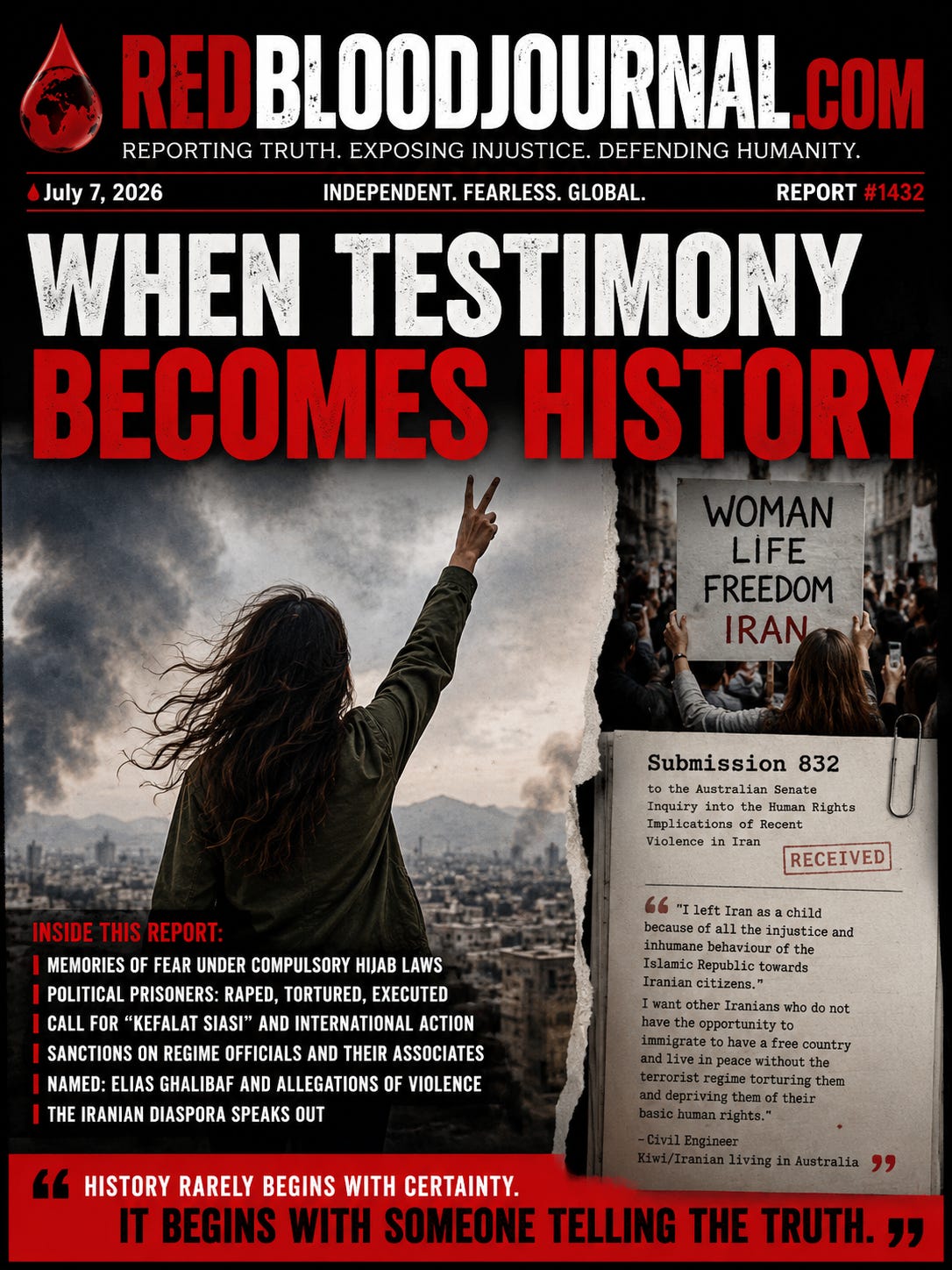
🩸Report #1432
When Testimony Becomes History
RedBloodJournal.com
History is not built solely from government reports, intelligence briefings, or newspaper headlines. It is also built from the voices of ordinary people who decide that remaining silent is no longer an option.
One such voice appears in Submission 832 to the Australian Senate Foreign Affairs, Defence and Trade References Committee during its inquiry into the human rights implications of recent violence in Iran. The submission was written by a Kiwi-Iranian civil engineer now living in Australia, who explains that she left Iran as a child because of what she describes as injustice and inhumane treatment under the Islamic Republic.
The author recalls growing up under compulsory hijab laws and living with the constant fear of the morality police. She describes an environment where simply choosing how to dress could result in intimidation or arrest. According to her testimony, these experiences left lasting memories that continue to shape her understanding of freedom and human rights.
Her submission extends beyond personal memories. It urges Australia to expand support for Iranian political prisoners through the initiative known as Kefalat Siasi, in which elected officials publicly sponsor individual prisoners to increase international attention to their cases. The submission argues that external political pressure can make it more difficult for governments to mistreat prisoners without international scrutiny.
The author also calls for sanctions against individuals she believes are connected to the Islamic Republic and asks Australia to freeze assets, halt business relations with the Iranian government, and investigate relatives of senior officials who reside in Australia.
Among the names mentioned is Elias Ghalibaf, whom the author identifies as the son of Mohammad Bagher Ghalibaf. The submission includes serious allegations concerning responsibility for violence against university students and urges Australian authorities to examine whether individuals connected to senior Iranian officials should continue enjoying residency privileges in democratic countries. These allegations are presented by the author as part of her parliamentary submission and should be understood as testimony provided to the inquiry rather than findings established by the committee.
The Importance of Testimony
This distinction is important.
Parliamentary inquiries exist precisely because democratic societies recognize that testimony deserves to be heard, documented, questioned, and examined. A submission is not a court judgment. It is evidence placed into the public record, where it can contribute to broader investigations and policy discussions.
Throughout history, many of the world’s most significant human rights investigations began not with official admissions, but with individuals willing to speak publicly about experiences that others preferred to ignore. Personal testimony often becomes the first thread that investigators, journalists, historians, and future generations follow.
Whether every claim contained in a submission is ultimately confirmed is the responsibility of investigators—not the responsibility of those who choose to testify.
For many members of the Iranian diaspora, speaking before democratic institutions is itself an act of resistance. It reflects the belief that even if justice is delayed, preserving the historical record matters. Once testimony enters the public archive, it becomes far more difficult for future generations to say they never knew.
Conclusion
History rarely begins with certainty.
It begins with someone deciding that the truth, as they experienced it, is worth placing on the record.
📜 The Architecture of Witness:
Testimony as Historical Resistance
Jul 2, 2026
This text explores how personal testimony serves as a foundational element of historical record and human rights advocacy. It highlights a specific submission to an Australian Senate inquiry from an Iranian-born engineer who details her upbringing under compulsory hijab laws and the constant threat of the morality police. The author advocates for international intervention, specifically urging the Australian government to adopt targeted sanctions, freeze assets, and support political prisoners through public sponsorship. Beyond these specific requests, the source emphasizes that parliamentary submissions are vital tools for documenting injustice and pressuring authoritarian regimes. By placing private experiences into the public archive, individuals transform their memories into durable evidence that demands accountability. Ultimately, the source argues that the act of testifying is a powerful form of resistance that prevents future generations from claiming ignorance of systemic abuses.


