


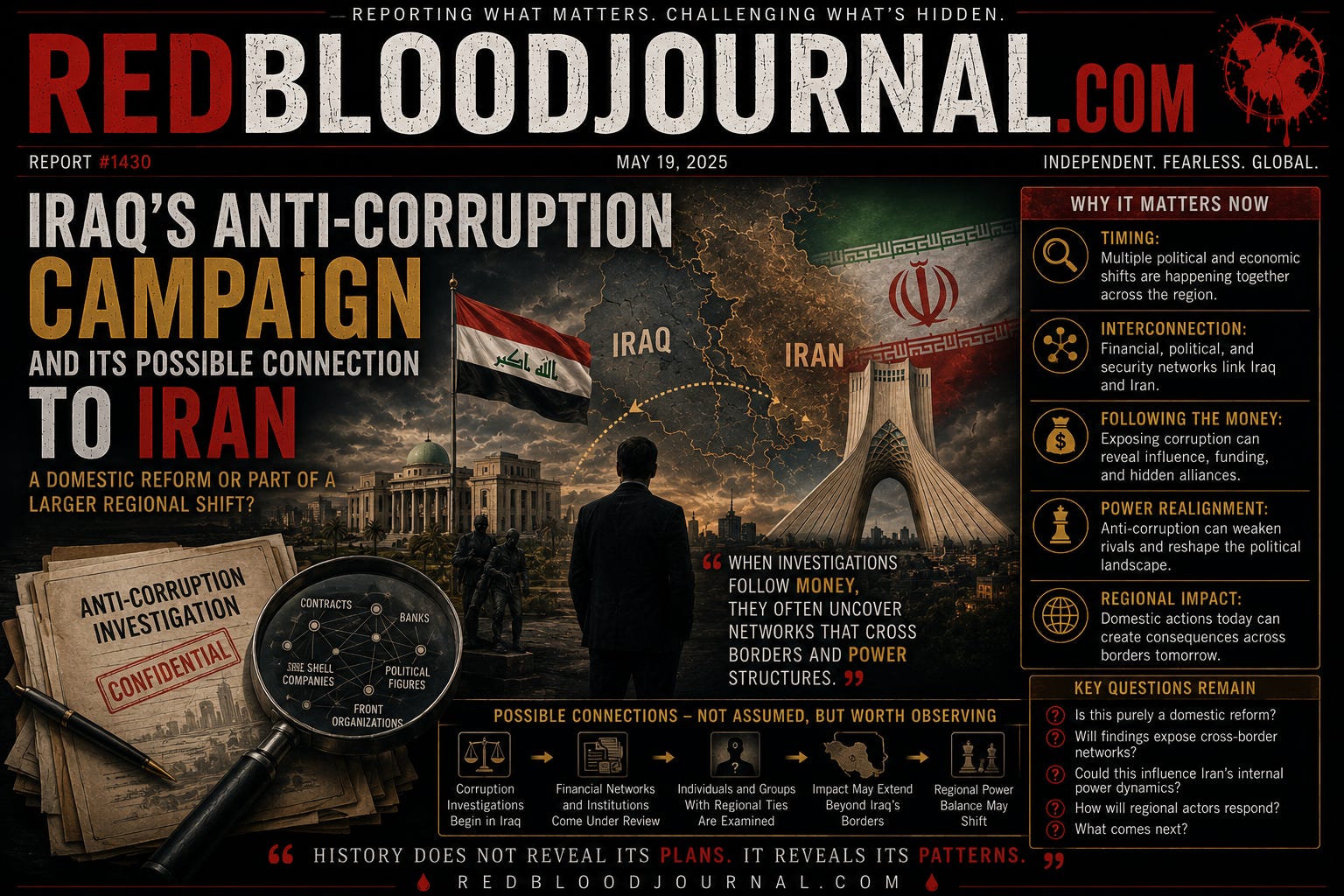
🩸 Report #1430
Iraq’s Anti-Corruption Campaign
Could It Be Connected to Iran’s Political Transition?
Every anti-corruption campaign serves two purposes.
The first is obvious: removing corruption.
The second is often less visible: reshaping political power.
As Iraq intensifies investigations into corruption, financial networks, and government institutions, some observers have begun asking whether these developments are entirely domestic—or whether they may also intersect with the changing political landscape across the border in Iran.
At present, there is no public evidence proving that Iraq’s anti-corruption campaign is being directed as part of a broader strategy involving Iran. Nevertheless, the timing has prompted analytical discussion among regional observers.
More Than Fighting Corruption
Anti-corruption campaigns frequently accomplish several objectives simultaneously.
They recover public funds.
They strengthen confidence in government.
They weaken political rivals.
They expose financial networks.
They reorganize institutions.
History shows that governments around the world have often used corruption investigations both as legal tools and as instruments of political restructuring.
The existence of corruption does not automatically explain why certain investigations begin at a particular moment.
Iraq and Iran: Interconnected Systems
For decades, Iraq and Iran have shared more than a border.
Their economies, security concerns, religious institutions, energy infrastructure, and political relationships have become deeply interconnected.
Changes in one country often create ripple effects in the other.
If financial networks extend across borders, investigations in Iraq could naturally affect individuals, companies, or organizations with regional ties.
That possibility alone has encouraged speculation about whether current investigations may have consequences beyond Iraq itself.
Following the Money
Power is often sustained through financial systems.
Political influence requires funding.
Organizations require financing.
Regional alliances frequently depend upon economic resources.
When investigators begin tracing financial flows, they sometimes uncover relationships extending far beyond the original investigation.
Whether that occurs in the present campaign remains uncertain.
Timing Matters
One reason analysts are paying attention is timing.
Several developments are unfolding at roughly the same time:
Internal political uncertainty inside Iran.
Continuing discussions about negotiations with the United States.
Regional diplomatic realignments.
Iraq’s renewed anti-corruption efforts.
Ongoing economic pressure throughout the region.
These events may be entirely independent.
They may also influence one another.
Distinguishing coincidence from coordination requires evidence rather than assumption.
A Region in Transition
The Middle East has entered a period in which political alliances are evolving.
Former rivals have reopened diplomatic relations.
Economic partnerships are shifting.
Energy markets continue adapting.
Governments are reassessing long-term security strategies.
In such an environment, domestic reforms may produce regional consequences even when they are not originally designed to do so.
Observation Versus Conclusion
It is tempting to connect every major event into one unified explanation.
Sometimes history confirms those connections.
Sometimes it reveals that parallel events simply occurred at the same time.
Responsible analysis therefore requires restraint.
Questions are valuable.
Evidence remains essential.
Final Observation
Whether Iraq’s anti-corruption campaign ultimately proves to be purely domestic or becomes part of a broader regional transformation is a question that cannot yet be answered with certainty.
What is already clear is that financial investigations rarely affect only accounting records.
They can reshape institutions.
They can alter political influence.
They can expose networks built over decades.
And in a region as interconnected as the Middle East, changes inside one nation are often felt well beyond its borders.
History will determine whether today’s investigations represent ordinary law enforcement—or one chapter in a much larger regional transition.
🩸 RedBloodJournal.com 🩸
“Corruption investigations follow money. Money follows power. When investigators begin tracing one, they often discover the other.”
⚖️ Financial Reform and the Transnational Architecture of Power
Jul 1, 2026
This report examines the potential regional implications of Iraq’s recent anti-corruption campaign, questioning whether these domestic investigations are linked to political shifts in Iran. While there is no definitive proof of external coordination, the text highlights how financial investigations often serve as tools for reshaping political power and weakening rivals. Because the economies and security structures of Iraq and Iran are deeply interconnected, a crackdown on illicit money in one nation can create significant ripple effects across the border. Analysts are particularly focused on the strategic timing of these events, which coincide with broader diplomatic realignments and internal uncertainty within the Iranian government. Ultimately, the source suggests that while these efforts may be standard law enforcement, they could also represent a pivotal transition in Middle Eastern power dynamics. This analysis emphasizes that tracing financial flows often uncovers complex networks that extend far beyond a single country’s borders.


