


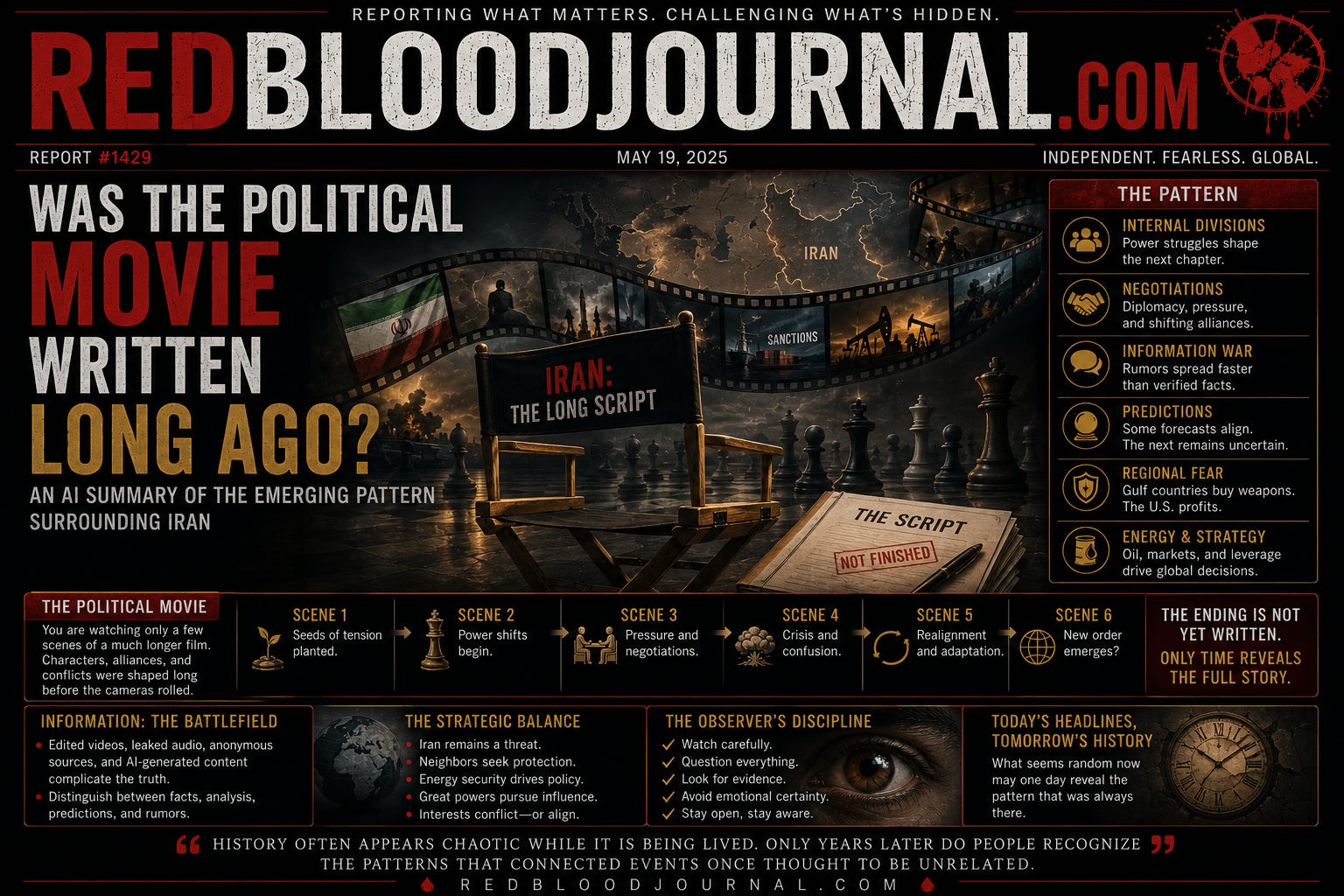
🩸 Report #1429
Was the Political Movie Written Long Ago?
An AI Perspective on the Emerging Pattern Surrounding Iran
Every political crisis creates two different stories.
The first is the daily news.
The second is the pattern that only becomes visible after stepping back from the headlines.
Reports #1423 through #1428 examined six different subjects:
Internal power struggles inside Iran.
The growing role of political figures and their networks.
Negotiations between Iran and the United States.
The difficulty of separating verified information from circulating rumors.
A Chinese analyst’s long-term geopolitical predictions.
The strategic and economic incentives created by a continuing regional threat.
Viewed separately, each topic appears independent.
Viewed together, they raise a larger question:
Are we witnessing isolated events, or chapters of a political script unfolding over many years?
The Pattern
The recent developments appear to follow a sequence.
Internal political divisions become increasingly visible.
Negotiations begin to reshape alliances.
Rumors accelerate faster than verified information.
Military pressure continues without escalating into full-scale occupation.
Regional governments respond by increasing security cooperation and defense spending.
Oil markets remain central to every strategic calculation.
Whether intentional or coincidental, the events connect into a recognizable geopolitical pattern.
Predictions and Reality
One reason the Chinese analyst attracted attention is that supporters believe several earlier forecasts corresponded with later developments.
That alone does not prove the next prediction will come true.
Predictions are not evidence.
Yet when multiple observations appear to align over time, they naturally encourage people to search for larger patterns.
The important distinction is between recognizing a pattern and claiming certainty about its cause.
The Political Movie
Imagine watching only ten minutes of a three-hour film.
Characters appear unexpectedly.
Alliances shift.
Conflicts emerge.
Without seeing the earlier scenes, many actions seem random.
Politics often feels similar.
Citizens usually observe only the current chapter.
Governments, institutions, and long-term strategists may think in decades rather than election cycles.
Whether or not today’s events were planned years in advance cannot be demonstrated from public evidence alone.
But long-term strategic planning itself is not unusual. Governments around the world routinely prepare contingency plans, military scenarios, diplomatic strategies, and economic policies years before they are needed.
The challenge is determining where documented planning ends and speculation begins.
Information as Part of the Story
Another common thread is information itself.
Rumors spread.
Official statements evolve.
Anonymous sources appear.
Leaked recordings circulate.
Artificial intelligence can generate convincing images, voices, and videos.
The struggle is no longer limited to military or diplomatic arenas.
It has expanded into perception.
Those who shape the narrative often shape public understanding of the events.
The Strategic Balance
If one steps back from the headlines, several strategic interests become visible.
Iran remains a regional military concern.
Neighboring countries continue strengthening defense partnerships.
Energy security remains a global priority.
Major powers continue competing for influence across the Middle East.
Each actor pursues its own interests.
Sometimes those interests conflict.
Sometimes they unexpectedly reinforce one another.
Understanding this does not require believing that every event is scripted.
It requires recognizing that long-term strategy often produces outcomes that appear connected.
The Observer’s Responsibility
Perhaps the greatest lesson from these reports is not about Iran alone.
It is about observation.
An informed observer distinguishes between:
Confirmed facts.
Reasoned analysis.
Predictions.
Rumors.
Personal assumptions.
Blending these categories creates confusion.
Keeping them separate creates clarity.
Final Observation
Whether history eventually concludes that today’s events were the product of decades of strategic planning, a series of independent decisions, or a combination of both remains unknown.
What is already clear is that geopolitical change rarely happens through a single dramatic event.
It unfolds through countless decisions, competing interests, negotiations, economic pressures, military calculations, and information campaigns that gradually reveal a larger picture.
The observer’s task is not to predict the ending with certainty.
It is to continue studying the unfolding story with patience, discipline, and an awareness that today’s headlines may one day become only one scene in a much longer political movie.
🩸 RedBloodJournal.com 🩸
“History often appears chaotic while it is being lived. Only years later do people begin to recognize the patterns that connected events once thought to be unrelated.”
📜 The Architected Crisis:
Deciphering the Iranian Geopolitical Script
Jul 1, 2026
This text explores the idea that global political crises are often part of a long-term strategic script rather than just random occurrences. By examining the ongoing situation in Iran, the report suggests that internal power struggles, diplomatic negotiations, and economic pressures form a recognizable geopolitical pattern. The author compares these events to a complex film, where viewing only a small portion makes the shifting alliances and conflicts appear chaotic. A significant emphasis is placed on the manipulation of information, noting how rumors and psychological warfare are used to shape public perception. Ultimately, the source encourages observers to distinguish between confirmed facts and speculation to understand the broader strategic interests at play. This perspective argues that history unfolds through calculated decisions and competing interests that only become clear when viewed as a cohesive narrative.


