


🩸 Report #1427
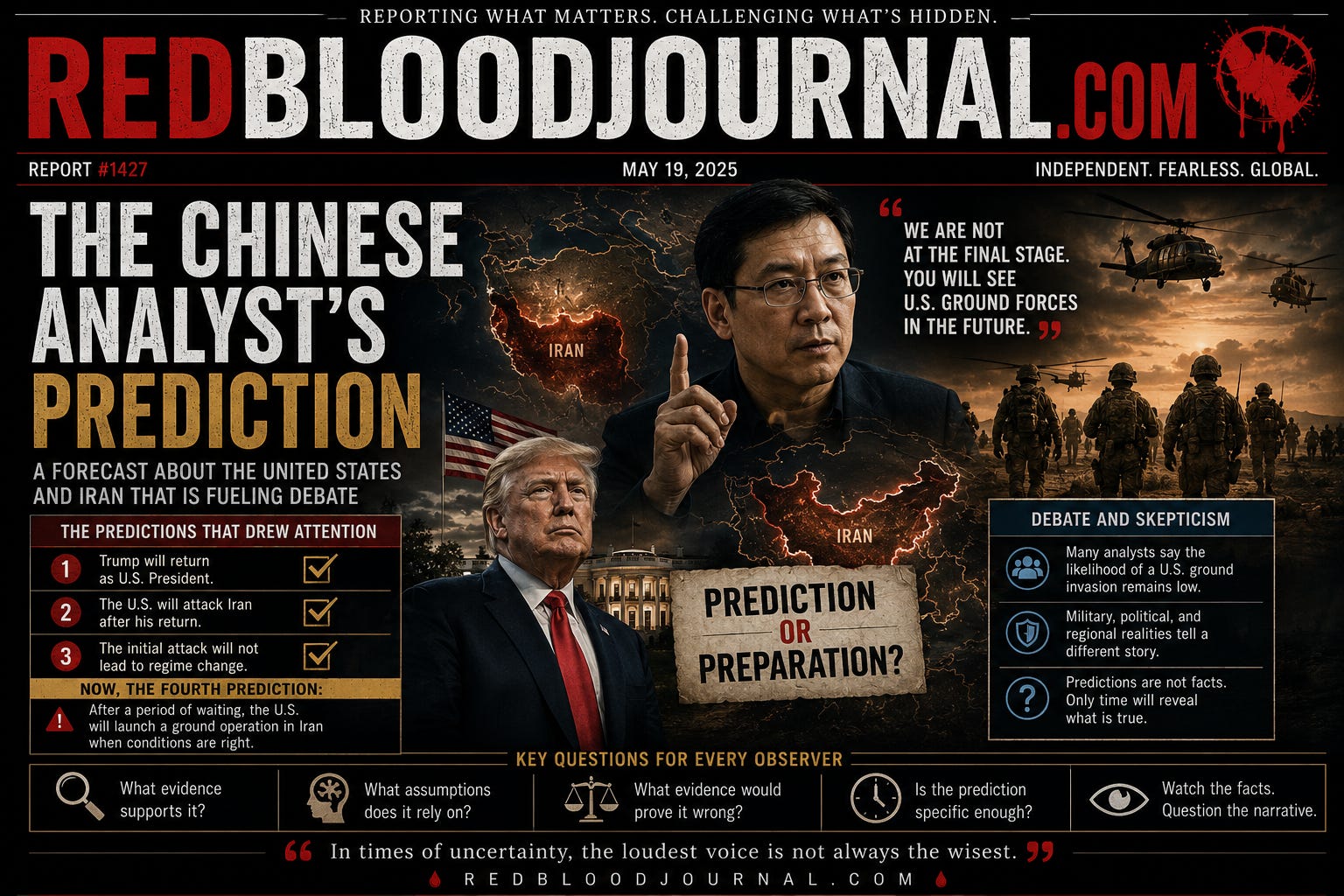
The Chinese Analyst’s Prediction
A Forecast About the United States and Iran That Is Fueling Debate
Periods of international tension often produce a surge of geopolitical predictions.
Some disappear without notice.
Others continue to attract attention because supporters believe earlier forecasts appeared to match later events.
One such example currently circulating in discussions about Iran involves a Chinese geopolitical analyst whose supporters claim he correctly anticipated several major developments involving the United States and Iran.
The Earlier Predictions
According to the discussion presented in the transcript, supporters of the analyst point to three previous forecasts.
First, they say he predicted during the previous U.S. administration that Donald Trump would return to the presidency.
Second, after Trump’s return, they claim he predicted that the United States would eventually launch military action against Iran.
Third, they state that he argued such an initial attack would not immediately result in regime change inside Iran.
Because followers believe these predictions align with subsequent events, attention has shifted to what they describe as his fourth prediction.
The Fourth Prediction
According to the transcript, the analyst reportedly believes that the present situation has not reached its final stage.
The discussion suggests he expects the possibility of a future U.S. ground operation after conditions become more favorable, arguing that timing, logistics, and seasonal factors could influence military planning.
This forecast has generated significant online discussion.
However, it remains a prediction rather than an established fact.
A Different View
The same transcript also notes that many military and political analysts disagree with this assessment.
Their view is that, based on publicly available evidence and current conditions, the likelihood of a large-scale U.S. ground invasion of Iran remains low.
This illustrates an important point:
Predictions are not evidence.
They are assessments based on assumptions that may or may not prove correct.
Why Such Predictions Spread
Forecasts gain influence during periods of uncertainty because people naturally seek explanations for rapidly changing events.
When governments release limited information, unofficial analysts often receive greater public attention.
Some predictions later prove remarkably accurate.
Others are forgotten once events take a different path.
The challenge is knowing the difference before history provides the answer.
Lessons for the Observer
Political forecasting has value when it encourages critical thinking rather than certainty.
Observers should ask:
What evidence supports the prediction?
What assumptions does it rely upon?
What evidence would prove it wrong?
Is the prediction specific enough to evaluate later?
These questions are more valuable than accepting—or rejecting—a forecast simply because it matches one’s expectations.
Final Observation
History is filled with predictions that seemed impossible until they happened—and with predictions that appeared inevitable but never occurred.
The Chinese analyst’s forecast has become part of today’s geopolitical conversation because supporters believe some of his earlier assessments matched subsequent developments.
Whether his latest prediction proves accurate is a question that only future events can answer.
Until then, it remains one possible interpretation among many competing analyses surrounding one of the world’s most closely watched geopolitical relationships.
🩸 RedBloodJournal.com 🩸
“The value of a prediction is not measured by how confidently it is spoken, but by whether time ultimately confirms it. Wise observers keep an open mind without surrendering their judgment.”
🔮 The Chinese Analyst:
Geopolitical Forecasts for U.S.-Iran Conflict
Jul 1, 2026
The provided text examines a controversial series of geopolitical forecasts made by a Chinese analyst regarding the intensifying conflict between the United States and Iran. This analyst gained notoriety for allegedly predicting the reelection of Donald Trump and subsequent American military strikes that did not immediately result in Iranian regime change. Current debate centers on his fourth prediction, which suggests a future U.S. ground invasion contingent on specific logistical and seasonal conditions. While supporters point to his past accuracy as proof of credibility, military experts remain skeptical, arguing that a large-scale invasion is currently improbable. Ultimately, the source serves as a cautionary lesson on political forecasting, emphasizing that predictions should be viewed as subjective interpretations rather than guaranteed outcomes. The narrative highlights the human tendency to seek out unofficial experts during times of global instability and government silence.


