


🩸 Report #1426
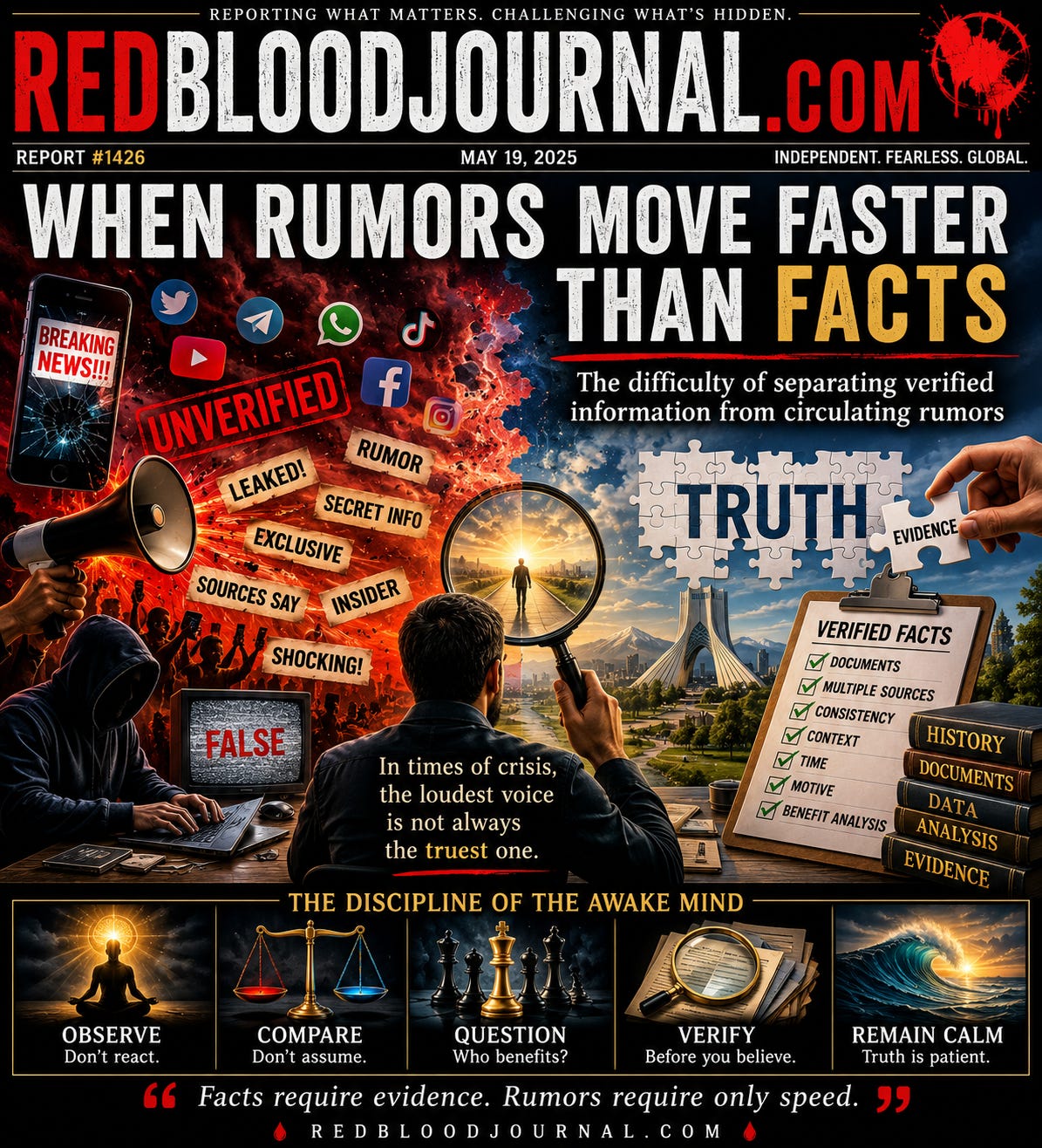
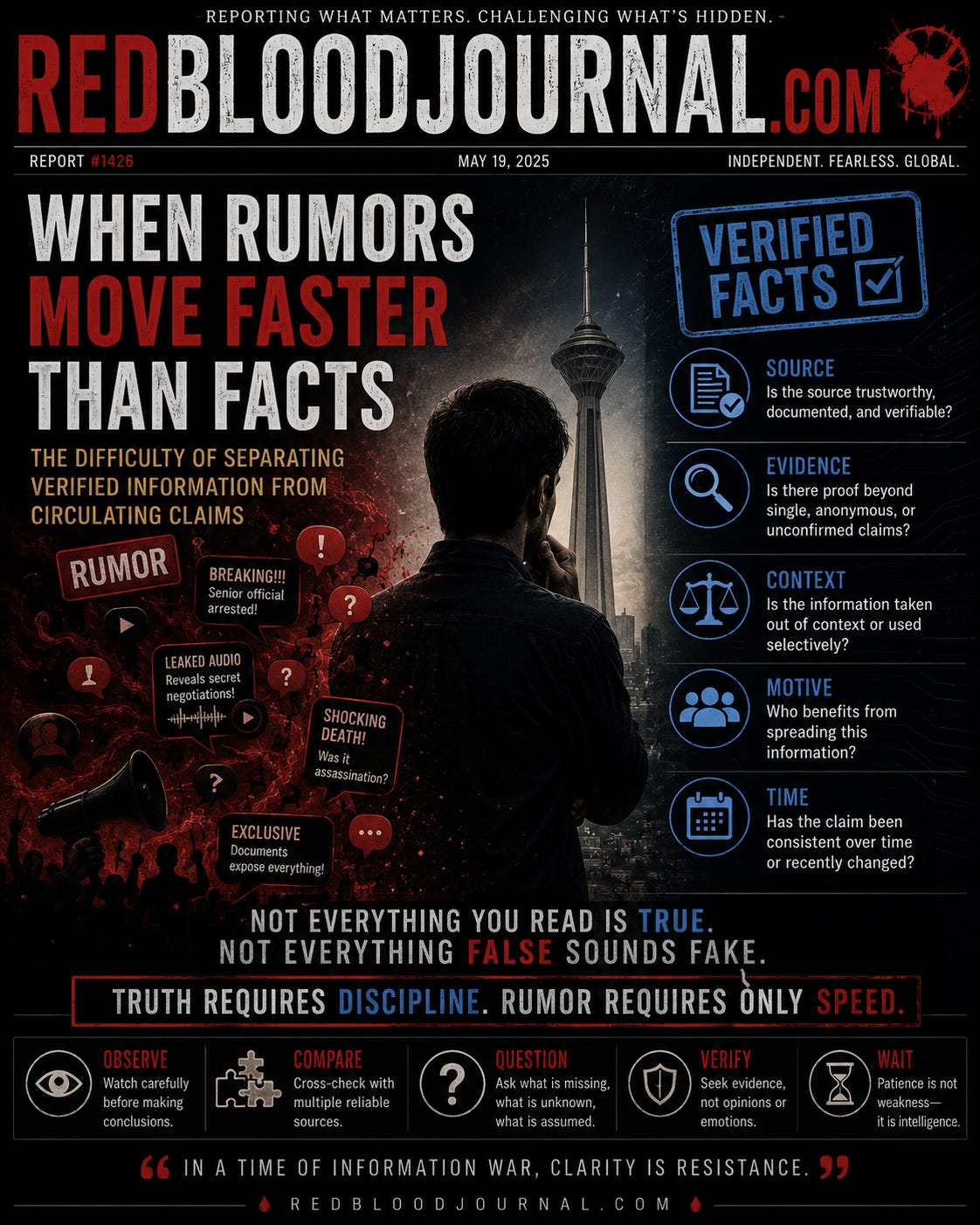
When Rumors Move Faster Than Facts
The Difficulty of Separating Verified Information from Circulating Claims
In moments of political crisis, information becomes a battlefield.
Facts, rumors, leaks, edited videos, anonymous claims, emotional reactions, and strategic propaganda all begin moving at the same time. The public is left trying to understand what is real, what is exaggerated, what is planted, and what is simply unknown.
The recent flood of claims surrounding Iran’s internal political situation shows how difficult this task has become.
The Information Vacuum
When official institutions do not speak clearly, the silence creates space.
That space is quickly filled by unofficial reports, social media accounts, anonymous sources, voice recordings, videos, and political commentary.
Some claims may contain truth.
Some may contain partial truth.
Some may be completely false.
The problem is that all of them often arrive with the same confidence.
Rumor as a Political Weapon
Rumors are not always accidental.
In political struggles, rumor can be used to test public reaction, damage rivals, pressure decision-makers, distract from larger events, or prepare society for a future announcement.
A rumor does not need to be fully true to have an effect.
Sometimes its purpose is simply to create confusion.
Verified Facts Versus Circulating Claims
A serious observer must separate three categories:
Verified facts are supported by official records, credible documentation, multiple reliable sources, or direct evidence.
Reasonable analysis connects known facts and explains possible meanings while admitting uncertainty.
Unverified claims may be interesting, but they remain allegations until evidence supports them.
Confusing these categories is how the public becomes trapped inside manufactured narratives.
The Danger of Emotional Certainty
During major political events, people often believe what confirms what they already feel.
Supporters accept rumors that protect their side.
Opponents accept rumors that damage the side they oppose.
Fear, anger, hope, and revenge can all weaken judgment.
This is why emotional certainty is dangerous.
A claim may feel true and still be false.
A claim may sound impossible and later prove accurate.
Only evidence can decide.
Technology Makes the Problem Worse
Modern technology has made verification harder.
Videos can be edited.
Voices can be cloned.
Images can be generated.
Documents can be forged.
Short clips can be removed from context.
A powerful-looking post can spread worldwide before anyone confirms its origin.
In this environment, speed often defeats accuracy.
Why This Matters
The struggle between fact and rumor is not a small media problem.
It shapes how people understand history as it is happening.
It can influence public anger.
It can damage reputations.
It can hide real crimes.
It can protect powerful actors.
It can also cause people to dismiss true warnings because they have been surrounded by too many false ones.
The Discipline of Waiting
Waiting is not weakness.
In a confused information environment, patience becomes intelligence.
The serious mind does not rush to believe or rush to reject.
It watches.
It compares.
It asks who benefits.
It looks for evidence.
It notices patterns without pretending that patterns are proof.
Final Observation
The modern world does not suffer from a lack of information.
It suffers from a lack of verified understanding.
In political crisis, the loudest claim is not always the truest. The most repeated story is not always the most accurate. The most emotional conclusion is not always the most honest.
Truth requires discipline.
Rumor requires only speed.
🩸 RedBloodJournal.com 🩸
“When facts are hidden, rumors multiply. When emotions lead, judgment weakens. The awakened mind must learn to observe without surrendering to every voice that claims to know the truth.”
⚖️ The Information Battlefield:
Navigating Political Truth and Rumor
1, 2026
This text explores the complex information landscape that emerges during political crises, specifically highlighting the struggle to distinguish verified facts from strategic rumors. It explains how information vacuums are often exploited by actors using propaganda and technology to manipulate public emotion and create manufactured narratives. The source warns that digital tools like deepfakes and rapid social media sharing prioritize speed over accuracy, making it difficult for the public to find the truth. Consequently, the report advocates for intellectual discipline and patience, suggesting that observers must resist emotional certainty to avoid being misled. Ultimately, the material serves as a guide for navigating modern misinformation by prioritizing evidence over the loud, repetitive nature of unverified claims.


