


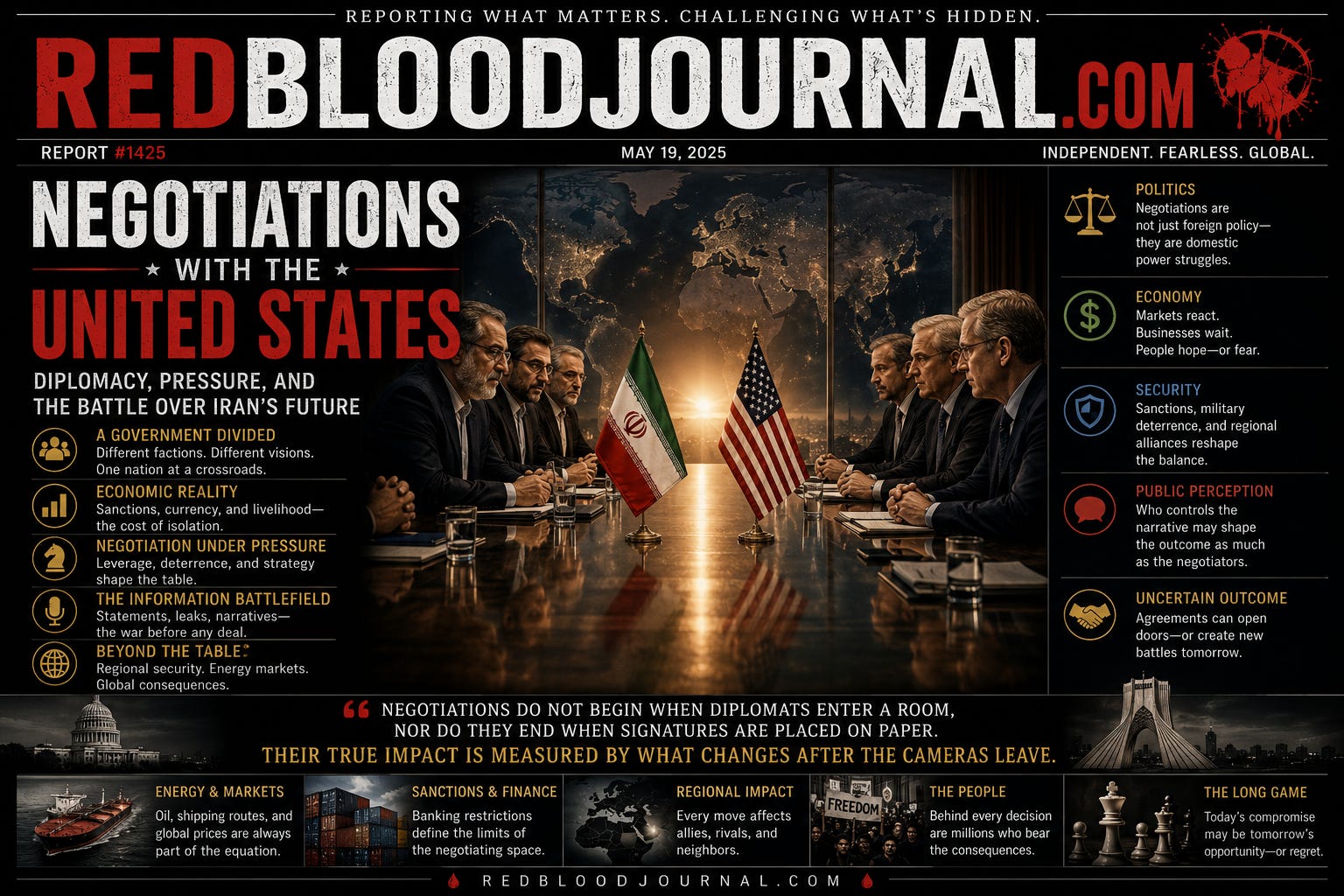
🩸 Report #1425
The Negotiations with the United States
Diplomacy, Pressure, and the Battle Over Iran’s Future
For decades, relations between Iran and the United States have alternated between confrontation and negotiation.
Military pressure, economic sanctions, diplomacy, indirect talks, and regional conflicts have all become recurring chapters in a relationship that has shaped not only the Middle East but also global energy markets and international security.
The latest round of negotiations has once again divided Iran’s political establishment, exposing competing visions of the country’s future.
A Government Divided
Public statements from senior Iranian officials suggest that negotiations with the United States are viewed very differently inside the political establishment.
One group presents diplomacy as a practical necessity for economic recovery and long-term stability.
Another views negotiations as a dangerous concession that risks weakening Iran’s strategic position and revolutionary identity.
The debate is no longer simply about foreign policy.
It has become a contest over who will shape Iran’s next political chapter.
Economic Reality
Years of sanctions have affected Iran’s economy in numerous ways.
Restrictions on banking, energy exports, international investment, and access to global financial markets have created continuing economic challenges.
Whenever negotiations begin, financial markets immediately react.
The value of the national currency fluctuates.
Businesses delay investment decisions.
Citizens speculate about possible improvements—or disappointments.
Diplomacy therefore becomes more than politics; it becomes an economic event.
Negotiation Under Pressure
History demonstrates that negotiations between rival governments rarely occur under ideal circumstances.
Each side attempts to improve its bargaining position before reaching an agreement.
Economic pressure.
Military deterrence.
Regional alliances.
Public messaging.
International diplomacy.
All become negotiating tools.
Whether one describes these measures as leverage or coercion often depends upon political perspective.
Domestic Political Consequences
Perhaps the greatest impact of negotiations is not international but domestic.
Whenever negotiations advance, political factions inside Iran compete to influence both the process and its public interpretation.
Supporters argue that diplomacy can reduce isolation.
Opponents argue that excessive compromise risks sacrificing national interests.
As these competing visions collide, internal political divisions become increasingly visible.
The Information Battlefield
Modern negotiations are conducted in two arenas simultaneously.
The first occurs behind closed diplomatic doors.
The second unfolds in public through speeches, media coverage, official statements, leaks, and social media.
Each side attempts to shape public perception before any agreement is finalized.
In this environment, verified information often competes with speculation, anonymous claims, and selective disclosures.
For observers, distinguishing confirmed developments from political messaging becomes increasingly difficult.
Beyond the Negotiating Table
The outcome of negotiations extends well beyond Iran and the United States.
Regional security.
Energy markets.
Shipping routes.
Sanctions policy.
Foreign investment.
Military alliances.
Each may be influenced by the success—or failure—of diplomatic efforts.
For neighboring countries and global markets alike, negotiations represent more than bilateral diplomacy.
They carry international consequences.
Looking Forward
Whether the present negotiations ultimately produce lasting change remains uncertain.
History shows that agreements may ease tensions temporarily, while underlying strategic disagreements continue to shape future relations.
Diplomatic breakthroughs can open new opportunities.
They can also create new political divisions.
Only time will reveal which path these negotiations ultimately follow.
Final Observation
Every negotiation produces winners and losers.
Some gain politically.
Some gain economically.
Some gain strategically.
Others lose influence.
Understanding negotiations therefore requires looking beyond official announcements and examining the broader political, economic, and strategic forces that shape them.
Only after history unfolds does it become clear whether an agreement represented a genuine turning point—or simply another chapter in a much longer story.
🩸 RedBloodJournal.com 🩸
“Negotiations do not begin when diplomats enter a room, nor do they end when signatures are placed on paper. Their true impact is measured by what changes after the cameras leave.”
🤝 The Tehran Paradox: Diplomacy and the Battle for Iran’s Future
Jul 1, 2026
The provided text explores the complex diplomatic struggle between Iran and the United States, illustrating how international negotiations function as a high-stakes contest of political and economic leverage. Internally, Iran faces a profound divide as various factions debate whether engagement is a pragmatic path toward financial recovery or a threat to national identity. These discussions are heavily influenced by years of severe economic sanctions, which have transformed foreign policy decisions into critical events for the country’s domestic markets. Beyond the private meeting rooms, the source highlights an information battlefield where public perception is shaped through strategic media leaks and official rhetoric. Ultimately, the success or failure of these talks carries global ramifications, impacting everything from regional security to international energy stability. The passage concludes that the true legacy of such diplomacy is measured not by signed documents, but by the lasting shifts in a nation’s strategic trajectory.


