


🩸 Report #1424
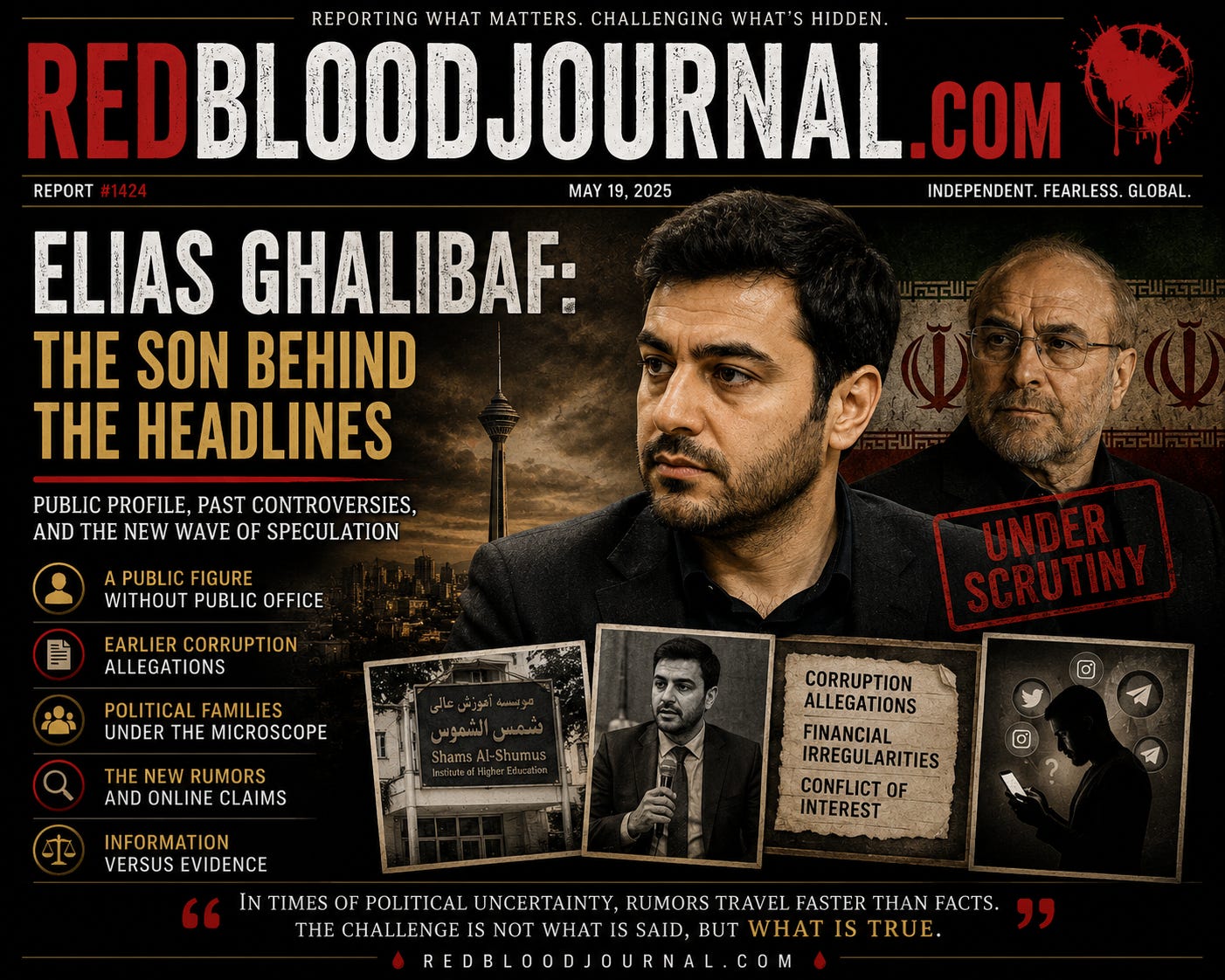
Elias Ghalibaf (Carpet weaver): The Son Behind the Headlines
Public Profile, Past Controversies, and the New Wave of Speculation
In times of political uncertainty, attention often expands beyond elected officials and reaches their families.
One name that has resurfaced repeatedly in recent discussions surrounding Iran’s internal political developments is Elias Ghalibaf, the son of Parliament Speaker Mohammad Bagher Ghalibaf.
Unlike his father, Elias has rarely occupied a prominent official political position. Nevertheless, his name has periodically appeared in Iranian media over the past decade in connection with business activities, educational institutions, and corruption allegations, while more recent online discussions have linked him to a variety of unverified claims concerning Iran’s current political transition.
A Public Figure Without Public Office
Elias Ghalibaf has been publicly associated with educational and media organizations connected to his father’s political network. During previous election campaigns, his business activities and management roles became subjects of political criticism from rival factions.
Earlier Corruption Allegations
Beginning in 2014, Iranian media reported allegations involving Elias Ghalibaf and an educational institution known as Shams al-Shumus.
The reports questioned property transactions, financial management, and possible conflicts of interest.
Elias Ghalibaf denied wrongdoing, while Iranian officials disputed several accusations. Some news organizations that reported on the case later removed their stories, and legal disputes followed. Although allegations continued to circulate, no definitive public judicial finding established criminal responsibility.
Political Families Under the Microscope
Throughout modern political history, family members of influential leaders frequently become symbols within larger political battles.
Supporters often portray them as unfairly targeted.
Opponents frequently present them as evidence of nepotism or corruption.
Iran has been no exception.
As Mohammad Bagher Ghalibaf’s political influence has grown, renewed public attention has naturally extended to members of his family.
The New Rumors
Since Iran entered its current period of political uncertainty, numerous social media accounts have circulated claims involving Elias Ghalibaf.
Among the allegations are claims about international travel, communications with foreign officials, financial activities, and involvement in broader political developments.
At present, many of these claims remain unverified and have not been independently confirmed by reliable public evidence.
The speed with which these narratives spread illustrates how political uncertainty often creates fertile ground for speculation.
Information Versus Evidence
Periods of leadership transition are frequently accompanied by information warfare.
Anonymous sources, leaked documents, edited videos, and unverified intelligence claims often compete with confirmed reporting.
For observers attempting to understand unfolding events, the distinction between documented evidence and circulating rumor becomes increasingly important.
History repeatedly demonstrates that some early reports ultimately prove accurate, while others disappear entirely once reliable information emerges.
Why the Interest?
The attention surrounding Elias Ghalibaf reflects more than curiosity about one individual.
It reflects broader public questions:
Who is gaining influence?
Who may be losing influence?
Which political networks are expanding?
Which narratives are being promoted?
Who benefits from the spread of specific information?
These questions remain central to understanding Iran’s evolving political landscape.
Final Observation
Whether Elias Ghalibaf ultimately becomes an important political figure or simply remains the son of one of Iran’s most influential politicians is a question only future events can answer.
For now, the verified public record shows a figure who has periodically attracted controversy and political scrutiny, while the newest and most dramatic claims surrounding him remain largely within the realm of speculation rather than established fact.
For serious observers, distinguishing between evidence and allegation is essential—particularly during moments when rumors can travel faster than facts.
🩸 RedBloodJournal.com 🩸
“Political transitions create two battles simultaneously: one for power, and another for control of the narrative. The second often begins long before the first has ended.”
📰The Ghalibaf Legacy:
Narrative Control and Political Speculation
Jul 1, 2026
The provided text examines the public profile of Elias Ghalibaf, the son of Iran’s Parliament Speaker, who has become a focal point of political speculation and nepotism allegations. Although he holds no official government role, his involvement in educational ventures and various business activities has historically drawn scrutiny and accusations of financial misconduct. As Iran undergoes a period of leadership transition, Elias has been targeted by a new wave of unverified rumors involving international dealings and political maneuvering. The source highlights the difficulty of distinguishing between documented evidence and information warfare during times of national uncertainty. Ultimately, the narrative serves as a case study on how the families of powerful elites become symbols in broader battles for political influence and narrative control.


