


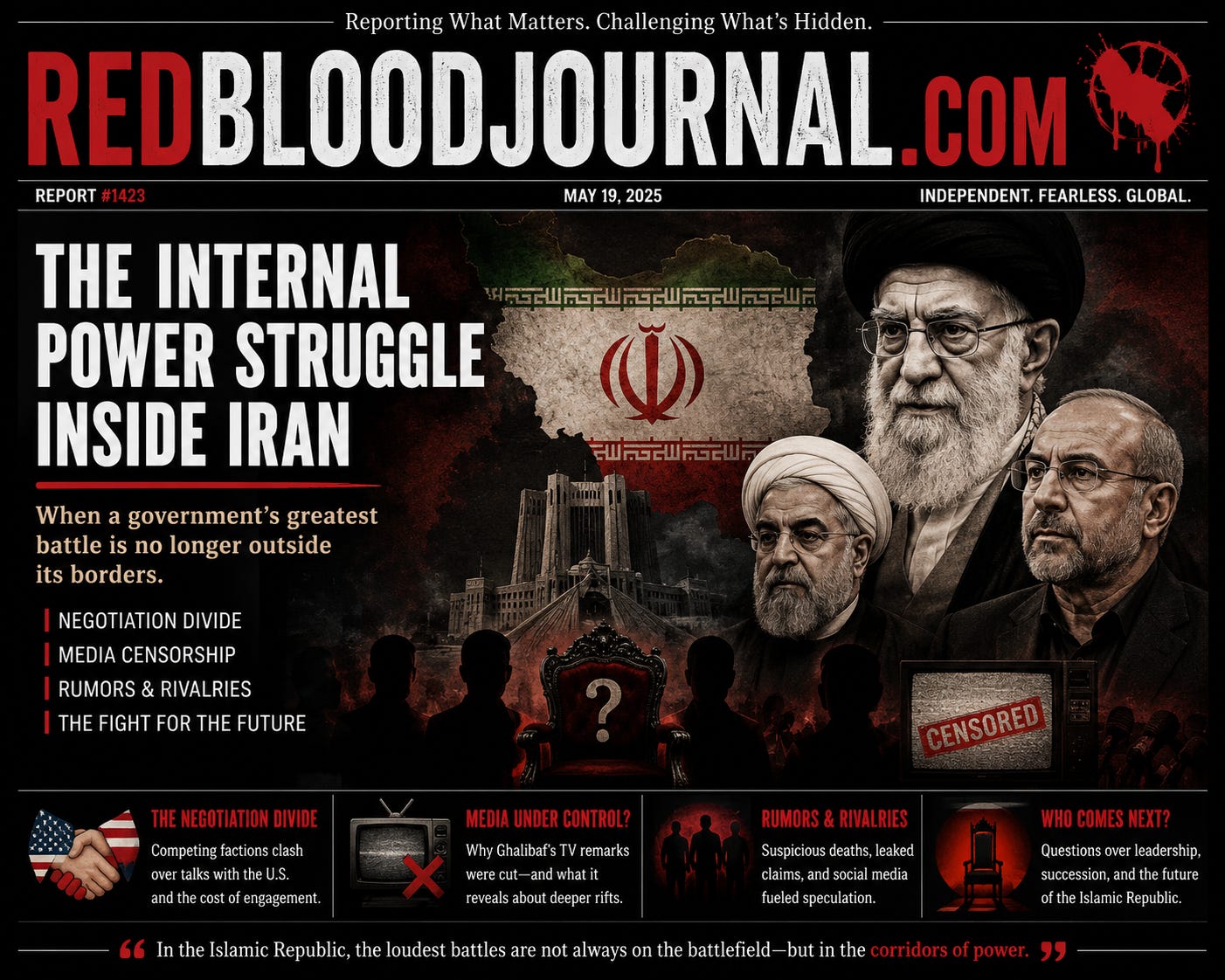
🩸 Report #1423
The Internal Power Struggle Inside Iran
When a Government’s Greatest Battle Is No Longer Outside Its Borders
Every government eventually reaches a moment when its greatest challenge is no longer an external enemy but itself.
Recent developments inside Iran suggest that the country’s political establishment is experiencing one of its most delicate internal periods in decades. Public disagreements over negotiations with the United States, unusual media censorship, conflicting public statements by senior officials, and a growing stream of rumors surrounding senior figures have all contributed to an atmosphere of uncertainty.
Whether these events represent an organized restructuring of power or simply competing political factions remains impossible to determine from publicly available evidence alone. What is clear, however, is that signs of internal friction are becoming increasingly visible.
The Negotiation Divide
One of the most obvious fractures concerns negotiations with the United States.
Within Iran’s political establishment, competing voices appear to disagree over both the direction and the cost of diplomatic engagement. Public speeches, televised appearances, and reactions from political groups suggest that negotiations have become more than foreign policy—they have become a test of political influence inside the government itself.
When disagreement over foreign policy begins producing visible political confrontation, it often reflects a deeper struggle over future leadership.
State Television Reveals the Tension
One of the most discussed moments occurred when portions of parliamentary speaker Mohammad Bagher Ghalibaf’s televised remarks were reportedly interrupted or removed during state broadcasting.
Whether the interruption resulted from editorial decisions, political disagreement, or routine broadcasting procedures has not been officially explained.
Nevertheless, the incident fueled speculation that competing centers of authority may no longer be presenting a unified public message.
In tightly controlled political systems, even small breaks in messaging often attract significant attention.
Rumors Fill Information Vacuums
As official information becomes limited, rumors naturally multiply.
Social media has circulated numerous claims involving senior officials, suspicious deaths, leadership succession, and internal rivalries.
Some of these reports reference unnamed sources, anonymous accounts, or leaked conversations. Others rely entirely on speculation.
At present, many of these allegations remain unverified.
The rapid spread of competing narratives demonstrates an important reality: when reliable information becomes scarce, public imagination often fills the gap.
Leadership Questions
Another recurring subject is the question of future leadership.
Various reports and online discussions have speculated about changes among Iran’s highest political and judicial institutions.
Some observers interpret personnel changes as routine government restructuring.
Others see them as evidence of a broader redistribution of power.
Without official confirmation, these interpretations remain analytical rather than factual.
The Visible Signs
Regardless of which interpretation ultimately proves correct, several observable developments have occurred simultaneously:
Public disagreement over negotiations.
Increased political rhetoric among competing factions.
Intense online speculation regarding senior officials.
Growing public attention to succession questions.
Unusual media moments that have generated widespread discussion.
Each event alone might appear ordinary.
Taken together, they create the impression of a political system navigating a period of significant internal uncertainty.
Reading Beyond Headlines
History shows that major political transitions rarely become visible through a single dramatic event.
Instead, they often emerge gradually through small signals—changes in messaging, shifting alliances, personnel movements, competing narratives, and increasingly visible disagreements among those who once appeared united.
Whether today’s developments represent the beginning of such a transition remains unknown.
Time—not speculation—will ultimately determine which narratives prove accurate.
For observers, the most valuable approach is neither blind acceptance nor automatic rejection of every claim. It is careful observation, patience, and a willingness to separate verified facts from rumor while recognizing that uncertainty itself can become an important part of the story.
🩸 RedBloodJournal.com 🩸
“The strongest governments often appear most united just before their internal divisions become visible. The challenge for observers is not predicting the future—it is learning to distinguish evidence from speculation while watching history unfold.”
⚖️ Cracks in the Citadel: Iran’s Internal Power Struggle
Jul 1, 2026
The provided report explores the escalating internal friction within Iran’s political establishment, suggesting that the government’s primary challenges are now domestic rather than foreign. Evidence of this power struggle manifests through public disputes over diplomatic negotiations with the United States and uncharacteristic instances of media censorship involving high-ranking officials. The document highlights how a lack of official transparency has fueled a surge in unverified rumors concerning leadership succession and suspicious deaths. Observers are tracking these personnel shifts and conflicting narratives to determine if they signal a routine reorganization or a fundamental transition in governance. Ultimately, the text characterizes the current atmosphere as a period of significant political uncertainty where once-unified factions are increasingly at odds. This analysis encourages a cautious approach to information, separating verifiable facts from the speculation that naturally fills information vacuums during times of crisis.


