


🩸 Red Blood Take #1421
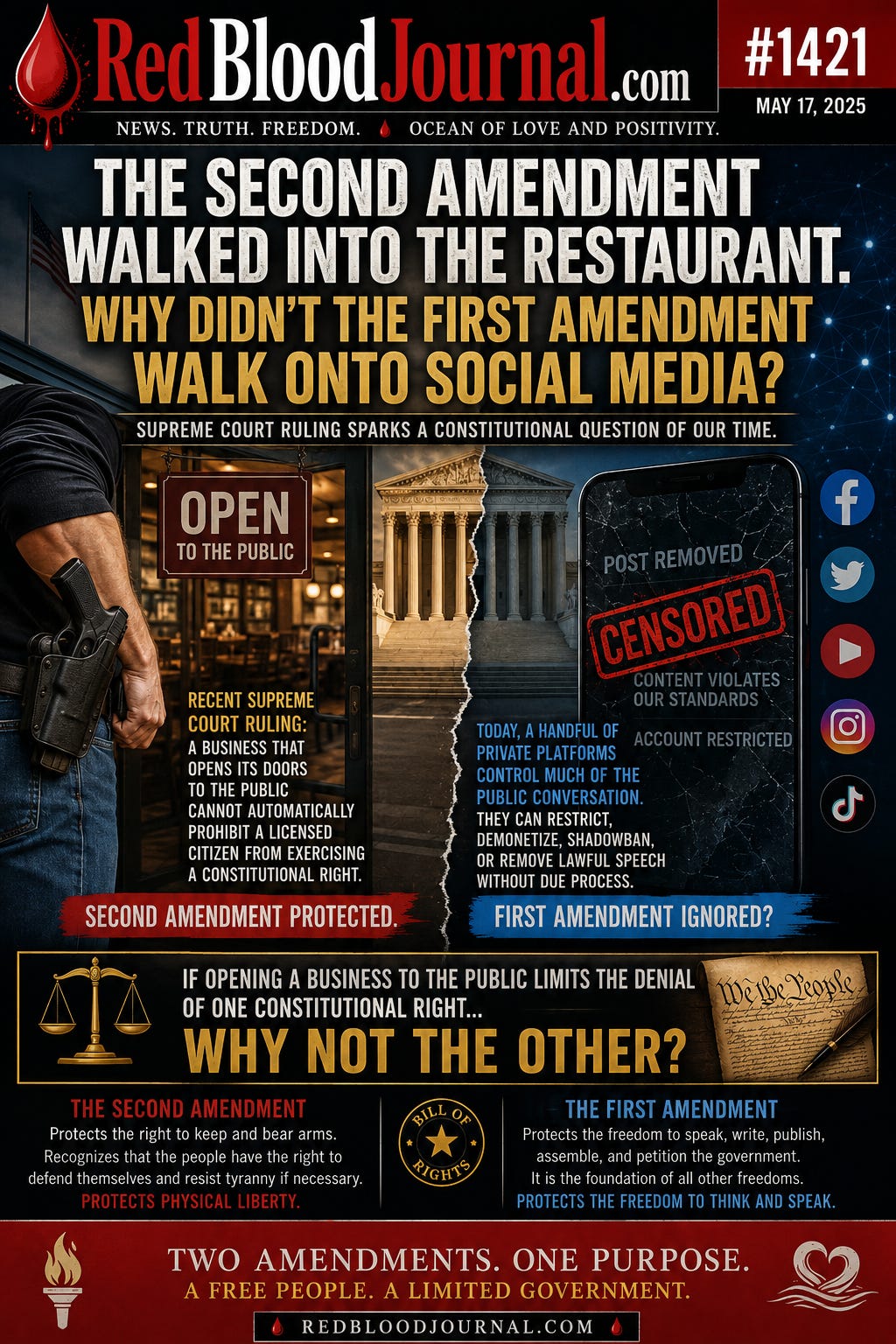
The Second Amendment Walked Into the Restaurant.
Why Didn’t the First Amendment Walk Onto Social Media?
A recent Supreme Court ruling has reinforced an important constitutional principle.
According to the reasoning discussed in the recent concealed-carry case, a business that voluntarily opens its doors to the public cannot automatically prohibit a licensed citizen from exercising a constitutional right simply because the owner disagrees with it.
The Court’s reasoning recognizes that once a business serves the general public, constitutional protections become part of the legal discussion.
That raises a much larger question.
If this reasoning applies to the Second Amendment, why doesn’t the same constitutional reasoning automatically apply to the First?
The First Amendment appears first in the Constitution.
It protects freedom of speech.
Freedom of the press.
Freedom of religion.
Freedom of peaceful assembly.
The right to petition the government.
The Second Amendment appears immediately afterward.
It protects the right of the people to keep and bear arms.
Both are part of the same Bill of Rights.
Neither amendment says:
“This right applies only when a corporation approves.”
The recent concealed-carry decision recognizes that opening a commercial business to the public changes the legal relationship between owner and customer.
If that principle protects a citizen carrying a lawfully licensed firearm inside a public business...
Why does it not automatically raise the same constitutional question when a handful of private companies control much of the nation’s public conversation?
Today millions of Americans no longer gather in the town square.
They gather online.
Political debate.
News.
Journalism.
Campaigns.
Business.
Education.
Whistleblowers.
Nearly every major public conversation now flows through privately owned digital platforms.
This is where the constitutional debate begins—not where it ends.
Current constitutional doctrine generally treats social media companies as private entities with editorial discretion, while the recent concealed-carry ruling concerns government restrictions on the exercise of the Second Amendment.
Those are different legal doctrines.
But the comparison remains difficult to ignore.
If opening a business to the public affects how one constitutional right is analyzed...
Should it also affect how another constitutional right is analyzed?
Perhaps that is the constitutional question of our generation.
Not whether the First Amendment exists.
Everyone agrees it does.
The question is whether freedom of speech can remain meaningful if the modern public square is controlled by a small number of private platforms that decide what lawful speech may or may not be amplified, restricted, or removed.
This report does not answer that question.
It simply asks whether the same constitutional reasoning that protects one amendment deserves to be examined when considering another.
If the Second Amendment receives renewed constitutional protection inside businesses open to the public, many Americans will naturally ask whether the First Amendment deserves the same level of constitutional examination inside the digital public square.
Perhaps that conversation has only just begun.
🩸 RedBloodJournal.com 🩸
Ocean of Love and Positivity
Every generation inherits the responsibility to revisit first principles. Constitutional rights are not preserved merely by repeating their words, but by continually asking whether they are being applied with consistency. Honest questions are not a threat to liberty—they are one of its strongest safeguards. A free society grows stronger when it examines its principles with courage, fairness, and a sincere desire to understand.
⚖️ The Second Amendment Logic in the Digital Public Square
Jun 30, 2026
This source examines the legal parallels between Second Amendment rulings and the regulation of free speech on digital platforms.
It highlights a recent Supreme Court decision suggesting that private businesses open to the public may have a limited ability to restrict the constitutional rights of their patrons.
The author questions why this same logic is not consistently applied to social media companies, which currently function as the modern public square.
While existing law treats these platforms as private entities with editorial control, the text argues that the concentration of power among a few tech firms necessitates a reevaluation of First Amendment protections.
Ultimately, the piece calls for a serious constitutional inquiry into whether civil liberties should remain robust even when exercised within privately owned digital spaces.


