


🩸 RedBloodJournal.com 🩸
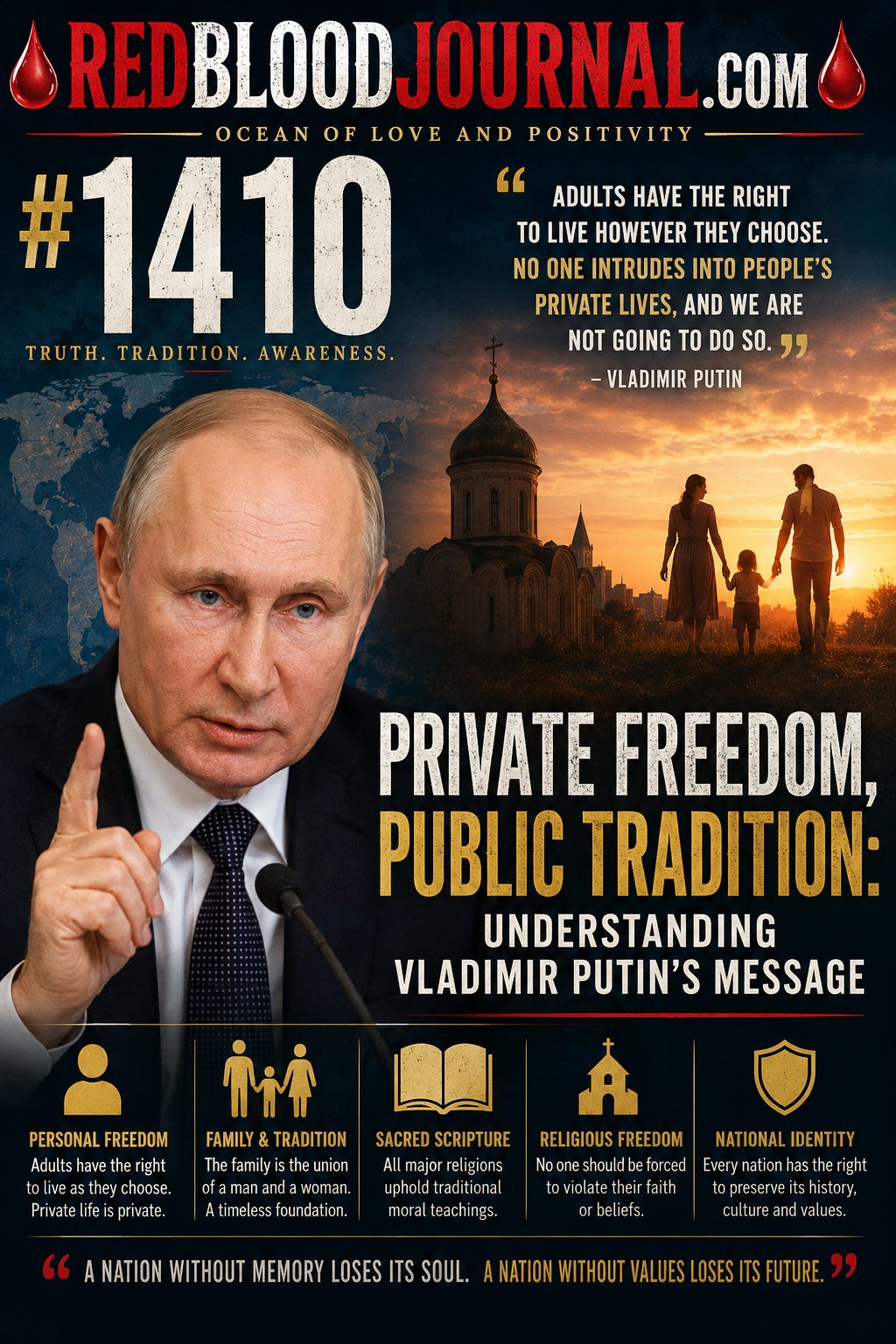
#1410 — Private Freedom, Public Tradition: Understanding Vladimir Putin’s Message
Governments often reveal their priorities not only through military actions or economic policies, but also through the values they choose to defend in public.
In one of his speeches, Russian President Vladimir Putin draws a distinction between private individual freedom and public cultural identity. Rather than arguing that governments should police the private lives of adults, he presents the position that a nation has the right to preserve its own historical, religious, and cultural traditions.
The translated portion of the speech conveys several key ideas.
First, Putin criticizes what he describes as a growing trend in parts of the West where traditional concepts of family, religion, and morality are being replaced by new social norms. He argues that practices he considers morally unacceptable—including the normalization of certain forms of sexual ideology involving children—are increasingly presented as acceptable parts of society.
Second, he claims that members of the clergy are being pressured to bless same-sex marriages, presenting this as an example of religious institutions being expected to conform to changing social expectations.
However, the speech then makes an important distinction that is often overlooked.
Rather than calling for government interference in the private lives of adults, Putin states that adults have the right to live however they choose. He says Russia has no intention of entering people’s private lives and does not seek to do so.
His argument instead shifts toward the preservation of cultural identity. He refers to the sacred texts of the world’s major religions, stating that they traditionally define the family as the union of a man and a woman. The transcript provided ends before he completes this thought, but the direction of the argument is clear: private freedom should not necessarily require religious or cultural institutions to redefine long-standing beliefs.
The Larger Question
Whether one agrees or disagrees with Putin’s position, the speech raises a broader philosophical question that many countries are now debating:
Where does individual liberty end and cultural tradition begin?
Should governments remain neutral between changing social values and historical religious beliefs?
Can a society simultaneously protect personal freedom while preserving institutions built upon centuries of tradition?
Different nations answer these questions differently.
Some prioritize individual autonomy above all else.
Others place greater emphasis on preserving inherited cultural frameworks.
Neither approach is without consequences, and each reflects different assumptions about the role of government, religion, and national identity.
Final Thought
Political speeches often become reduced to headlines or isolated quotations. Reading them in full frequently reveals a more nuanced argument than supporters or critics present.
Understanding what was actually said is not the same as agreeing with it.
It is simply the first step toward informed discussion.
🩸 RedBloodJournal.com 🩸
Ocean of Love and Positivity
The strongest societies are not built by silencing questions but by allowing people to examine ideas calmly, compare perspectives honestly, and seek truth without fear. Whatever conclusions one reaches, let them come through thoughtful reflection rather than anger, remembering that lasting understanding begins with an open mind and a peaceful heart. 🌊✨
🇷🇺 The Sovereignty of Tradition Versus Individual Liberty
Jun 29, 2026
The provided text examines a specific speech by Vladimir Putin regarding the philosophical tension between personal autonomy and national heritage.
According to the source, the Russian leader distinguishes between the private lives of citizens, which he claims should remain free from state interference, and the public preservation of traditional values.
He specifically critiques modern Western social shifts, arguing that religious and cultural institutions should not be forced to abandon historical definitions of family.
The article suggests that this stance highlights a global debate over whether governments should prioritize individual rights or protect long-standing societal norms.
Ultimately, the passage encourages readers to look past sensational headlines to understand the nuanced arguments surrounding cultural sovereignty and identity.
This analysis frames the discourse as a fundamental question of how a society balances modern liberty with its ancestral foundations.


