


🩸 Red Blood Take #1409
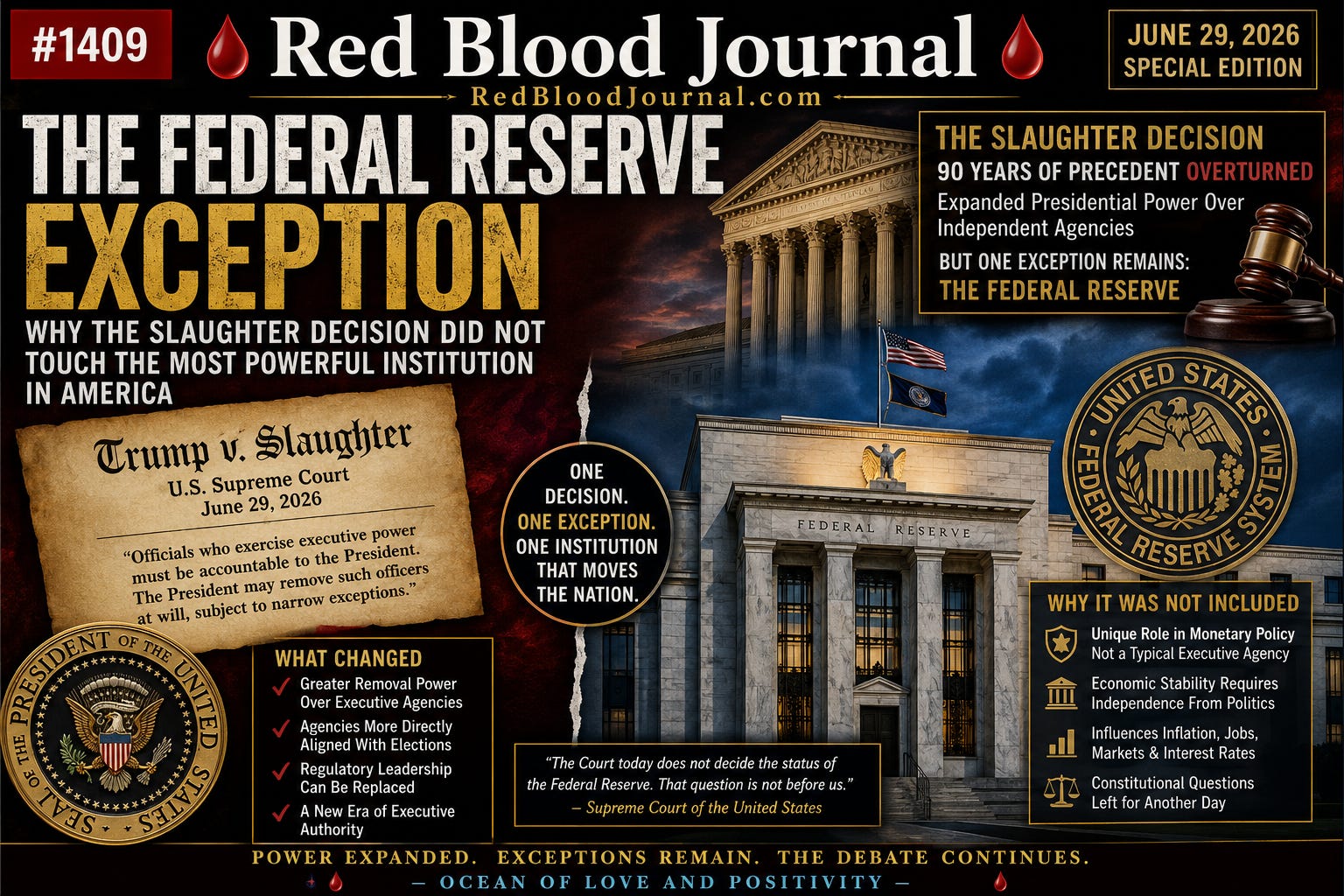
The Federal Reserve Exception — The One Institution the Slaughter Decision Did Not Touch
By Red Blood | RedBloodJournal.com
On June 29, 2026, the United States Supreme Court fundamentally reshaped presidential authority by allowing much broader removal power over officials leading independent executive agencies. Many observers immediately focused on the practical consequences for organizations such as the Federal Trade Commission.
But hidden within the ruling was another story.
The Federal Reserve was deliberately left untouched.
That exception may ultimately become one of the most discussed aspects of the entire decision.
A Constitutional Earthquake—With One Building Still Standing
The Court effectively announced that many agencies exercising executive power ultimately answer to the President.
Yet when discussion turned toward the Federal Reserve, the Court signaled that today’s decision should not automatically be interpreted as applying to the nation’s central bank.
Why?
Because the Federal Reserve occupies an unusual position inside the American constitutional framework.
It is neither fully independent nor fully controlled by the Executive Branch.
It exists in a category almost entirely its own.
Why Is the Federal Reserve Different?
Unlike agencies such as the FTC, whose primary responsibilities involve enforcing federal laws and regulations, the Federal Reserve directs the nation’s monetary policy.
Among its responsibilities are:
Setting benchmark interest rates.
Managing inflation.
Supervising portions of the banking system.
Acting as lender of last resort during financial crises.
Influencing the money supply through open-market operations.
Its decisions affect:
Mortgage rates.
Credit card interest.
Business lending.
Employment.
Inflation.
Financial markets.
Government borrowing costs.
In practical terms, very few institutions influence the daily economic lives of Americans more than the Federal Reserve.
Why Preserve Its Independence?
Supporters of Federal Reserve independence argue that monetary policy should remain insulated from short-term political pressures.
Every elected president naturally prefers:
Lower interest rates.
Faster economic growth.
Strong employment.
Rising financial markets.
Those objectives are politically attractive.
However, economists often argue that central banks sometimes must make unpopular decisions—such as raising interest rates to reduce inflation—even if those actions temporarily slow economic growth.
Their argument is simple:
If every president could remove the Federal Reserve Chair whenever interest rates became politically inconvenient, monetary policy could become an extension of election cycles rather than long-term economic stability.
The Other Perspective
Critics ask a different question.
If virtually every executive agency ultimately answers to an elected President, why should one of the most economically powerful institutions remain insulated from direct democratic accountability?
They argue:
The Federal Reserve makes decisions affecting trillions of dollars, influences employment, borrowing costs, and financial markets, yet its leaders are not directly elected. From this perspective, if constitutional accountability is the principle behind expanding presidential removal power, some question why the nation’s central bank should be treated differently.
This debate has existed for decades and extends far beyond a single court case.
What the Court Appears to Be Saying
The Court did not rule that the Federal Reserve can never be affected by future constitutional challenges.
Instead, it indicated that today’s decision should not automatically be read as deciding that question.
In other words:
The constitutional conversation may not be finished.
It may simply have reached the next chapter.
Looking Beyond the Immediate Headlines
History often reveals that landmark decisions raise almost as many questions as they answer.
The Slaughter decision expanded presidential authority over much of the Executive Branch.
Yet by leaving the Federal Reserve outside today’s ruling, the Court highlighted that one of the most influential institutions in the American government remains governed by a distinct constitutional framework—for now.
Whether that framework remains unchanged or becomes the subject of future legal challenges is a question that only time, future litigation, and future courts can answer.
🩸 RedBloodJournal.com 🩸
Ocean of Love and Positivity
Institutions evolve. Constitutions are interpreted. Court decisions reshape governments. Yet beyond every legal structure remains the responsibility of each individual to seek understanding rather than assumption. Questions asked with patience often illuminate more than conclusions reached in haste. The pursuit of truth begins not with certainty, but with curiosity.
🏦 The Federal Reserve Exception: Constitutional Independence and Judicial Review
Jun 29, 2026
A recent judicial ruling known as the Slaughter decision significantly increased the President’s power to dismiss leaders of various executive agencies, yet it notably excluded the Federal Reserve from this change.
While most independent organizations are now more directly accountable to the Executive Branch, the Supreme Court maintained the central bank’s autonomy due to its unique role in managing monetary policy and interest rates.
This legal distinction protects the institution from short-term political pressure, ensuring that economic stability is prioritized over election cycles.
However, critics argue that such independence lacks democratic accountability, especially given the Federal Reserve’s massive influence over the national economy.
Ultimately, the Court’s refusal to apply the new removal standards to the bank suggests that its constitutional status remains a complex and unresolved issue.
This ongoing debate highlights the tension between presidential authority and the specialized needs of the American financial system.


