


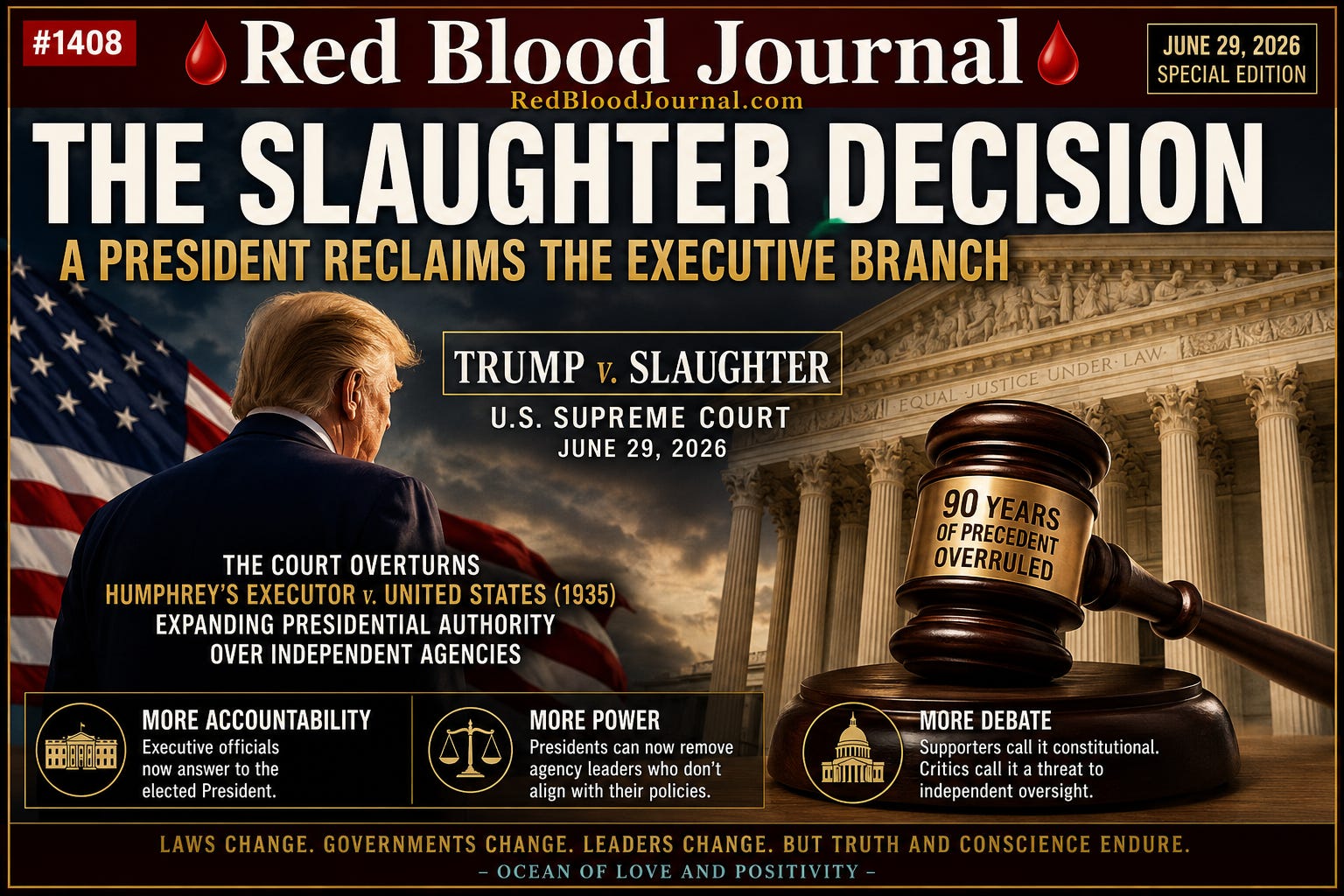
🩸 Red Blood Take #1408
The Slaughter Decision: A President Reclaims the Executive Branch
By Red Blood | RedBloodJournal.com
On June 29, 2026, the United States Supreme Court issued one of the most consequential constitutional rulings in nearly a century. In Trump v. Slaughter, the Court overturned the 1935 precedent established in Humphrey’s Executor v. United States, fundamentally redefining the relationship between the President and independent federal agencies. (Reuters)
For approximately ninety years, Congress had been able to create independent agencies whose leaders could not be removed by the President simply because of policy disagreements. Commissioners at agencies such as the Federal Trade Commission (FTC) enjoyed statutory protection from dismissal except for specific causes such as misconduct or neglect of duty.
The Supreme Court has now ruled otherwise.
A Constitutional Turning Point
The Court held that officials exercising executive authority ultimately answer to the President. As a result, presidents now possess substantially broader authority to remove leaders of many independent executive agencies. The ruling arose from President Donald Trump’s dismissal of FTC Commissioner Rebecca Slaughter, whose challenge became the vehicle for revisiting the long-standing precedent. (Reuters)
President Trump immediately celebrated the decision, writing:
“90 years of precedent has been COMPLETELY AND UNEQUIVOCALLY OVERRULED, greatly increasing Presidential Power...”
From his perspective, the decision restores constitutional accountability by ensuring that executive officials answer to the elected head of the Executive Branch.
Two Very Different Interpretations
Supporters view the decision as restoring the Constitution’s original structure.
Their reasoning is straightforward:
The President is elected by the people.
Executive agencies carry out executive functions.
Therefore, executive officers should ultimately answer to the elected President rather than operate independently for years after an election.
Critics reach the opposite conclusion.
They argue that independent agencies were intentionally designed to be insulated from political influence so that enforcement of antitrust laws, consumer protection, labor law, and other regulatory functions would remain stable regardless of which political party controls the White House. They warn that concentrating greater removal power in the presidency weakens an important institutional check on executive authority. (The Guardian)
What Does This Mean?
Whether viewed as a restoration of constitutional design or an expansion of executive power, the practical effect is significant.
Future presidents will have greater authority to reshape regulatory agencies by replacing leadership that does not align with their policy objectives. That could make federal agencies more directly responsive to presidential elections—but also potentially more political from one administration to the next.
The Court also signaled that the ruling does not automatically extend to the Federal Reserve, recognizing its unique constitutional and historical role. (Reuters)
Looking Beyond the Headlines
History often records certain court decisions as turning points. In time, Trump v. Slaughter may join that list.
Whether history judges this decision as a correction of constitutional doctrine or as a concentration of executive authority will depend not only on today’s legal arguments but on how future presidents choose to exercise the powers that have now been affirmed.
As with many landmark rulings, the long-term consequences will likely become clear only years after the headlines have faded.
🩸 RedBloodJournal.com 🩸
Ocean of Love and Positivity:
Regardless of political preference, constitutional debates remind us that institutions evolve while people remain responsible for how power is exercised. Laws may change, governments may change, and leaders may change, but the greatest safeguard of a free society is an informed population capable of examining events calmly, asking thoughtful questions, and treating one another with dignity.
⚖️ The Slaughter Decision:
Consolidation of Executive Agency Power
Jun 29, 2026
The provided text describes a landmark Supreme Court ruling in Trump v. Slaughter that significantly expanded presidential authority over the federal bureaucracy.
By overturning the nearly century-old precedent of Humphrey’s Executor, the Court granted the President the power to dismiss leaders of independent agencies due to policy disagreements.
Proponents of the decision argue it restores constitutional accountability by ensuring executive officials answer to the elected head of state.
Conversely, critics express concern that this change erodes the independence of regulatory bodies and subjects them to increased political volatility.
While the ruling reshapes the oversight of organizations like the FTC, it notably excludes the Federal Reserve from this immediate shift in removal power.
Ultimately, the source highlights a fundamental transformation in the balance of power between the executive branch and independent government institutions.


