


🩸 RedBloodJournal.com 🩸
#1405 — The Hidden Rift: The Rumor That Raised Questions About Power Inside Iran
By Red Blood | Investigative Report
Introduction
Political history is often remembered through public speeches, official appointments, and constitutional titles.
Yet those who study governments closely know that another history exists—one that unfolds behind closed doors.
Many of the most consequential political rivalries never appear in official communiqués. They survive instead through memoirs, insider accounts, and rumors that continue to circulate long after the events themselves.
Whether such stories ultimately prove true, partly true, or false, they often reveal how observers believe power operates behind the visible institutions.
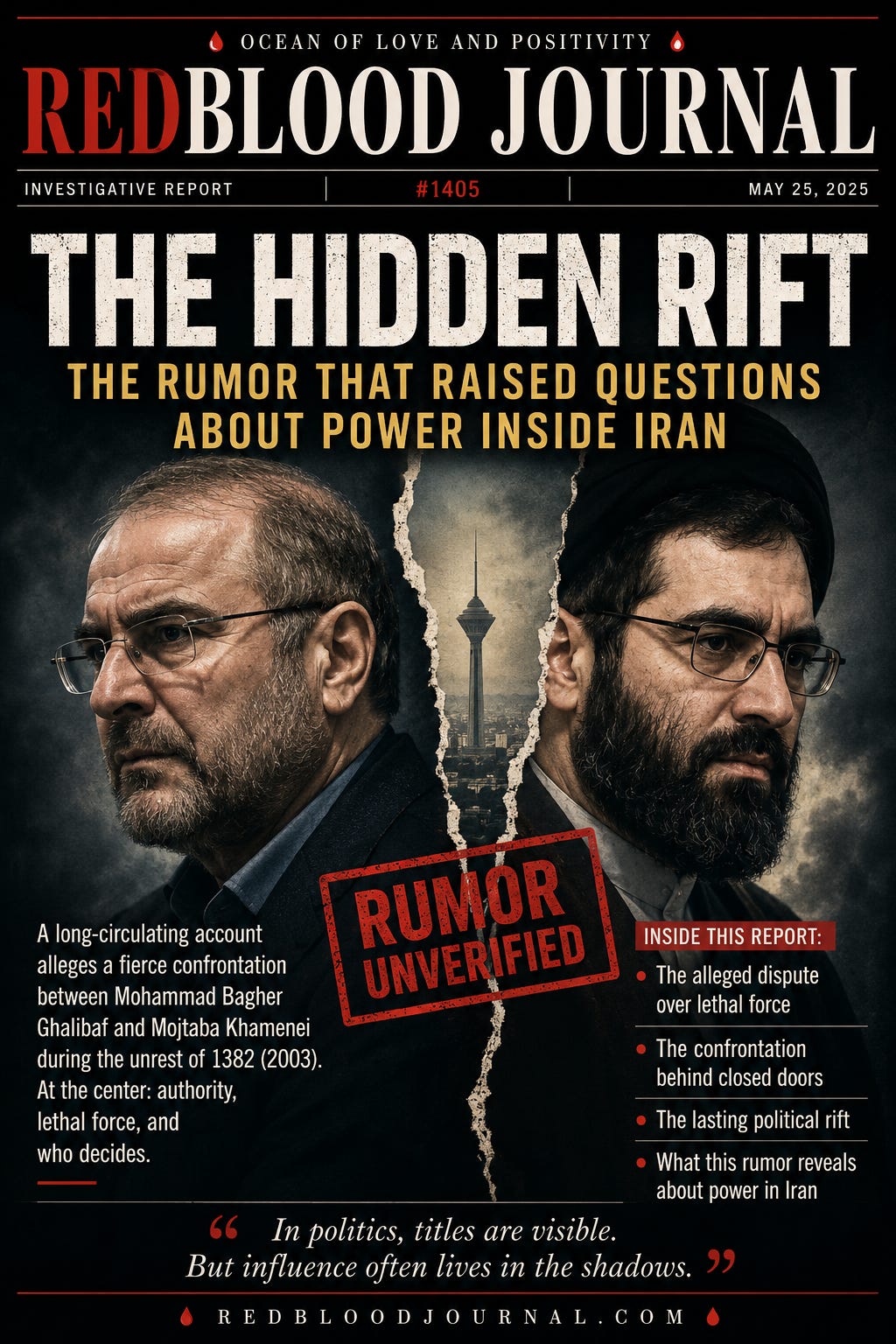
One such long-circulating rumor concerns an alleged confrontation involving senior figures in Iran during the unrest of 1382 (2003).
The Rumor
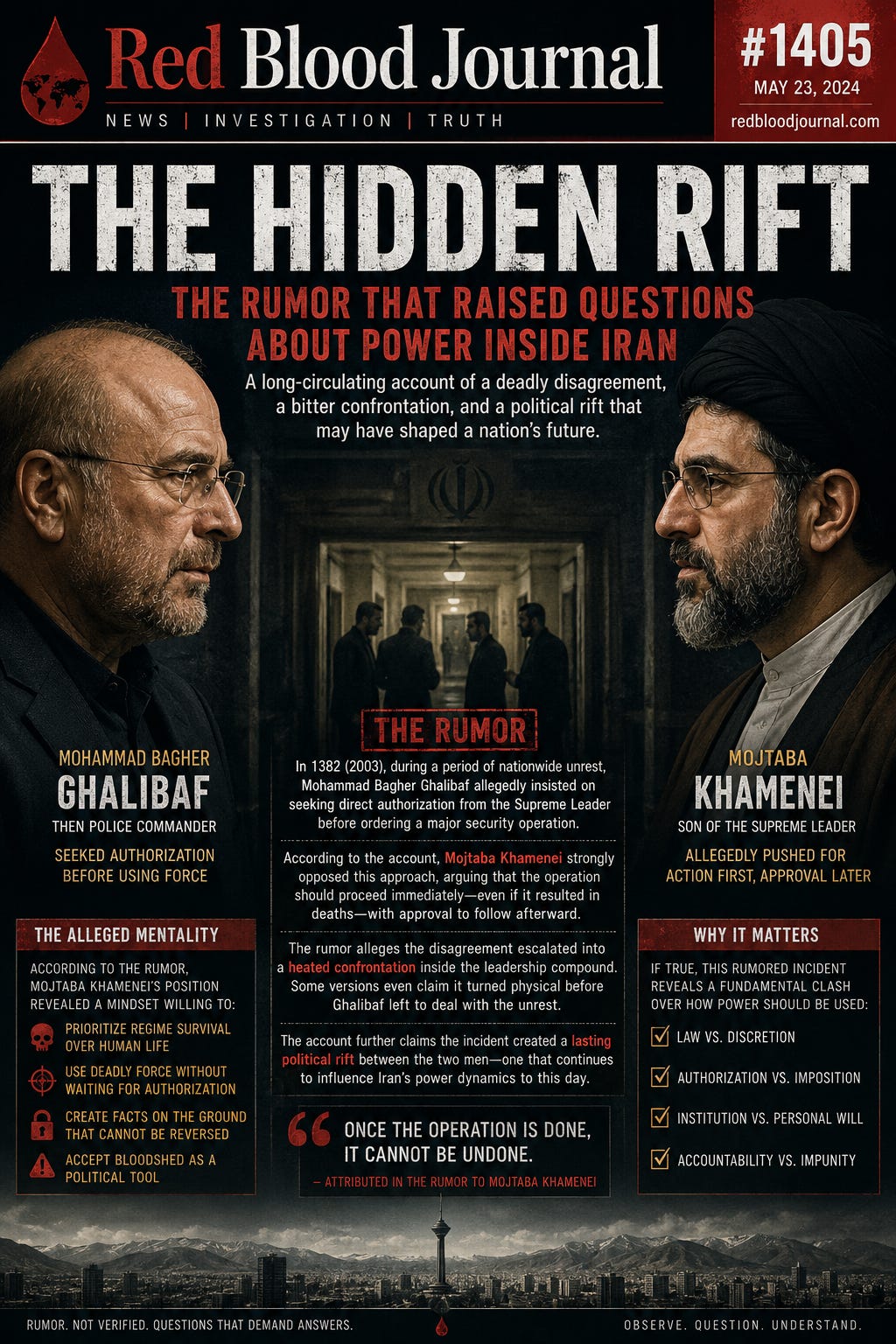
According to the account, then-police commander Mohammad Bagher Ghalibaf sought direct authorization from the Supreme Leader before ordering a large-scale security operation.
The rumor alleges that others present urged him not to wait.
According to the story, Mojtaba Khamenei argued that the operation should proceed immediately and that the Supreme Leader could be informed afterward. The reasoning attributed to him in the rumor was that once the operation had already been carried out, it would be difficult or impossible to reverse.
The account further alleges that the disagreement centered on whether potentially lethal force could be used without first obtaining explicit authorization. According to the rumor, Ghalibaf insisted that such a decision required direct approval from the Supreme Leader, while Mojtaba Khamenei argued that operational necessity came first and formal approval could follow later.
The story claims the disagreement escalated into a heated confrontation inside the leadership compound. Some versions of the rumor even allege that the exchange became physical before Ghalibaf eventually left to deal with the unrest.
Red Blood Journal has not independently verified these allegations.
The Alleged Political Consequences
The rumor does not end with the confrontation itself.
According to those who repeat the story, the disagreement created a lasting personal and political rift between Ghalibaf and Mojtaba Khamenei.
The account alleges that in the years that followed, Ghalibaf found himself increasingly marginalized within certain leadership circles and feared that the confrontation could have long-term consequences for his political future if Mojtaba Khamenei’s influence continued to grow.
Whether those claims are accurate remains unverified. However, they have continued to circulate because they offer one possible explanation for later political dynamics that some observers believe they have seen.
Why This Rumor Continues to Circulate
The significance of the rumor is not simply the alleged argument.
Its significance lies in the question it raises.
If such a disagreement occurred, it would suggest two different approaches to authority.
One approach insists that decisions involving the use of force require explicit authorization from the highest constitutional authority before action is taken.
The other, according to the rumor, places priority on immediate operational action, with political approval addressed afterward.
Whether or not this account is accurate, it reflects a broader discussion about how authority and influence may function inside highly centralized political systems.
Looking Beyond the Individuals
Political systems often contain both formal institutions and informal networks of influence.
Official titles describe how authority is intended to operate.
Personal relationships, trusted advisers, family connections, and long-standing rivalries may influence how decisions are made in practice.
This distinction is not unique to Iran. Similar questions have arisen throughout history in monarchies, republics, military governments, corporations, and other organizations where formal authority and informal influence coexist.
The Observer’s Responsibility
Rumors should neither be accepted as fact nor dismissed without thought.
They are part of the historical record of political discourse, but they are not the same as verified evidence.
Responsible observation requires distinguishing between what is documented, what is alleged, and what remains unknown.
Sometimes rumors disappear when evidence contradicts them.
Sometimes they gain credibility as additional information emerges.
Often they remain unresolved.
The role of an observer is not to replace evidence with certainty, but to continue asking informed questions.
Conclusion
Whether this particular rumor proves accurate or not, it highlights an enduring reality of politics.
Public institutions are visible.
Personal relationships are often not.
History records official decisions.
Only later do historians attempt to understand the conversations, rivalries, and private judgments that may have influenced them.
For that reason, understanding politics requires looking not only at the offices people hold, but also at the relationships that surround those offices.
🩸 RedBloodJournal.com 🩸
Ocean of Love and Positivity
The search for truth is strongest when it is guided by patience rather than certainty. A calm mind can examine claims, weigh evidence, and remain open to new information without surrendering to fear or hostility. In the Ocean of Love and Positivity, wisdom begins with honest questions and grows through disciplined observation.
📜 Shadow Politics:
The Ghalibaf-Khamenei Rift of 2003
Jun 29, 2026
The provided source examines a persistent unverified rumor regarding a high-level political confrontation in Iran during the 2003 civil unrest.
It describes an alleged dispute between police commander Mohammad Bagher Ghalibaf and Mojtaba Khamenei over the necessity of obtaining official authorization before using force against protesters.
While Ghalibaf supposedly insisted on direct approval from the Supreme Leader, the account claims the younger Khamenei favored immediate operational action to create an irreversible reality.
This narrative is used to illustrate the broader tension between formal institutional authority and the informal networks of influence that often operate behind closed doors.
Ultimately, the text argues that such stories, whether factually accurate or not, provide insight into how observers perceive power dynamics and long-standing rivalries within centralized governments.


