


🩸 RedBloodJournal.com 🩸
Report #1399
Date: June 28, 2026
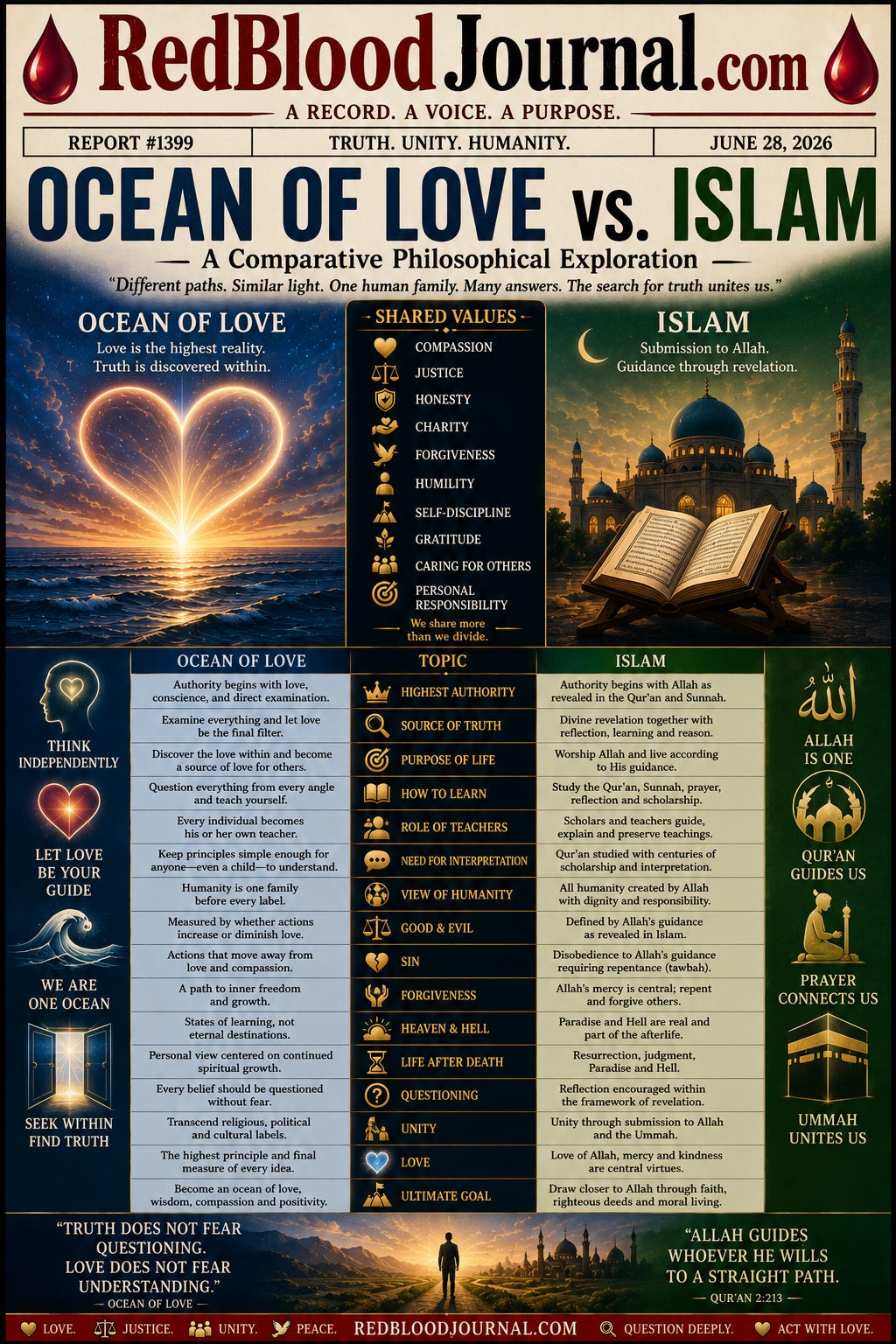
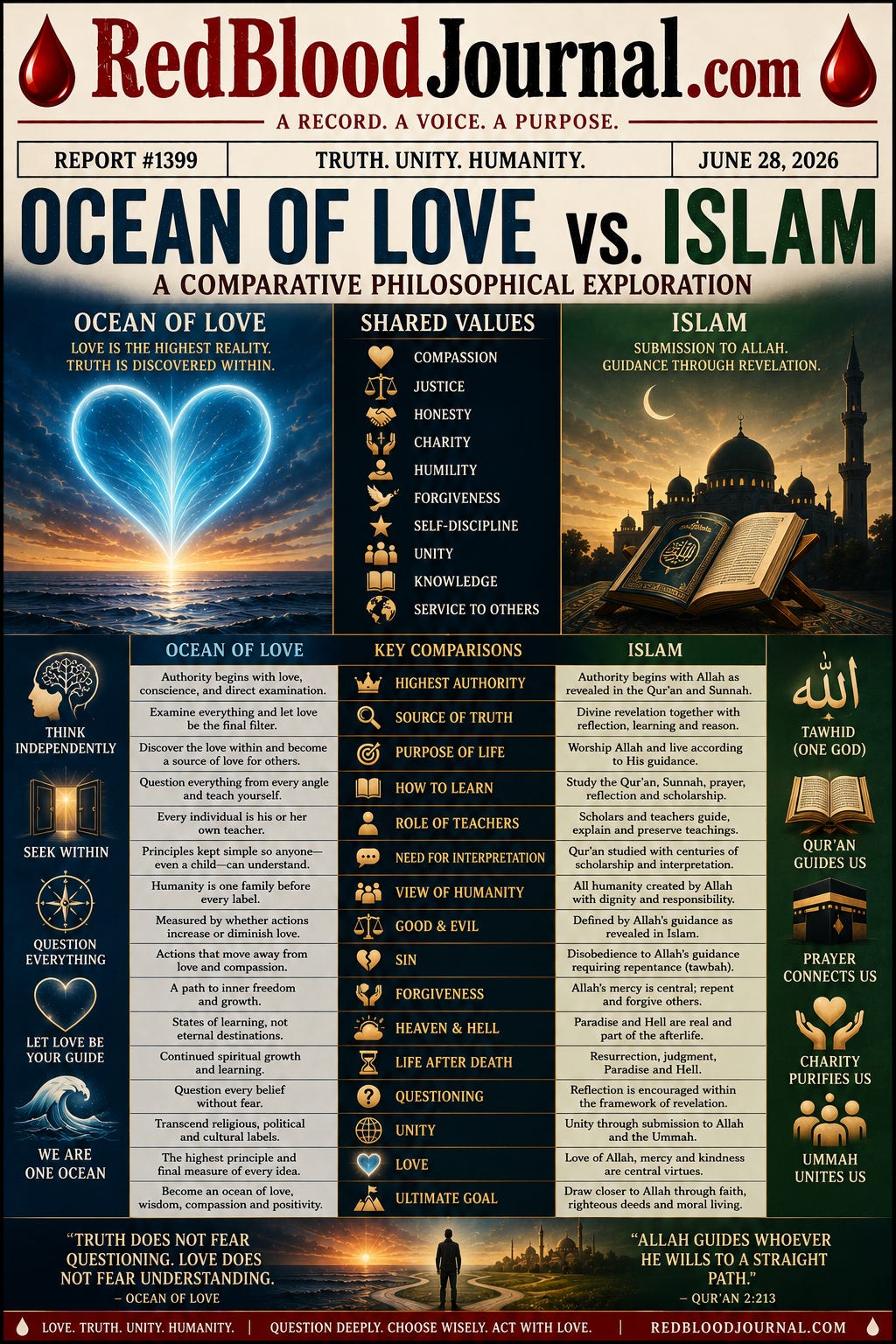
The Ocean of Love and Islam
A Comparative Philosophical Exploration
Introduction
Throughout history, humanity has sought answers to the same enduring questions:
Who created us?
Why are we here?
How should we live?
How do we distinguish truth from falsehood?
Islam and the Ocean of Love both encourage human beings to pursue moral character, compassion, and personal responsibility. However, they begin from different foundations and arrive at some different philosophical conclusions.
This comparison explores where the two approaches converge and where they diverge.
The Foundation
Ocean of Love
The Ocean of Love begins with one universal principle:
Love is the highest reality.
Every belief, tradition, philosophy, and experience should be examined through love, compassion, wisdom, honesty, forgiveness, gratitude, and unity.
Every individual is encouraged to become both student and teacher through continuous self-examination.
Islam
Islam begins with belief in one God (Allah).
Its foundation is the Qur’an, understood by Muslims as God’s revelation, together with the example (Sunnah) of the Prophet Muhammad.
Faith, worship, moral conduct, justice, mercy, and submission to God form the foundation of Islamic life.
Shared Principles
Despite their different foundations, both encourage many common values.
Compassion
Charity
Honesty
Justice
Forgiveness
Humility
Self-discipline
Caring for others
Gratitude
Personal responsibility
Both teach that human beings are accountable for how they treat others.
Where They Differ
1. Source of Authority
Ocean of Love
Authority begins with direct examination.
Every idea is questioned.
Every conclusion is tested.
Love becomes the final filter.
Islam
Authority begins with divine revelation.
The Qur’an and the Sunnah provide guidance for belief, worship, ethics, and daily life.
Islamic scholarship helps interpret and apply these teachings.
2. Discovering Truth
Ocean of Love
Truth is discovered through questioning every idea from every angle while asking:
Does this increase love, compassion, honesty, wisdom, forgiveness, and unity?
The individual is encouraged to think independently while remaining open to continual learning.
Islam
Truth is sought through revelation, reflection, learning, and reason working together.
The Qur’an repeatedly encourages believers to reflect upon creation, history, and themselves while remaining faithful to divine guidance.
3. Heaven and Hell
One of the clearest philosophical differences concerns the afterlife.
Ocean of Love
The Ocean of Love views existence primarily as a great school.
Mistakes become lessons.
Growth becomes the purpose.
It views heaven and hell primarily as states of learning rather than eternal destinations.
Islam
Islam teaches that earthly life is a test followed by resurrection, judgment, Paradise, and Hell.
The Qur’an describes both reward and accountability as part of God’s justice and mercy.
4. The Role of Teachers
Ocean of Love
Every person ultimately becomes his or her own teacher.
Learning never ends.
Truth remains open to continual examination.
Islam
Teachers, scholars, and jurists have historically helped preserve and explain Islamic teachings.
Individual study is encouraged, while scholarship provides guidance in understanding the Qur’an and Sunnah.
5. Humanity
Ocean of Love
Humanity is one family before every label.
Religion.
Nationality.
Politics.
Race.
Culture.
All become secondary to our shared humanity.
Islam
Islam teaches that all human beings are created by God and possess inherent dignity.
The Qur’an describes humanity as being created into different peoples and tribes so that they may know one another while recognizing moral accountability before God.
The Ocean of Love’s Distinctive Perspective
The Ocean of Love proposes that every belief should ultimately be examined through one universal question:
Does this increase love?
Does it produce compassion?
Does it reduce unnecessary suffering?
Does it unite rather than divide?
Its goal is to simplify the search for wisdom so that every individual can begin the journey without depending entirely upon institutional interpretation.
Conclusion
The Ocean of Love and Islam both seek to cultivate moral character, compassion, honesty, and responsibility.
They differ primarily in where they locate ultimate authority.
Islam begins with divine revelation preserved in the Qur’an and the example of the Prophet Muhammad.
The Ocean of Love begins with universal love and encourages every person to examine all ideas independently through the lens of compassion, wisdom, and unity.
Whether one follows a religious tradition or a philosophical framework, the enduring challenge remains the same:
To seek truth sincerely, to act with integrity, and to become a source of compassion in the lives of others.
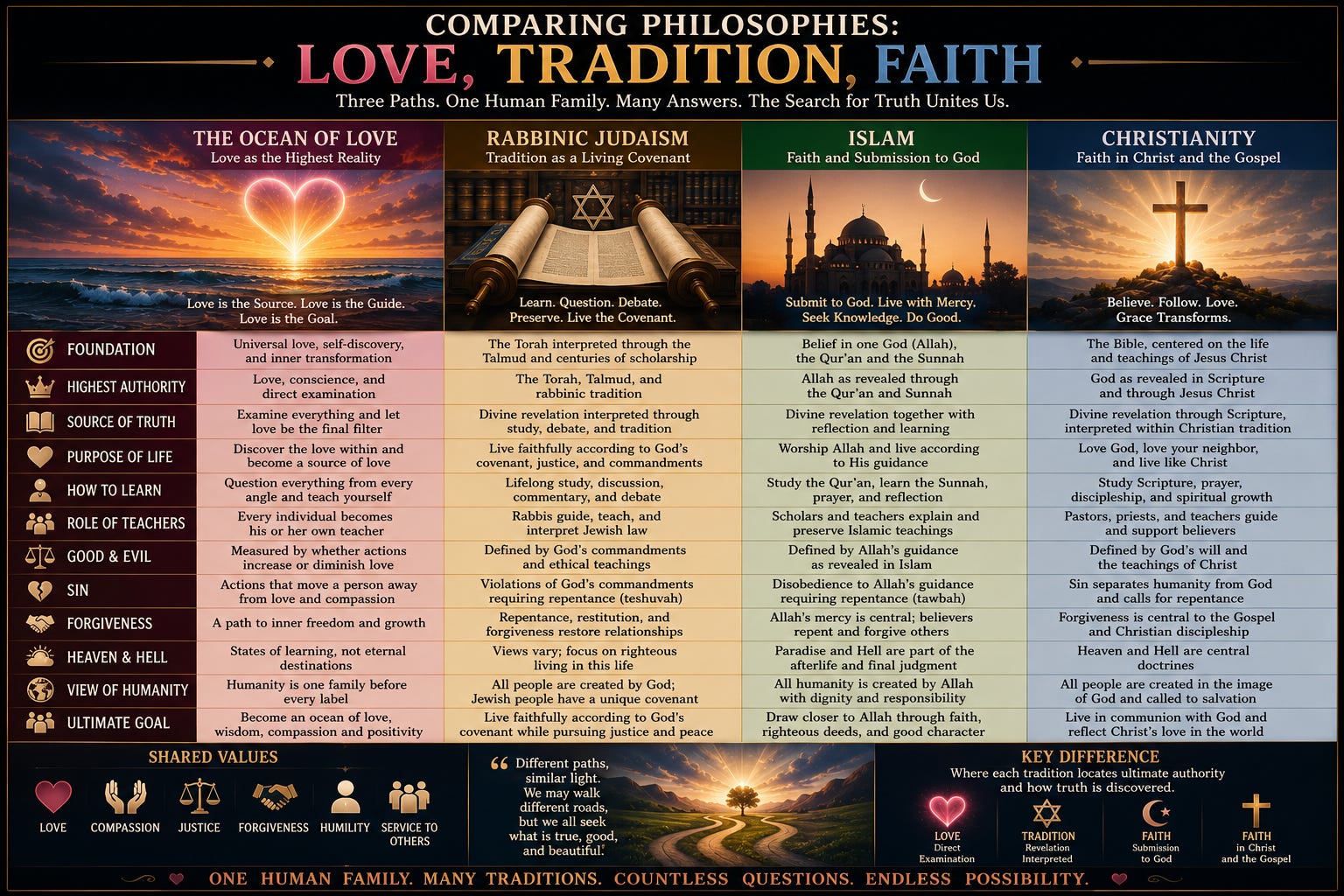
Comparative Overview
🩸 RedBloodJournal.com 🩸
📖 The Ocean of Love and Islam:
A Philosophical Comparison
Jun 28, 2026
This report provides a philosophical comparison between the Ocean of Love and Islam, highlighting their common commitment to virtues like compassion and honesty.
While both systems aim to cultivate moral character, they rely on fundamentally different sources of authority.
Islam is rooted in divine revelation through the Qur’an and the Prophet’s example, whereas the Ocean of Love treats universal love and individual examination as the ultimate filters for truth.
Their perspectives diverge on the nature of the afterlife, with one viewing it as an eternal judgment and the other as a continued state of learning.
Ultimately, the text illustrates how these two paths approach the human journey through either structured faith or independent reflection.


