


🩸 RedBloodJournal.com 🩸
Report #1398
Date: June 28, 2026
Three Paths to Truth
The Ocean of Love, Rabbinic Judaism, and Christianity Compared
Introduction
For thousands of years, humanity has searched for answers to the same timeless questions.
Who are we?
Why are we here?
How should we live?
How do we discover truth?
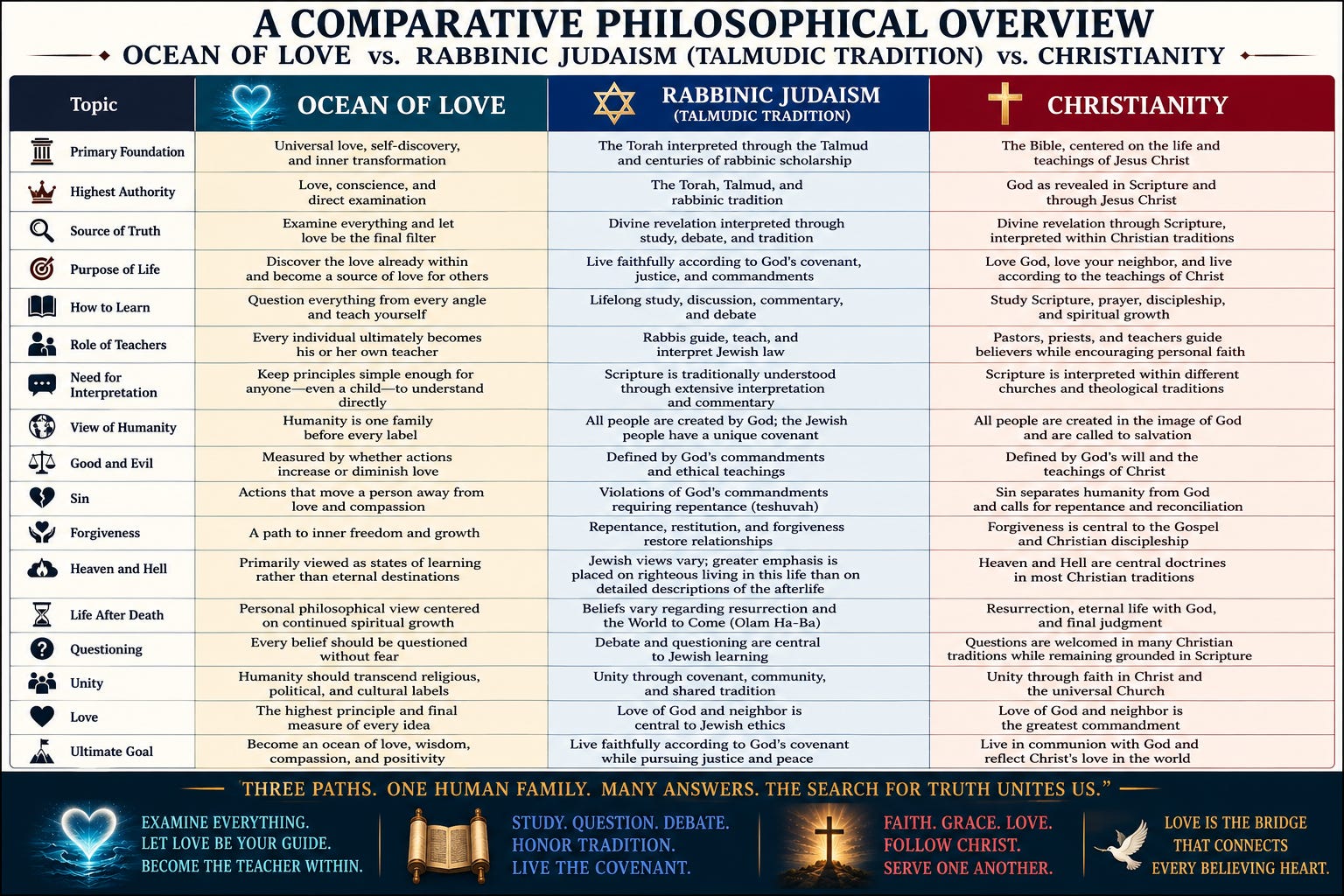
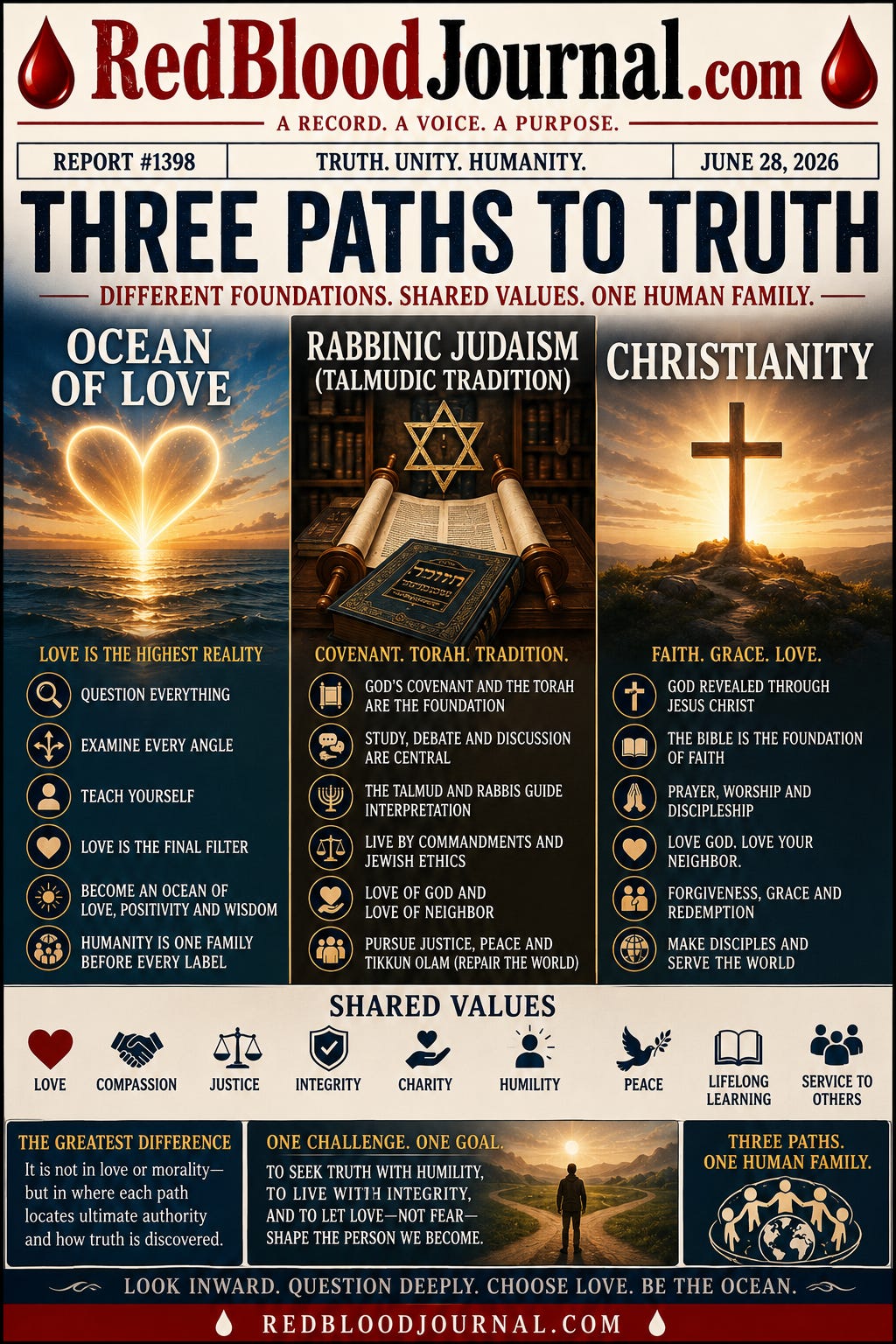
Among the many philosophies and religions that have emerged, three distinct approaches illustrate different ways of answering these questions: the Ocean of Love, Rabbinic Judaism, and Christianity.
Although they share many moral values, they begin from different foundations and follow different paths toward understanding.
The Ocean of Love
The Ocean of Love begins with one principle:
Love is the highest reality.
Every belief, tradition, philosophy, and experience should be examined without fear.
Nothing should be accepted merely because it is ancient.
Nothing should be rejected merely because it is new.
Every idea passes through one simple question:
Does this increase love, compassion, honesty, wisdom, forgiveness, gratitude, and unity?
If the answer is yes, it deserves consideration.
If the answer is no, it deserves further examination.
Truth is considered simple enough that even a child can begin discovering it.
The individual becomes both the student and the teacher.
Rabbinic Judaism
Rabbinic Judaism begins with God’s covenant with the Jewish people.
Its foundation is the Torah, interpreted through the Talmud and centuries of rabbinic scholarship.
Study is not passive.
Questioning is encouraged.
Debate is respected.
Generations of rabbis have explored the meaning of Scripture through discussion, legal reasoning, and commentary.
Rather than avoiding difficult questions, the tradition has historically treated thoughtful disagreement as an important part of learning.
Authority rests in divine revelation together with the accumulated wisdom of Jewish tradition.
Christianity
Christianity centers on the life and teachings of Jesus Christ.
Its foundation is the belief that God’s love has been revealed through Christ and preserved in Scripture.
Christians are encouraged to study, pray, worship, and live according to Christ’s example.
Love occupies a central place:
Love God.
Love your neighbor.
Forgive others.
Serve the poor.
Seek peace.
Christianity teaches that reconciliation with God and moral transformation are inseparable.
Where They Meet
Despite their different foundations, all three encourage:
Love
Compassion
Honesty
Justice
Charity
Humility
Forgiveness
Personal responsibility
Lifelong learning
Service to others
These shared values demonstrate that different traditions can arrive at similar ethical aspirations through different paths.
Where They Differ
The greatest differences are not found in compassion or morality.
They are found in where each tradition locates authority.
The Ocean of Love
Authority begins within.
Every idea is personally examined.
Love becomes the final filter.
Rabbinic Judaism
Authority begins with God’s revelation through the Torah and continues through the Talmud and generations of rabbinic interpretation.
Study and discussion are lifelong responsibilities.
Christianity
Authority begins with God as revealed through Scripture and the life of Jesus Christ.
Faith, discipleship, and spiritual growth shape the believer’s understanding.
The Role of Questioning
One of the most interesting similarities is that all three value questions, although they approach them differently.
The Ocean of Love asks people to question everything and allow love to guide every conclusion.
Rabbinic Judaism has built one of history’s richest traditions of debate, preserving discussions that often present multiple viewpoints rather than a single simple answer.
Christianity has also produced centuries of theological reflection, interpretation, and dialogue while grounding itself in the teachings of Christ.
Each sees questioning as valuable, though each understands its purpose differently.
The Ocean of Love’s Distinctive Perspective
The Ocean of Love differs most clearly in two ways.
First, it views love as the highest principle through which every belief should be examined.
Second, it seeks to simplify spiritual discovery so that no person feels dependent upon another individual to begin searching for truth.
Its central question remains remarkably simple:
Does this make me a more loving human being?
If it does, continue.
If it does not, continue searching.
Conclusion
The Ocean of Love, Rabbinic Judaism, and Christianity represent three distinct approaches to humanity’s oldest questions.
One begins with universal love.
One begins with covenant and centuries of interpretation.
One begins with Christ and the Gospel.
Each invites human beings to pursue moral character, compassion, and a meaningful life.
Whether one follows a religious tradition, a philosophical framework, or another path entirely, the enduring challenge remains the same:
To seek truth with humility, to live with integrity, and to allow love—not fear—to shape the person we become.
🩸 RedBloodJournal.com 🩸
❤️ Three Paths to Truth: Love, Law, and Faith
Jun 28, 2026
The provided text explores three distinct ideological frameworks—the Ocean of Love, Rabbinic Judaism, and Christianity—to compare how they seek spiritual and ethical truth.
While each path relies on a different foundation of authority, such as personal intuition, ancient law, or the life of Christ, they all converge on shared moral values like compassion and honesty.
The Ocean of Love prioritizes internal sentiment as the ultimate filter for any belief, whereas Rabbinic Judaism emphasizes scholarly debate surrounding divine law and Christianity focuses on reconciliation through Jesus.
All three traditions value the act of questioning, though they apply it toward different theological ends.
Ultimately, the source highlights that despite their unique origins, these paths all encourage individuals to pursue a life of integrity and service to others.
This comparison suggests that while the methods of discovery differ, the goal of fostering a more loving and meaningful human existence remains a universal priority.


