


🩸 RedBloodJournal.com 🩸
Report #1396
Date: June 28, 2026
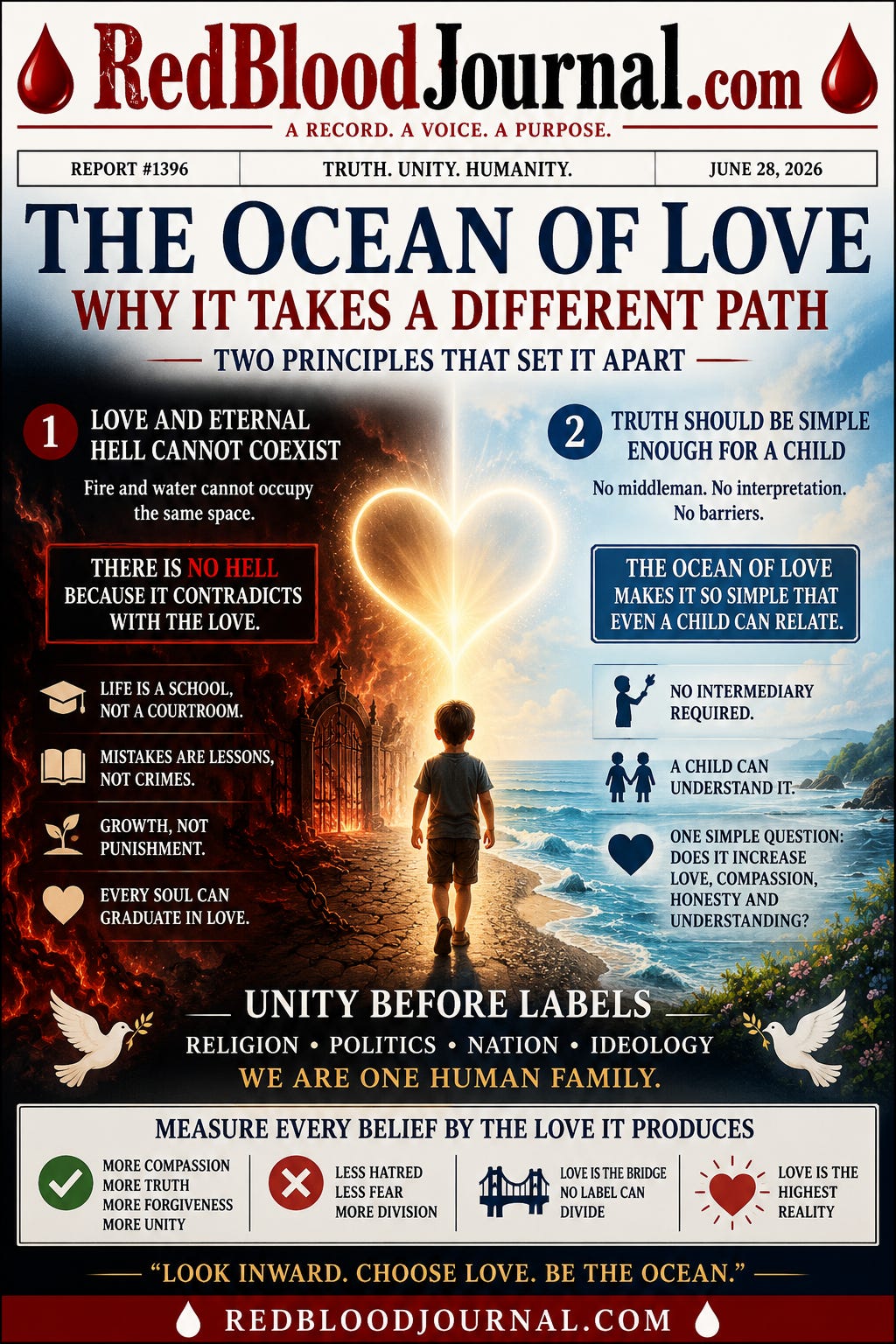
The Ocean of Love: Why It Takes a Different Path
Two Principles That Set It Apart
Introduction
Every philosophy and every religion attempts to answer the same fundamental questions:
Why are we here?
Why do we suffer?
How should we live?
The Ocean of Love begins with the same questions but arrives at two conclusions that distinguish it from many traditional belief systems.
These conclusions are not presented as attacks on religion. Rather, they represent a philosophical framework intended to simplify humanity’s search for meaning.
The First Principle:
Love and Eternal Hell Cannot Coexist
The Ocean of Love begins with a single foundation:
Love is the highest reality.
If love is unconditional, then eternal punishment presents a philosophical contradiction.
Fire and water cannot occupy the same space.
The Ocean of Love therefore views existence as a university rather than a courtroom.
Every person is a student.
Every mistake is a lesson.
Every hardship becomes an opportunity for growth.
Graduation is measured not by fear, but by the degree to which an individual has learned compassion, forgiveness, humility, gratitude, and love.
Punishment exists only insofar as our own actions naturally teach us their consequences. Its purpose is education, not eternal condemnation.
The Second Principle:
Truth Should Be Simple Enough for a Child
History shows that humanity has produced thousands of interpretations of its religious traditions.
Schools became denominations.
Denominations became institutions.
Institutions produced scholars, clergy, commentators, and competing interpretations.
For many people, the search for truth gradually became dependent upon someone else explaining it.
The Ocean of Love proposes a different approach.
Its central question is remarkably simple:
Does this thought, word, or action increase love, compassion, honesty, humility, and understanding?
If it does, move toward it.
If it does not, move away from it.
No intermediary is required to begin asking that question.
A child can understand it.
An elderly person can understand it.
Its simplicity is its strength.
Unity Before Labels
Religious identity.
Political identity.
National identity.
Ideological identity.
These labels often become the starting point from which people define themselves.
The Ocean of Love reverses the order.
It asks the individual to begin with their shared humanity.
Instead of asking,
“What group do I belong to?”
it first asks,
“Am I becoming a more loving human being?”
The goal is not to eliminate religions or philosophies.
The goal is to prevent labels from becoming walls between people.
The Measure of a Philosophy
The Ocean of Love suggests that every worldview can be examined with a simple question:
Does it help human beings become more compassionate, more truthful, more forgiving, and more united?
If it does, it contributes to human flourishing.
If it encourages hatred, fear, or permanent division, then it deserves careful reflection.
Conclusion
The Ocean of Love is not built upon rituals, institutions, or theological complexity.
It is built upon one enduring principle:
Love should unite where fear divides.
Its philosophy proposes that truth should be accessible without requiring an intermediary, and that the deepest spiritual journey begins not with labels or doctrines, but with the transformation of one’s own character.
Whether one agrees with its conclusions or not, its invitation is simple:
Look inward.
Measure every belief by the love it produces.
And allow that love to become the bridge that no label can divide.
🩸 RedBloodJournal.com 🩸
❤️ The Ocean of Love:
A Philosophy of Compassionate Unity
Jun 28, 2026
The provided text outlines the core tenets of a philosophy titled The Ocean of Love, which prioritizes universal compassion over rigid dogma.
This belief system rejects the concept of eternal punishment, viewing life instead as an educational journey where mistakes serve as vital lessons for personal growth.
Central to this worldview is the idea that spiritual truth should be accessible and simple enough for anyone to understand without needing religious intermediaries.
By focusing on whether actions increase honesty and kindness, the philosophy encourages individuals to prioritize their shared humanity over divisive social or political labels.
Ultimately, the text presents a framework where the value of any belief is measured solely by its ability to foster unity and love among people.


