


🩸 RedBloodJournal.com 🩸
Report #1395
Date: June 28, 2026
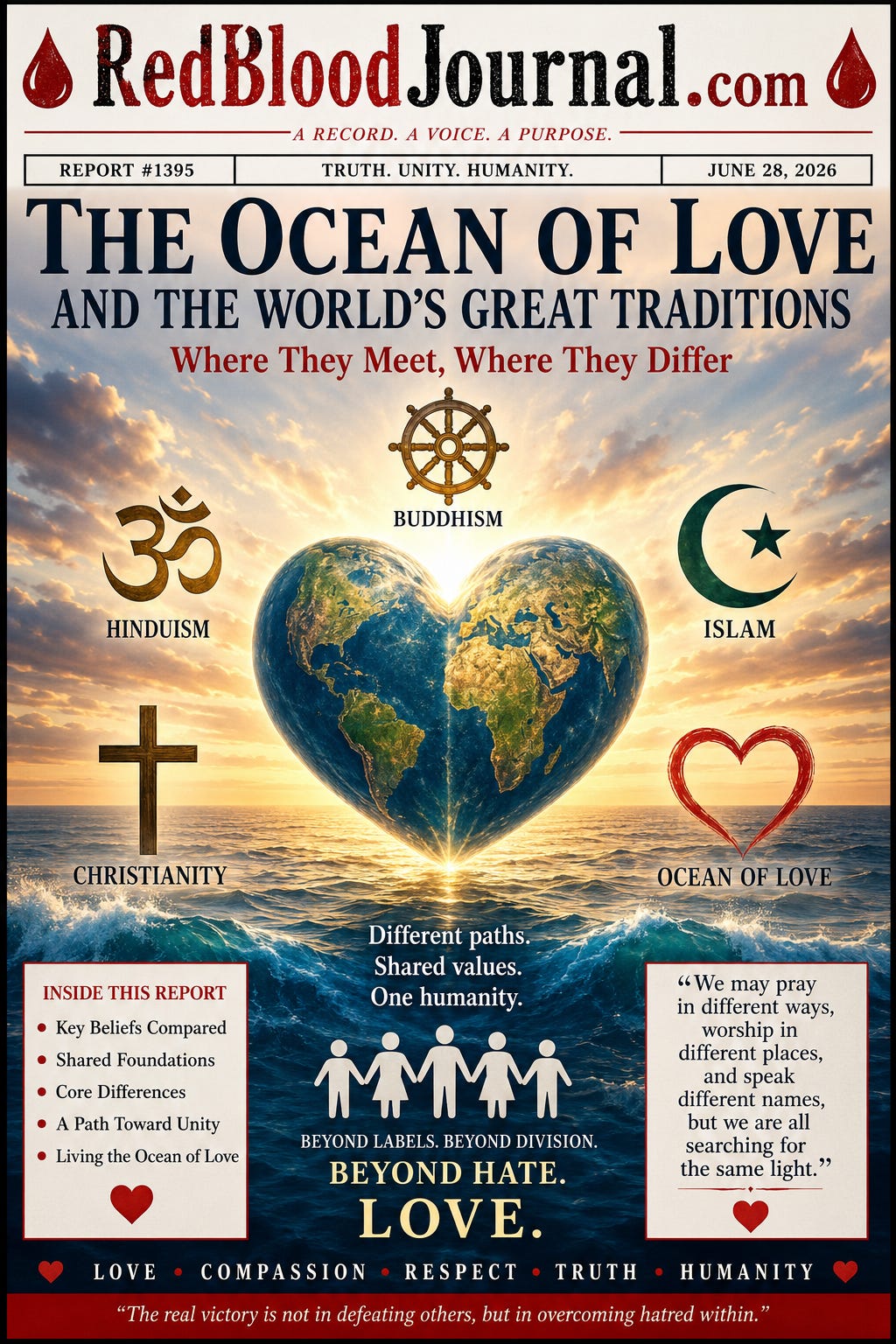
The Ocean of Love and the World’s Great Traditions
Where They Meet, Where They Differ
Introduction
Throughout history, humanity has searched for the same questions:
Why are we here?
Why do we suffer?
What is truth?
How should we live?
Different civilizations produced different answers. Some answers became religions, others became philosophies, and others remained personal journeys.
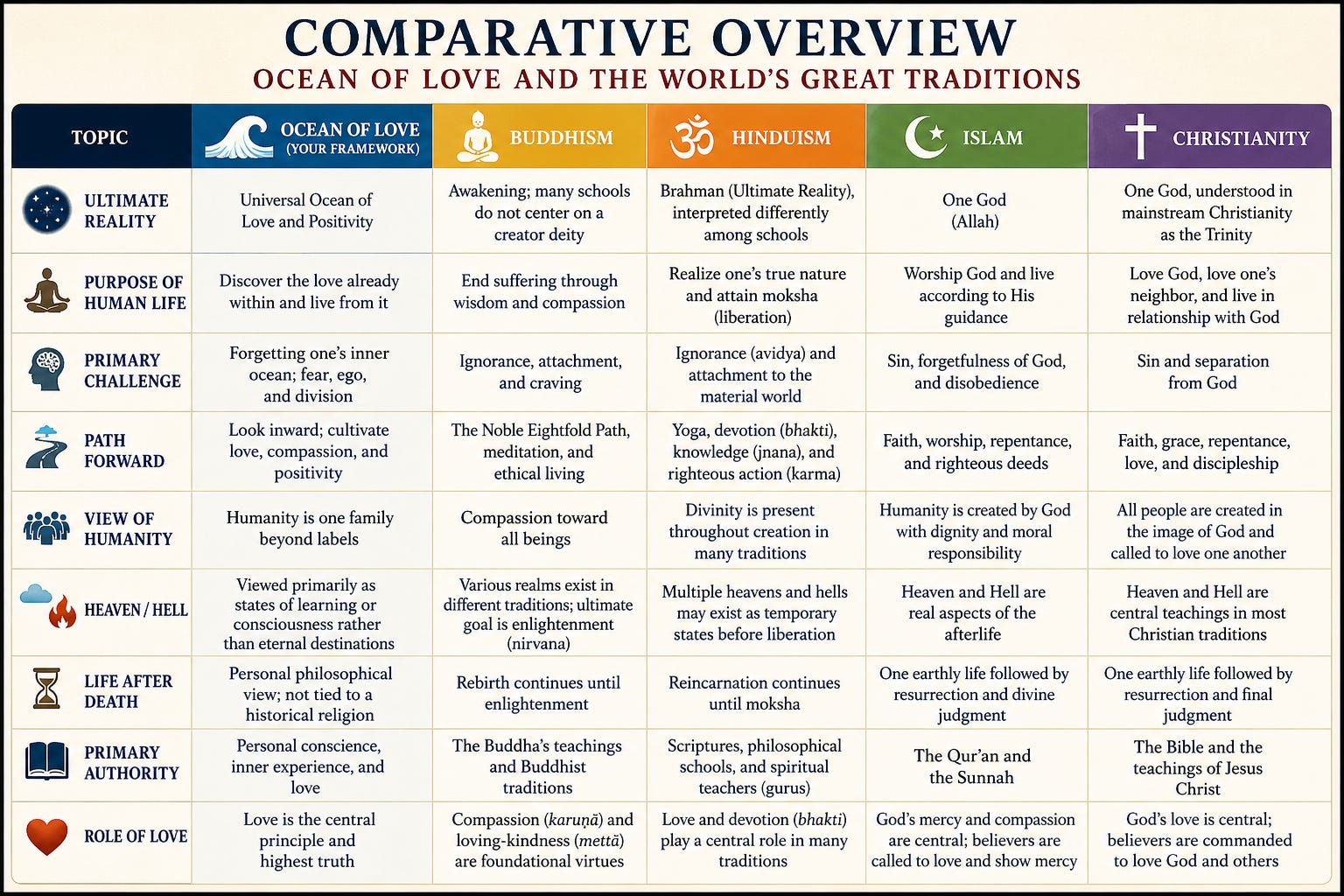
The Ocean of Love is presented not as a replacement for the world’s great traditions, but as a framework through which their common ethical principles can be observed while recognizing where their underlying beliefs differ.
The Ocean of Love
The Ocean of Love begins with a simple premise:
Every human being possesses an inner source of love, compassion, gratitude, forgiveness, and peace.
The purpose of life is not merely to belong to a group, defend an ideology, or win arguments, but to discover and cultivate these qualities from within.
In this framework:
Love is the compass.
Positivity becomes strength rather than weakness.
Fear, hatred, and division are obstacles to be recognized rather than identities to embrace.
Every interaction becomes an opportunity to learn and grow.
Buddhism
Buddhism focuses on understanding suffering.
It teaches that attachment, craving, and ignorance create much of humanity’s suffering. Through mindfulness, ethical conduct, and meditation, individuals seek wisdom and compassion.
The Ocean of Love shares several practical values with Buddhism:
Looking inward.
Developing compassion.
Reducing ego.
Seeking inner peace.
The principal difference is that Buddhism is a historical religious tradition with its own teachings, practices, and philosophical foundations, while the Ocean of Love is presented as a universal philosophical framework rather than an organized religion.
Hinduism
Hinduism contains many schools of thought, but many emphasize discovering one’s deeper spiritual nature beyond the temporary material world.
Its traditions explore devotion, knowledge, meditation, and righteous action.
The Ocean of Love similarly encourages moving beyond purely material identity and cultivating inner transformation.
The difference lies in structure.
Hinduism includes scriptures, rituals, philosophical schools, and a long historical tradition, whereas the Ocean of Love proposes no required rituals, clergy, or formal religious identity.
Islam
Islam teaches belief in one God, moral responsibility, worship, charity, justice, mercy, and accountability.
Compassion and mercy occupy central places throughout Islamic teachings.
The Ocean of Love shares many ethical values:
Kindness
Charity
Mercy
Honesty
Respect for fellow human beings
The primary distinction is authority.
Islam grounds its guidance in divine revelation through the Qur’an and the teachings of the Prophet, while the Ocean of Love encourages individuals to cultivate love and conscience directly without relying on a single revealed scripture as its foundation.
Christianity
Christianity centers on love of God and love of neighbor.
Its teachings emphasize forgiveness, mercy, compassion, humility, sacrifice, and reconciliation.
These themes strongly overlap with the Ocean of Love.
Where they differ is in theology.
Christianity bases salvation and its understanding of God on the life, death, and resurrection of Jesus Christ, while the Ocean of Love focuses on universal inner transformation without depending upon adherence to a specific religious doctrine.
The Shared Foundation
Although their beliefs differ, remarkable similarities emerge.
Every tradition encourages people to become better human beings through qualities such as:
Love
Compassion
Forgiveness
Humility
Charity
Patience
Self-discipline
Service to others
These shared virtues suggest that while humanity often debates different paths, many traditions encourage similar ethical aspirations.
The Difference
The Ocean of Love proposes that labels themselves should never become barriers.
Rather than asking:
“Which religion is correct?”
it first asks:
“Am I becoming a more loving, compassionate, and truthful human being?”
Its focus is inward before outward.
It does not seek to erase religious traditions or replace them, but to encourage individuals to recognize the universal virtues that can be appreciated across different beliefs while respecting genuine theological differences.
Conclusion
Human civilization has produced many spiritual paths.
Some emphasize revelation.
Some emphasize meditation.
Some emphasize devotion.
Some emphasize wisdom.
The Ocean of Love suggests that beneath these differences lies a common invitation: to cultivate love, compassion, honesty, and humility in daily life.
Whether one follows a religion, a philosophy, or another path entirely, the enduring question remains the same:
Does the journey lead us toward greater love, greater understanding, and greater humanity?
Only each individual can answer that through the way they choose to live.
🩸 RedBloodJournal.com 🩸
❤️ The Ocean of Love and the World’s Great Traditions
Jun 28, 2026
The Ocean of Love is a philosophical framework that identifies universal ethical virtues found across major world religions like Buddhism, Hinduism, Islam, and Christianity.
While these traditions differ in their theological foundations, rituals, and historical scriptures, they all share a core commitment to compassion, forgiveness, and inner peace.
This source suggests that instead of focusing on religious labels or dogmatic divisions, individuals should prioritize their own internal transformation into more loving human beings.
It positions love as a central compass for life, emphasizing that the primary goal of any spiritual or personal journey is the cultivation of kindness and honesty.
Ultimately, the text presents a vision where diverse beliefs can coexist by recognizing their common aspirations for humanity and moral growth.
Shared Ethical Foundations
Despite significant theological differences, all of these worldviews encourage many of the same virtues:
Love
Compassion
Forgiveness
Humility
Charity
Patience
Self-discipline
Service to others
Moral responsibility
The Distinctive Perspective of the Ocean of Love
The Ocean of Love is presented as a philosophical framework rather than an organized religion.
It does not seek to replace existing faiths, nor does it require membership in a particular tradition. Instead, it emphasizes discovering the source of love, compassion, gratitude, forgiveness, and inner peace within oneself, while recognizing the common ethical values that appear across many of the world’s spiritual traditions.


