


🩸 RedBloodJournal.com 🩸
Report #1393
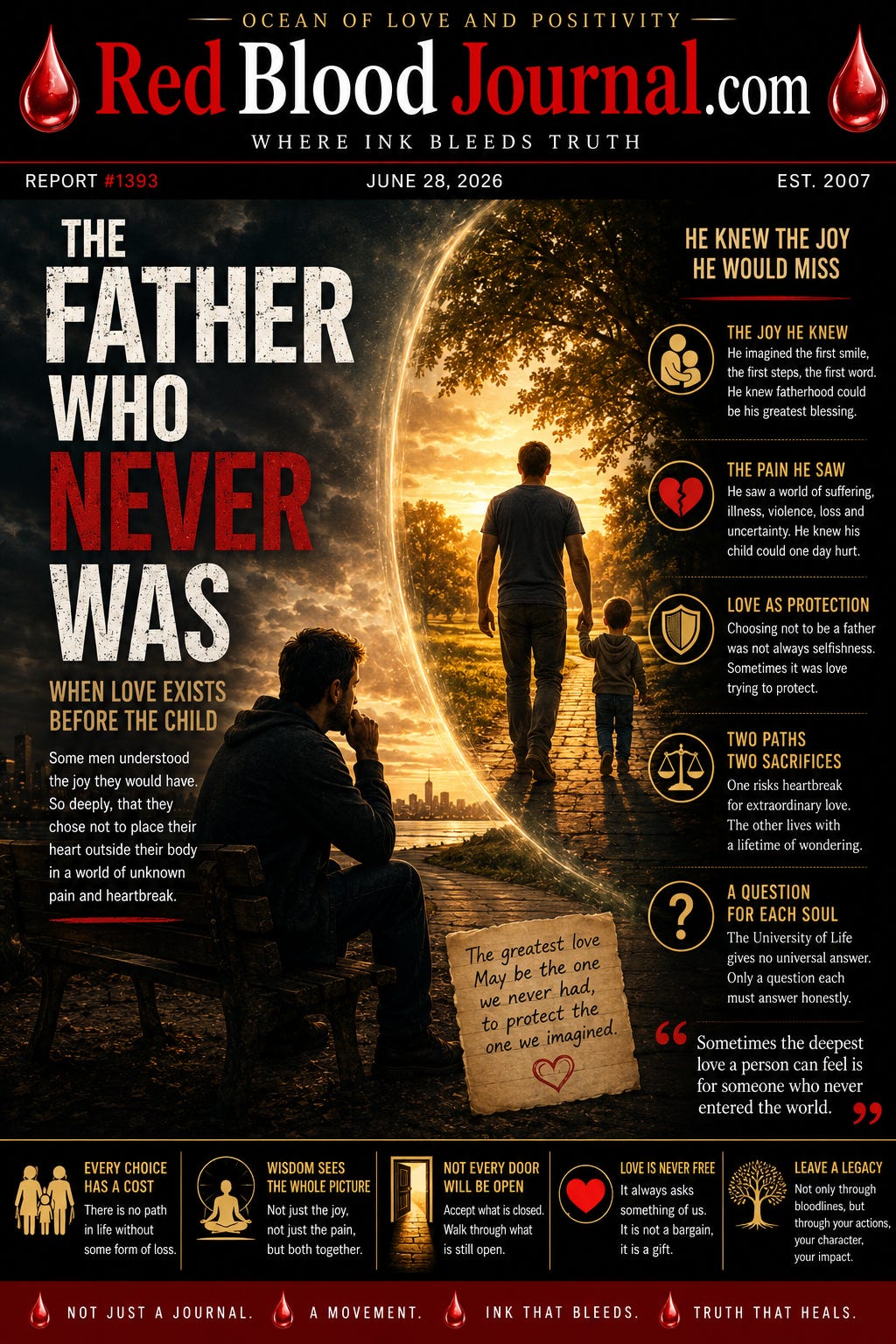
The Father Who Never Was
When Love Exists Before the Child
By Red Blood | June 28, 2026
When people speak about men who never became fathers, the explanations are often predictable.
They wanted freedom.
They chose a career.
They never met the right woman.
They were afraid of commitment.
Sometimes those explanations are true.
Sometimes they are not.
There is another possibility that is rarely discussed.
Some men understood exactly what they would be giving up.
They knew the joy that fatherhood could bring.
They imagined the first smile.
The first steps.
The first words.
The first time a small hand would reach for theirs.
They understood that becoming a father might become the greatest experience of their lives.
And that understanding became the very reason they hesitated.
There is an old expression that when a child is born, a parent’s heart begins walking outside of their body.
Perhaps that expression contains more truth than poetry.
The deeper a person’s capacity to love, the greater their willingness to become vulnerable.
Some men look upon the material world and see beauty mixed with hardship.
They see illness.
War.
Violence.
Loss.
Heartbreak.
Uncertainty.
They recognize that bringing a child into such a world also means accepting that one day the child may suffer in ways they cannot prevent.
The love that promises life’s greatest joy also carries the possibility of life’s deepest pain.
For these men, the decision not to become a father is not always rooted in fear of responsibility.
Nor is it necessarily rooted in selfishness.
It may instead arise from a profound awareness of how deeply they would love.
Their heart would no longer belong only to them.
It would exist outside their body, walking through a world they cannot completely protect.
Whether such a decision is wise or mistaken is not a question with a universal answer.
History is filled with parents who would say that every hardship was worth experiencing because of the love they found.
Others quietly wonder about the child they never held, the laughter they never heard, and the family they never built.
Both paths carry their own form of sacrifice.
One accepts the risk of heartbreak in exchange for extraordinary love.
The other avoids that risk but may carry a lifetime of wondering.
Perhaps the University of Life presents this not as a problem to solve, but as a question each soul must answer for itself.
Love is never free.
It always asks something of us.
Sometimes it asks us to open our hearts despite uncertainty.
Sometimes it asks us to accept that not every path will be walked.
Perhaps wisdom is not found in choosing the path without pain.
Perhaps wisdom is found in understanding that every path has a cost—and accepting that cost with open eyes.
For perhaps the greatest mystery is this:
Sometimes the deepest love a person can feel is for someone who never entered the world.
🩸 Ocean of Love and Positivity 🩸
Love is measured not only by the lives we touch, but also by the depth of our capacity to care. Whether our love is shared with a child, a family, a friend, or humanity itself, the invitation remains the same: to let love make us wiser rather than more fearful, and to leave this world with a heart that remained open.
🩸 RedBloodJournal.com 🩸
❤️The Weight of a Heart Walking Outside the Body
Jun 28, 2026
This reflective piece examines the unconventional motives behind a man’s choice to forego parenthood, challenging the assumption that such decisions stem from selfishness or apathy.
The author suggests that some men decline fatherhood precisely because they possess an overwhelming capacity for love and a heightened awareness of a child’s potential suffering.
By viewing a child as a vulnerable extension of one’s own heart, these individuals may choose to avoid the profound emotional risks inherent in a volatile world.
The narrative contrasts the sacrifices of parenthood with the quiet longing of those who remain childless, noting that both paths require a unique form of courage.
Ultimately, the text presents this dilemma as a deeply personal inquiry into the cost of affection and the various ways humans express devotion to the unborn.


