


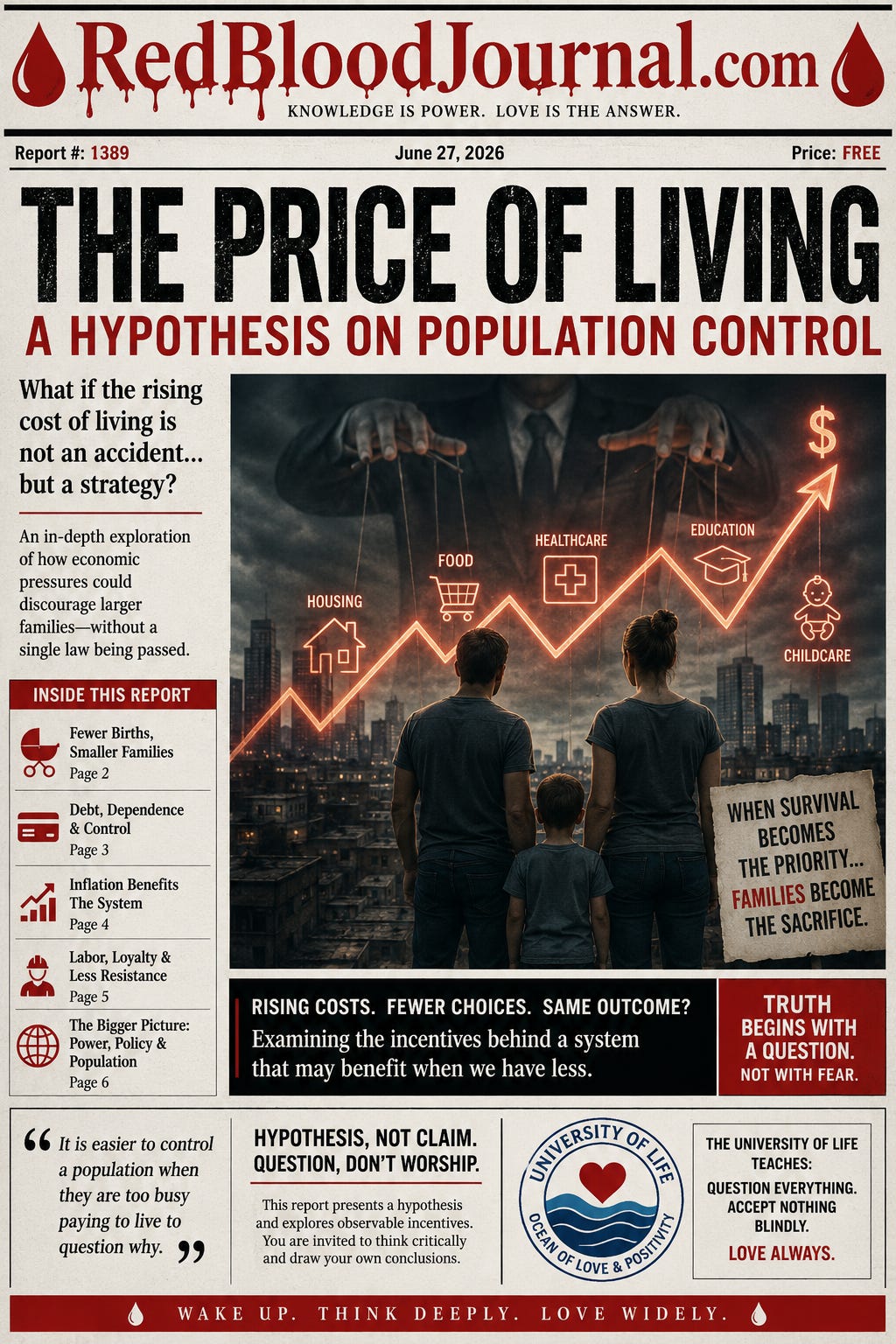
🩸 RedBloodJournal.com 🩸
The Price of Living — A Hypothesis on Population Control
Report #: 1389
Date: June 27, 2026
Introduction
Every generation inherits questions that previous generations either could not answer or were unwilling to ask. One of those questions may be hiding in plain sight:
What if the rising cost of living is not merely an economic failure, but a feature of the system rather than a flaw?
This report does not claim that such a strategy exists. Instead, it presents a thought experiment—a hypothesis intended to encourage readers to examine incentives rather than assumptions.
Throughout history, governments have openly pursued policies aimed at influencing population growth. Some encouraged larger families. Others attempted to reduce birth rates through laws, financial incentives, or restrictions. But imagine a different approach—one that requires no public announcement and no explicit population-control policy.
Suppose a governing system concluded that people naturally postpone marriage, delay having children, or choose smaller families when the cost of housing, food, healthcare, education, transportation, and childcare continually rises. Rather than limiting births directly, the economic environment itself could become the mechanism.
If that were true, what other effects might accompany such a system?
A continually rising cost of living could produce a society where:
Young adults delay marriage and parenthood.
Families choose to have fewer children because they cannot comfortably afford more.
Two-income households become a financial necessity rather than a choice.
Citizens become increasingly dependent on steady employment, reducing their willingness to take entrepreneurial or political risks.
Household debt becomes a permanent feature of life.
Governments collect higher nominal tax revenues as wages and prices rise.
Inflation gradually reduces the real burden of public debt.
Large corporations with greater financial resources gain advantages over smaller competitors.
People spend more time working to meet basic expenses and less time questioning the broader direction of society.
None of these outcomes, by themselves, prove deliberate intent. They are observable incentives that can emerge in an environment of sustained rising costs. The purpose of this report is not to declare certainty, but to invite readers to ask an often-overlooked question:
If a particular outcome consistently benefits a system, should we assume it is entirely accidental, or is it reasonable to examine whether incentives may help explain why it persists?
The University of Life teaches that every system should be examined—not with fear, anger, or blind acceptance, but with curiosity. Sometimes the most important discoveries begin with a single question that challenges what everyone else has accepted as normal.
The Ocean of Love and Positivity does not ask us to believe every hypothesis. It asks us to think deeply, question honestly, and seek truth without becoming prisoners of any conclusion.
💰 The Economic Architecture of Population Control
Jun 27, 2026
This report explores a provocative hypothesis regarding the potential relationship between rising living costs and population management.
It suggests that rather than being an economic failure, high prices for essentials like housing and childcare may act as a silent mechanism to discourage larger families.
By analyzing the incentives of such a system, the text outlines how financial strain can lead to delayed marriage, increased household debt, and a workforce too preoccupied with survival to challenge the status quo.
The source encourages readers to look beyond face-value economic assumptions and consider if these outcomes serve a deliberate systemic purpose.
Ultimately, the document advocates for critical thinking and curiosity when examining why certain global economic trends persist despite their negative impact on the average citizen.


