


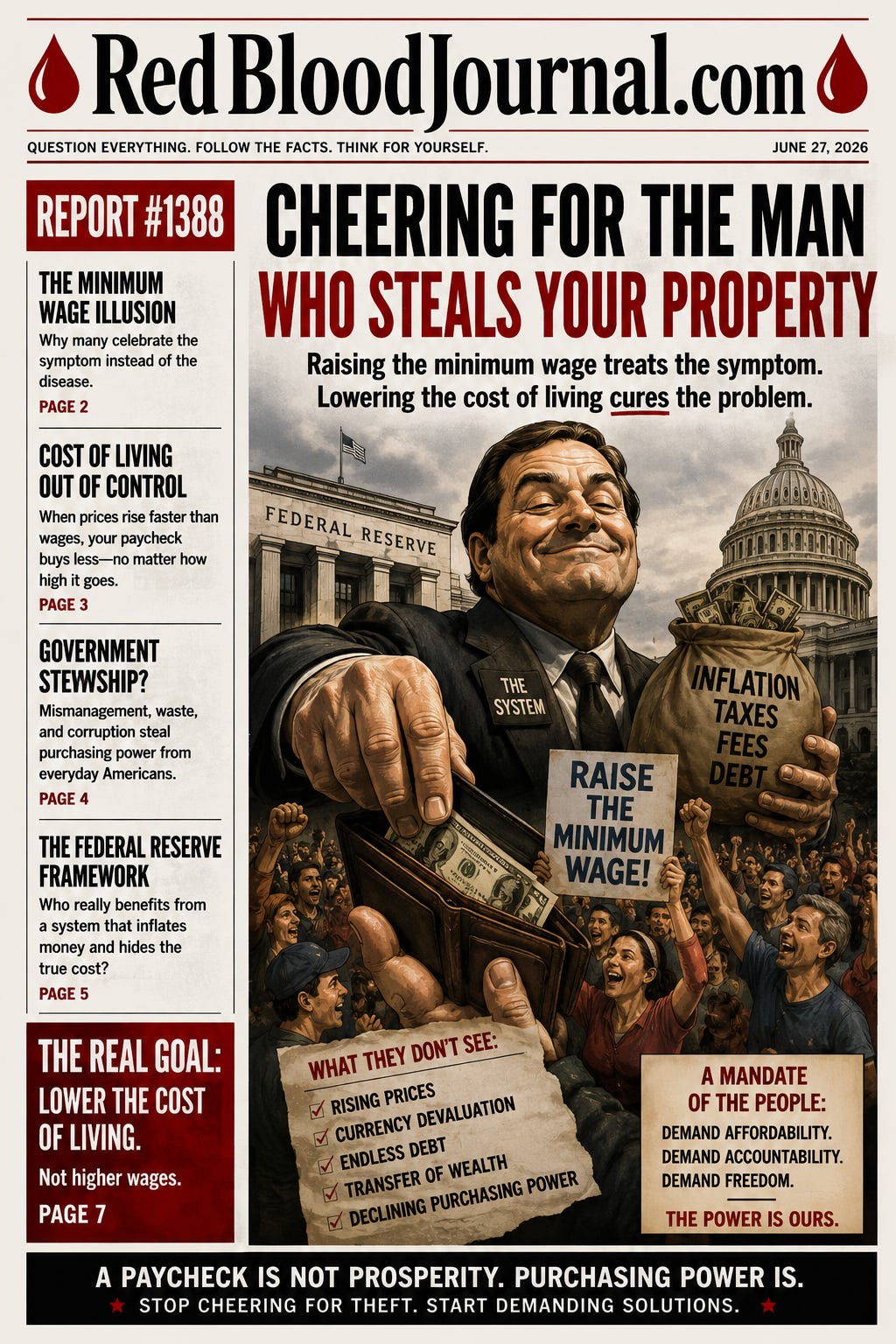
🩸Report #1388
The Minimum Wage Illusion — Why Many Celebrate the Symptom Instead of the Disease
Date: June 27, 2026
Introduction
When the minimum wage is increased, many people celebrate it as a victory for working families. Yet another way of looking at the same event is to ask a different question:
Why did wages have to rise in the first place?
If the cost of housing, food, healthcare, transportation, and energy had remained affordable, the demand for ever-higher minimum wages would likely be far less urgent.
From this perspective, raising the minimum wage may address the symptom while leaving the underlying causes untouched.
The Cost of Living vs. The Wage
A population may cheer when its paycheck increases, but if prices rise faster than wages, purchasing power can remain unchanged—or even decline.
Imagine someone takes one hundred dollars from your pocket and later returns twenty dollars. You might feel relieved to receive something back, but you are still poorer than before.
The same question can be asked of the economy:
Would people rather receive higher wages, or pay lower prices for the necessities of life?
A society with affordable housing, affordable food, affordable healthcare, and stable purchasing power may require fewer emergency wage increases than one experiencing persistent inflation.
Government Stewardship
Critics argue that continual increases in the cost of living reflect poor economic stewardship. Whether one attributes this to policy mistakes, excessive spending, monetary expansion, corruption, or other structural factors, the result is similar: the purchasing power of ordinary workers declines.
Under this view, repeatedly increasing the minimum wage becomes a recurring response to problems that were allowed to develop rather than prevented.
The Monetary System
Some critics further argue that the structure of the modern monetary system—including the role of the Federal Reserve—contributes to long-term inflation and declining purchasing power.
Others disagree, arguing that inflation has multiple causes, including supply shocks, fiscal policy, productivity changes, demographics, and global economic conditions.
Regardless of where one stands in that debate, one question remains central:
Who ultimately benefits from a monetary system in which the purchasing power of money steadily declines over generations?
That question deserves careful public examination.
A Different Goal
Perhaps the public conversation should focus less on how high the minimum wage should become and more on how low the cost of living can reasonably be kept.
A prosperous society is not necessarily one where wages rise every few years.
It may instead be one where families can comfortably afford food, shelter, healthcare, education, and retirement without requiring continual wage adjustments simply to maintain the same standard of living.
Final Thought
The true measure of economic success is not the number printed on a paycheck.
It is what that paycheck can actually buy.
When people celebrate higher wages without asking why those increases became necessary, they may be applauding the treatment while overlooking the illness.
As always, every reader should examine the evidence, question assumptions—including those presented here—and follow the facts wherever they lead.
🩸 RedBloodJournal.com 🩸
⚖️ The Minimum Wage Illusion and the Cost of Living Truth
Jun 27, 2026
This report argues that increasing the minimum wage is often a superficial fix for the deeper problem of a rising cost of living. The author suggests that the public frequently celebrates nominal pay raises while ignoring the eroding purchasing power caused by the high costs of essential goods like housing and healthcare. Instead of focusing solely on income levels, the text proposes that society should examine why persistent inflation makes these frequent wage adjustments necessary in the first place. By questioning the monetary system and government stewardship, the article shifts the focus from how much workers earn to how much their money can actually buy. Ultimately, the source advocates for a stable economy where affordability is prioritized over the symbolic victory of a higher paycheck.


