


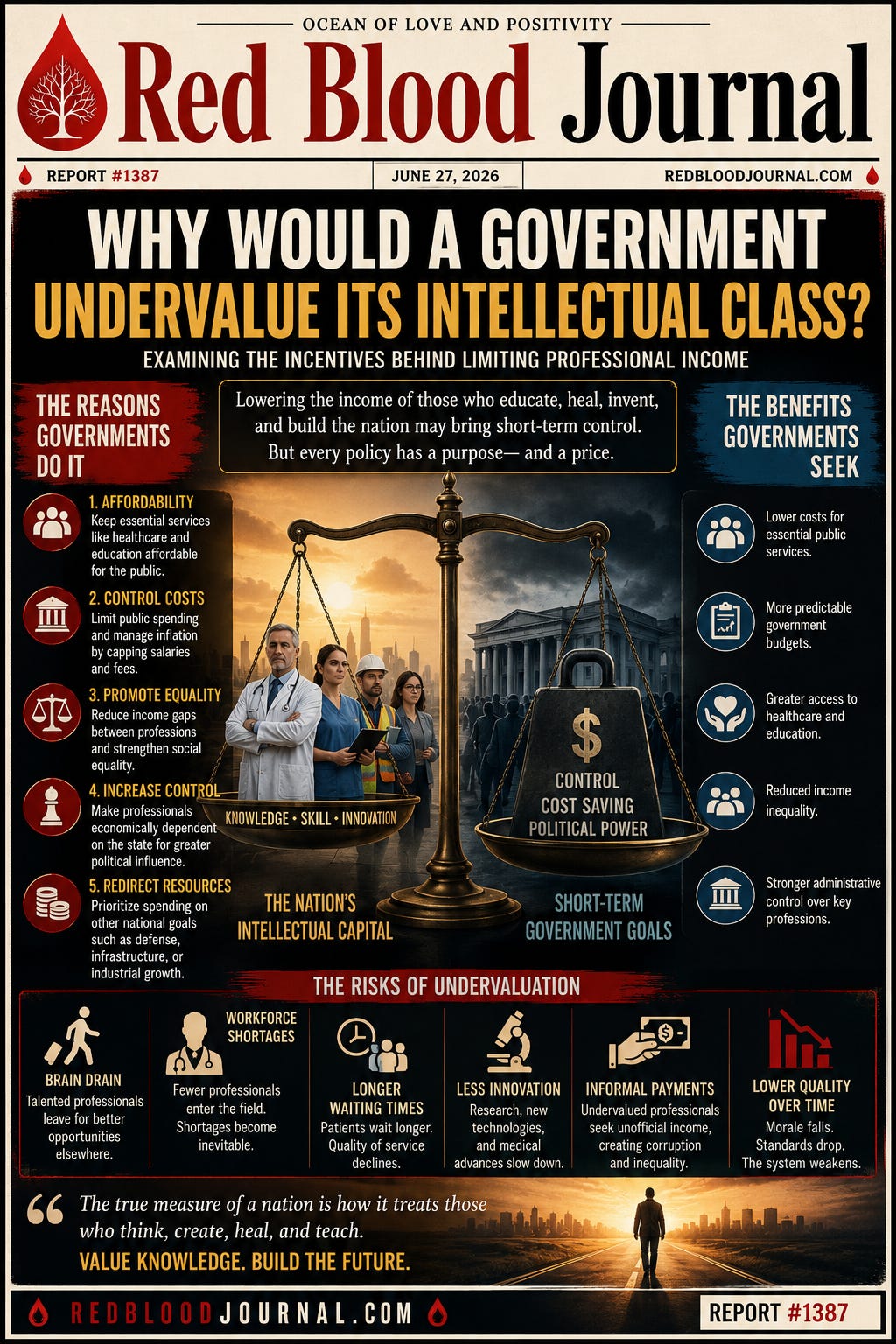
🩸 Red Blood Journal Report #1387
Why Would a Government Undervalue Its Intellectual Class?
Examining the Incentives Behind Limiting Professional Income
Report #: 1387
Date: June 27, 2026
Introduction
At first glance, it seems counterintuitive.
Why would any government intentionally reduce the earning potential of the very people who educate, heal, invent, and build the nation?
Yet throughout history, governments of different political systems have sometimes imposed strict controls on the compensation of professionals such as physicians, teachers, scientists, lawyers, and engineers.
The motivations have varied, and the outcomes have differed. Understanding those motivations helps explain why such policies continue to appear.
1. Making Essential Services Affordable
The most commonly stated reason is to make healthcare, education, or other essential services accessible to everyone.
By regulating prices or salaries, governments seek to prevent costs from rising beyond what ordinary citizens can afford.
The intended public benefit is broader access to essential services.
2. Controlling Inflation and Public Spending
When governments employ large numbers of professionals directly, limiting salaries can reduce pressure on public budgets.
This approach may allow governments to allocate resources to other priorities, though it can also affect recruitment and retention if compensation falls too far behind competing opportunities.
3. Promoting Economic Equality
Some governments view large income differences as socially undesirable.
Compressing professional salaries is sometimes intended to narrow income gaps and reduce economic inequality.
The trade-off is that the financial incentive for pursuing lengthy and demanding education may also decline.
4. Expanding Political Control
In highly centralized political systems, governments often become the primary employer of professionals.
When careers, promotions, licenses, and income depend heavily on the state, professionals may become more economically dependent on government institutions.
This does not automatically determine how individuals behave, but greater economic dependence can increase governmental influence over a profession.
5. Redirecting National Resources
Governments may decide that limited national resources should first support infrastructure, defense, food security, industrial development, or other priorities rather than higher professional compensation.
Whether this allocation benefits society depends on the country’s circumstances and the balance struck between competing needs.
The Benefits Governments May Seek
From the government’s perspective, these policies can potentially provide:
Lower costs for essential public services.
More predictable government budgets.
Greater access to healthcare and education.
Reduced income inequality.
Increased administrative control over publicly funded professions.
These are the principal objectives often cited by governments that adopt such policies.
The Risks
If compensation remains substantially below what professionals consider sustainable for an extended period, governments may also face unintended consequences:
Brain drain.
Fewer students entering demanding professions.
Lower morale.
Reduced innovation.
Workforce shortages.
Growth of informal or secondary income sources.
The long-term outcome depends on many factors, including working conditions, professional autonomy, economic stability, and opportunities available elsewhere.
The Central Question
The issue is not whether professionals should earn unlimited incomes.
Nor is it whether governments should regulate essential services.
The enduring question is one of balance:
How can a nation keep healthcare and education affordable while still ensuring that the people who dedicate their lives to mastering these professions have strong reasons to remain, innovate, and teach the next generation?
History suggests that nations thrive when they succeed in doing both.
🩸 RedBloodJournal.com 🩸
Ocean of Love and Positivity
A civilization flourishes when it recognizes that compassion and knowledge are partners rather than competitors. Making essential services available to all and honoring the value of those who provide them are not opposing goals. The strongest societies seek a balance where every person can receive care, and every mind inspired to serve is encouraged to grow, create, and remain.
⚖️ The Economics of Valuing the Intellectual Class
Jun 27, 2026
This text explores the complex motivations and consequences behind governmental policies that limit professional compensation for experts like doctors and educators.
While authorities often aim to lower the cost of essential services and reduce economic inequality, these measures can inadvertently trigger a brain drain or labor shortages.
The sources suggest that centralized control over wages can be a tool for managing public budgets or increasing political influence over specialized fields.
However, such strategies risk stifling innovation and morale if the financial incentives for rigorous training disappear.
Ultimately, the report advocates for a harmonious balance where society ensures both public affordability and the professional sustainability of its intellectual class.
The overarching message emphasizes that a civilization truly prospers when it values expert knowledge while maintaining widespread access to care.


