


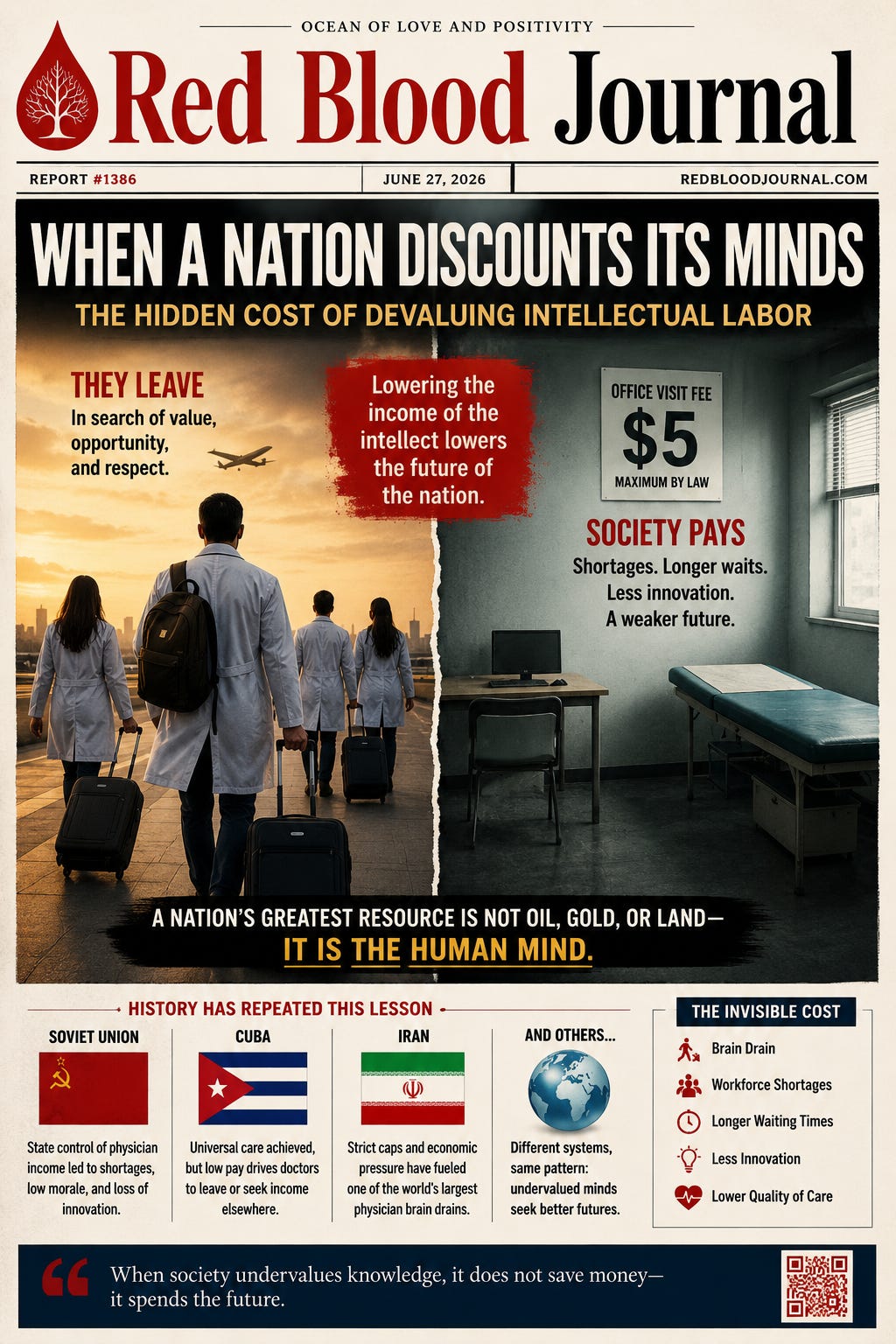
🩸 Red Blood Journal Report #1386
When a Nation Discounts Its Minds
The Hidden Cost of Devaluing Intellectual Labor
Report #: 1386
Date: June 27, 2026
Introduction
Every civilization depends on two forms of capital.
The first is material wealth—oil, minerals, factories, land, and money.
The second is intellectual wealth—the physicians, engineers, scientists, inventors, teachers, entrepreneurs, and skilled professionals whose knowledge continually renews a nation’s future.
History repeatedly shows that when governments deliberately reduce the economic value of intellectual work, they may make professional services appear more affordable in the short term, but they often create long-term challenges that are far more expensive.
The greatest resource any nation possesses is not buried underground.
It walks through the front door every morning.
What Happens When Knowledge Is Undervalued?
A physician spends well over a decade acquiring the knowledge required to diagnose illness and save lives.
An engineer designs bridges that stand for generations.
A scientist may devote twenty years to discovering one breakthrough.
When governments hold compensation far below what highly trained professionals believe reflects their education and responsibility, the message sent to society becomes:
“Knowledge has little economic value.”
The result is not simply lower incomes.
It changes the aspirations of future generations.
History Has Repeated This Lesson
Different countries have approached healthcare differently, but several governments have used strict state control over physician compensation or employment.
The Soviet Union
Under the Semashko system, physicians became salaried state employees and private medical practice was generally prohibited. Healthcare became universally available, but doctors were often paid relatively modest wages compared with other professionals, contributing to morale and retention challenges over time. (Wikipedia)
Cuba
Following the Cuban Revolution, healthcare became fully state-run, with physicians employed by the government. Cuba achieved impressive access to medical care and a high physician-to-population ratio, but low salaries and economic constraints have led many doctors to seek opportunities abroad or participate in overseas medical missions. (Wikipedia)
Iran
After the 1979 revolution, the government increased regulation over many sectors of healthcare. Over subsequent decades, economic pressures, inflation, sanctions, and compensation concerns have all contributed to significant emigration among physicians and other highly educated professionals. While multiple factors are involved, physician migration has become a recognized issue. (YouTube)
The Pattern
Although each country has its own political system and history, the pattern often follows a similar path.
First, professional compensation is compressed.
Then fewer young people pursue difficult careers.
Experienced professionals begin leaving.
Innovation slows.
The country eventually imports knowledge that it once produced itself.
The greatest export becomes its educated people.
The Invisible Cost
Initially, lower regulated prices may appear to benefit the public.
However, the long-term costs can include:
Brain drain.
Physician shortages.
Longer waiting periods.
Reduced medical innovation.
Less investment in equipment.
Lower morale among professionals.
Greater dependence on foreign expertise.
These effects are not inevitable in every system, but they have appeared in various forms when highly skilled labor is persistently undervalued. (PMC)
A Lesson Beyond Medicine
The principle applies to every profession requiring years of intellectual investment.
Teachers.
Scientists.
Engineers.
Researchers.
Inventors.
Entrepreneurs.
When society consistently rewards speculation more than knowledge, entertainment more than education, or bureaucracy more than innovation, it risks weakening the foundation upon which future prosperity depends.
Conclusion
A nation’s true wealth is measured not only by its natural resources but by the value it places on the human mind.
Knowledge cannot be legislated into existence overnight.
It requires years of sacrifice, discipline, and dedication.
When intellectual achievement is persistently undervalued, the loss extends beyond individual professionals. It influences the ambitions of future generations and gradually reshapes the nation’s capacity to innovate, heal, teach, and build.
History suggests that civilizations rise not merely by accumulating resources, but by cultivating and retaining the people capable of transforming those resources into progress.
🩸 RedBloodJournal.com 🩸
Ocean of Love and Positivity
Every child enters the world carrying potential that no government can manufacture and no economy can replace. The greatest investment a civilization can make is not only in buildings or technology, but in nurturing minds, encouraging curiosity, and honoring wisdom. When a society values knowledge alongside compassion, it strengthens both its future and its humanity.
🧠 The Hidden Cost of Devaluing Intellectual Capital
Jun 27, 2026
The provided text from the Red Blood Journal explores the detrimental long-term consequences that occur when a nation undervalues intellectual labor and highly skilled professions.
By examining historical examples from various countries, the report illustrates how suppressing professional compensation leads to a “brain drain” where doctors, engineers, and scientists emigrate to find better opportunities.
This systemic devaluation discourages future generations from pursuing rigorous education, ultimately resulting in innovation stagnation and a reliance on foreign expertise.
The source emphasizes that while lowering the cost of services may seem beneficial initially, it creates invisible costs like physician shortages and reduced service quality.
Ultimately, the text argues that a civilization’s true prosperity depends on its ability to respect and retain the human minds capable of driving progress.


