


🩸 RedBloodJournal.com 🩸
Report #1385
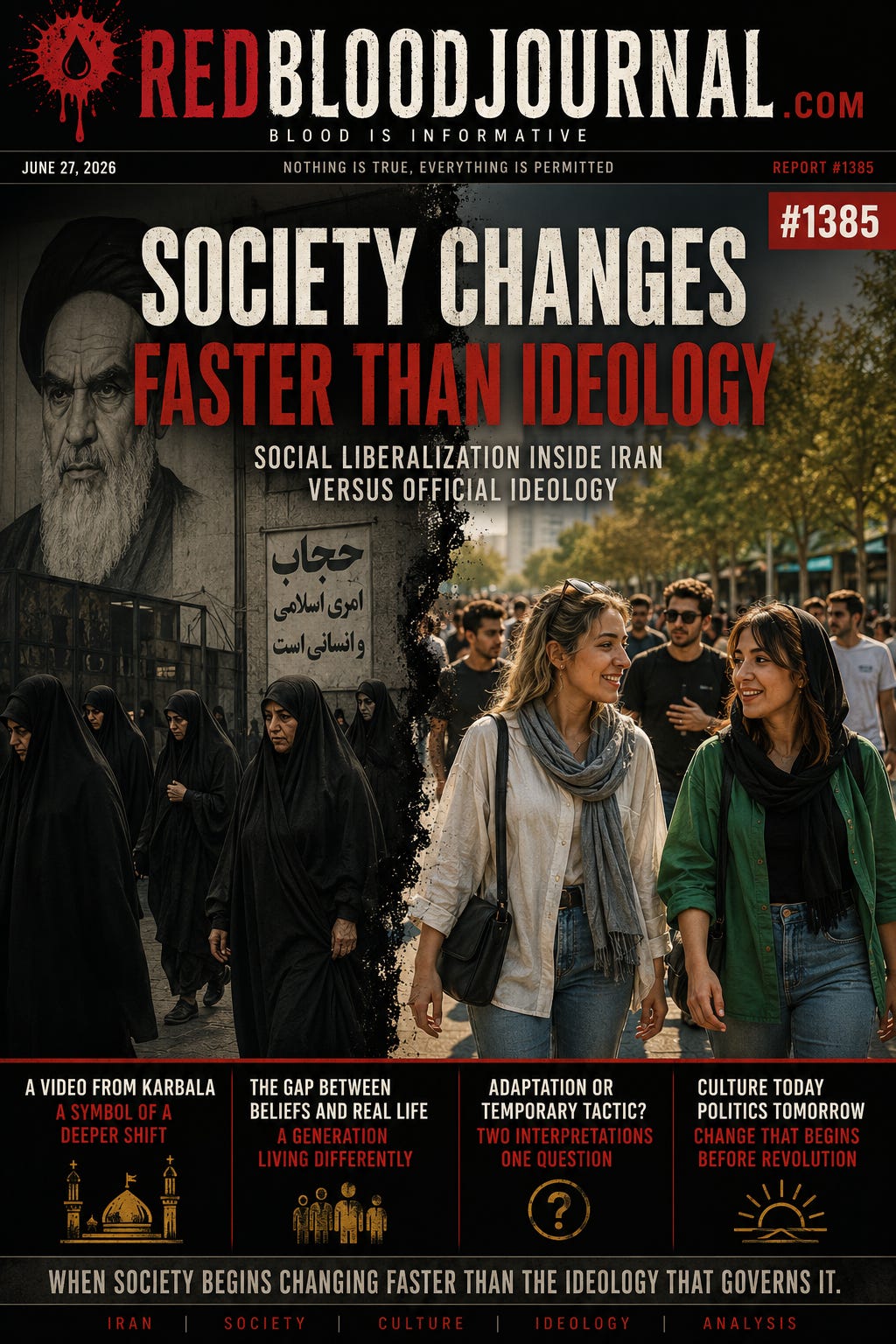
Title: Social Liberalization Inside Iran vs. Official Ideology
Date: June 27, 2026
Subtitle
When society begins changing faster than the ideology that governs it.
Introduction
Political systems often attempt to shape society through laws, education, religious institutions, media, and social pressure. Yet history repeatedly shows that societies do not remain frozen. Values evolve, generations change, technology expands access to information, and everyday life gradually diverges from official doctrine.
Recent developments discussed in the uploaded material raise an interesting question:
Is Iranian society changing more rapidly than the political and religious establishment can control?
The Symbolism of a Single Image
One of the first topics discussed is a widely circulated video reportedly filmed in the shrine of Husayn ibn Ali in Karbala.
The discussion is not centered on the private lives of the individuals shown. Rather, it argues that the image became symbolically important because it appeared in one of the holiest places for Shi’a Muslims and seemed inconsistent with decades of officially promoted social norms.
Whether one agrees with that interpretation or not, the report treats the image as evidence of a broader cultural shift.
Society May Be Moving Faster Than Government
The discussion suggests that changes are becoming visible in several areas:
Clothing and public appearance.
Social interaction.
Cultural expression.
Younger generations becoming less willing to conform to older expectations.
Authorities appearing less able—or less willing—to enforce every previous restriction.
The report asks whether these developments reflect genuine liberalization or simply practical limits on enforcement.
The Gap Between Official Ideology and Daily Reality
One of the recurring patterns throughout history is that governments often maintain official principles long after society itself has begun changing.
Eventually two realities emerge:
the official narrative,
and everyday lived experience.
As the distance between them grows, enforcement becomes increasingly difficult.
The uploaded discussion suggests this may now be occurring inside Iran.
Why This Matters Politically
The report argues that social change may actually precede political change.
People rarely wake up one morning with entirely different political beliefs.
Instead, change often begins much earlier:
new attitudes,
new conversations,
new fashions,
new media,
new expectations,
new definitions of personal freedom.
Politics frequently follows culture rather than creating it.
Technology Changes the Balance
Modern communication creates pressures that previous governments never faced.
A generation connected through smartphones, satellite media, and the internet experiences the outside world differently from earlier generations.
Ideas that once could be isolated now cross borders almost instantly.
As information spreads more freely, maintaining a single official narrative becomes increasingly difficult.
Adaptation or Temporary Flexibility?
The discussion raises two competing interpretations.
Possibility One
The governing establishment is gradually adapting to irreversible social change in order to preserve long-term stability.
Possibility Two
The apparent relaxation is temporary—a tactical adjustment intended to reduce pressure during a period of political uncertainty, after which previous restrictions could return.
The uploaded discussion does not establish which interpretation is correct; instead, it presents this as an open question based on recent events.
History’s Lesson
Many governments throughout history have discovered that laws can regulate behavior only to a certain extent.
Culture ultimately develops through millions of individual choices.
When enough individuals begin changing their behavior, governments often face a choice:
resist,
adapt,
or attempt some combination of both.
Conclusion
Whether recent events represent a permanent transformation or a temporary adjustment remains uncertain.
What appears increasingly clear is that the relationship between Iranian society and its official ideological framework is under visible strain.
The coming years may reveal whether these social shifts become lasting reforms, are reversed, or evolve into an entirely new relationship between the state and society.
History often records political revolutions.
Less visibly—but sometimes more profoundly—it records cultural revolutions that begin quietly, one generation at a time.
🩸 RedBloodJournal.com 🩸
📈 The Great Divergence: Iranian Society vs. Official Ideology
Jun 27, 2026
The provided report examines the growing disconnect between Iran’s official government doctrine and the evolving values of its citizens.
It highlights how technological access and generational shifts have fostered a cultural landscape that increasingly prioritizes personal freedom and social liberalization over state-mandated norms.
A symbolic event at a holy site serves as a focal point for discussing whether these visible changes in public behavior and dress represent a permanent societal transformation.
The text suggests that cultural evolution often precedes political reform, forcing authorities to choose between adapting to new realities or attempting to maintain control through traditional restrictions.
Ultimately, the source questions whether current trends indicate a strategic, temporary flexibility by the state or an irreversible move toward a more secularized society.
This tension illustrates a broader historical pattern where individual choices collectively reshape a nation’s identity, regardless of official policy.


