


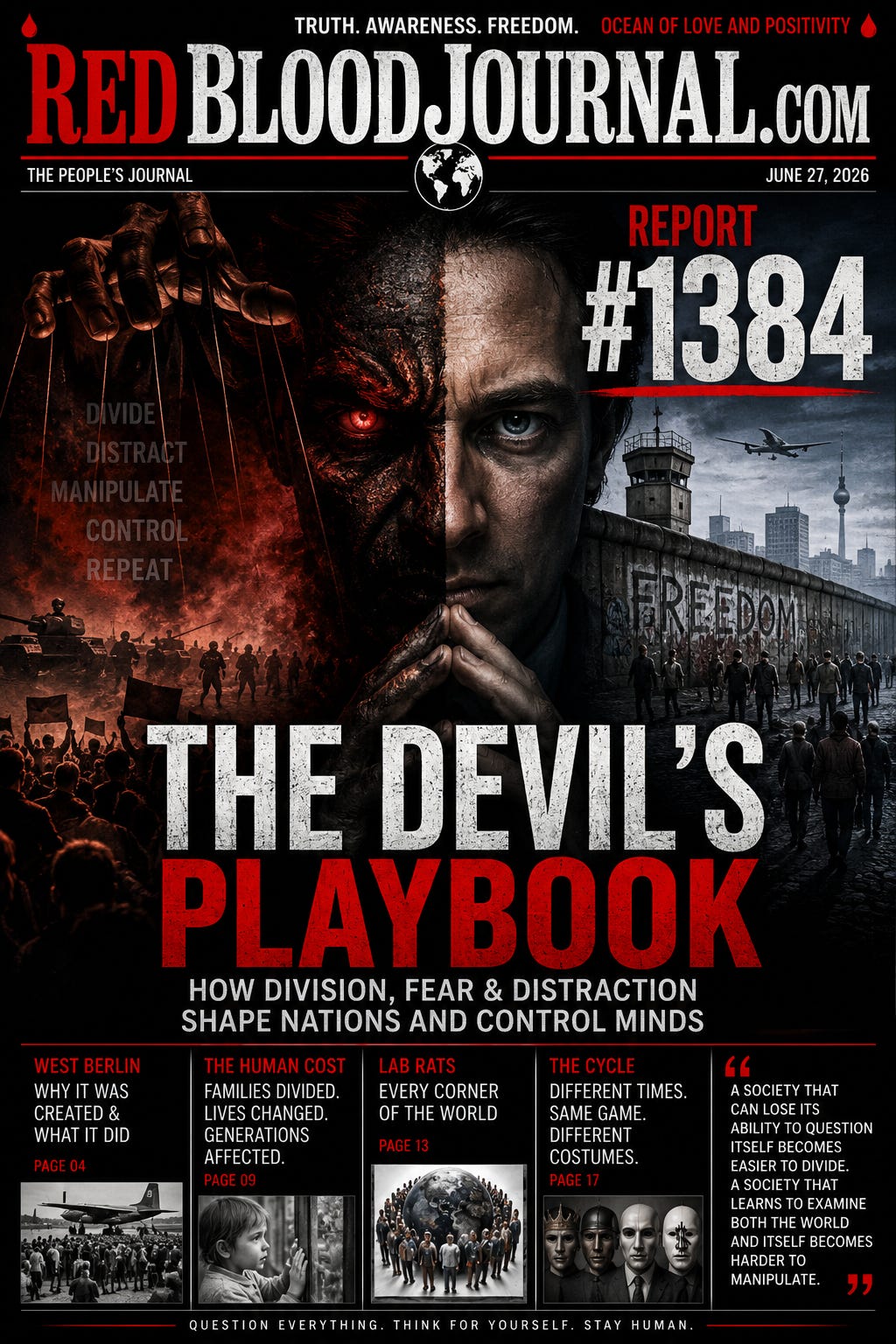
🩸 RedBloodJournal.com 🩸
Report #1384
Date: June 27, 2026
The Devil’s Playbook
A Fictional Allegory About Power, Division, and the Human Mind
By Red Blood
Editor’s Note: The following is a fictional allegory written from the imagined perspective of an all-powerful manipulator. It is not presented as a factual account of history but as a thought experiment about how division, fear, and human psychology can be used to shape societies.
Introduction
If I were the Devil—not a horned creature, but the embodiment of manipulation—I would not try to destroy humanity with fire.
I would let humanity destroy itself.
I would whisper instead of shout.
I would divide instead of conquer.
I would make people believe they are choosing freely while carefully limiting the choices placed before them.
Most importantly, I would ensure they never looked inward, because that is where my influence ends.
Chapter One: Never Let Them See the Whole Picture
The first rule would be simple.
Never allow anyone to step back far enough to see the entire chessboard.
Instead, give every person one puzzle piece and convince them it is the whole truth.
One calls himself conservative.
Another calls herself progressive.
One becomes religious.
Another becomes anti-religious.
One cheers one nation.
Another cheers another.
Each believes they are defending truth.
Very few ask who benefits from endless conflict.
Chapter Two: Build Invisible Walls
The Berlin Wall eventually fell.
The invisible walls are much stronger.
They are built from:
Ideology.
Identity.
Fear.
Pride.
Political loyalty.
Religious certainty.
Nationalism.
Tribal thinking.
Physical walls separate bodies.
Mental walls separate souls.
Those last much longer.
Chapter Three: Make Every Generation Believe It Is Different
Every generation believes it has discovered something new.
Yet history repeats.
Empires change names.
Kings become presidents.
Kingdoms become republics.
Empires become alliances.
Crowns become institutions.
The costumes change.
The stage remains.
The audience applauds each new act.
Chapter Four: Keep the Spotlight Moving
Whenever uncomfortable questions arise, move the spotlight.
One day it is war.
The next day an election.
Then a financial crisis.
Then a cultural battle.
Then another enemy.
The audience rarely notices who controls the lighting.
Chapter Five: Turn Every Difference Into a Team
Religion.
Politics.
Race.
Language.
Economics.
Gender.
Sports.
History.
Every difference becomes a jersey.
Soon everyone is cheering for teams instead of searching for truth.
Chapter Six: Reward Outward Searching
Teach humanity that every answer lies somewhere outside themselves.
Another leader.
Another ideology.
Another expert.
Another revolution.
Another election.
Another product.
Another crisis.
Keep them running.
Never let them discover that peace cannot be purchased.
Chapter Seven: Let History Become a Cycle
Nations rise.
Nations fall.
Borders move.
Governments change.
Currencies change.
Flags change.
People celebrate “new beginnings.”
Yet many of the same human weaknesses—fear, greed, pride, and the desire for power—reappear in different forms.
The cycle continues because the lesson remains unfinished.
Chapter Eight: Let Ordinary People Carry the Cost
Governments argue.
Generals plan.
Financial systems expand and contract.
Ordinary people bury loved ones.
Families are separated.
Communities are rebuilt.
History books often remember the powerful.
The people remember the price.
Chapter Nine: Never Fight the Human Spirit Directly
This would be my greatest secret.
I could never defeat love directly.
I could never erase compassion.
I could never destroy genuine curiosity.
Instead, I would distract.
Because a distracted person rarely discovers their own strength.
The Greatest Fear
My greatest fear would not be a stronger government.
Nor a weaker one.
Not one religion defeating another.
Nor one political party replacing another.
My greatest fear would be millions of ordinary people discovering they no longer need hatred to define themselves.
The moment they stop cheering against one another...
The play begins to end.
Conclusion
History contains real conflicts, real suffering, and real disagreements. Different people interpret the causes differently, and no single narrative explains every event. Yet one lesson appears across civilizations:
A society that loses its ability to question itself becomes easier to divide.
A society that learns to examine both the world and itself becomes harder to manipulate.
Whether one views history through politics, economics, religion, psychology, or philosophy, the enduring challenge is the same: to seek understanding without surrendering independent judgment.
Perhaps the most difficult journey is not across borders or ideologies, but inward—toward greater self-awareness, compassion, and responsibility.
🩸 Ocean of Love and Positivity 🩸
If manipulation begins by convincing people to fear one another, then its opposite begins with learning to understand oneself. The strongest defense against deception is not blind trust or blind skepticism—it is a disciplined mind, an open heart, and the willingness to keep asking honest questions while treating others with dignity. Only then can the cycle begin to change.
🎭 The Devil’s Playbook:
An Allegory of Human Division
Jun 27, 2026
This fictional allegory, titled The Devil’s Playbook, explores the psychological mechanisms used to manipulate and divide humanity through the perspective of a master deceiver.
The text suggests that societal fragmentation occurs when people prioritize tribal identities, ideological certainty, and external distractions over internal reflection.
By highlighting how invisible walls of fear and pride keep history in a repetitive cycle, the author argues that power structures thrive on constant conflict and distraction.
The narrative warns that true control is maintained by ensuring individuals focus on outward enemies rather than their shared human spirit.
Ultimately, the source serves as a philosophical call to action, positing that self-awareness and independent judgment are the only ways to break free from orchestrated manipulation.
The conclusion emphasizes that a society becomes resilient only when its members choose compassion and critical questioning over the comfort of hatred.


