


🩸 RedBloodJournal.com 🩸
Red Blood Take #1381
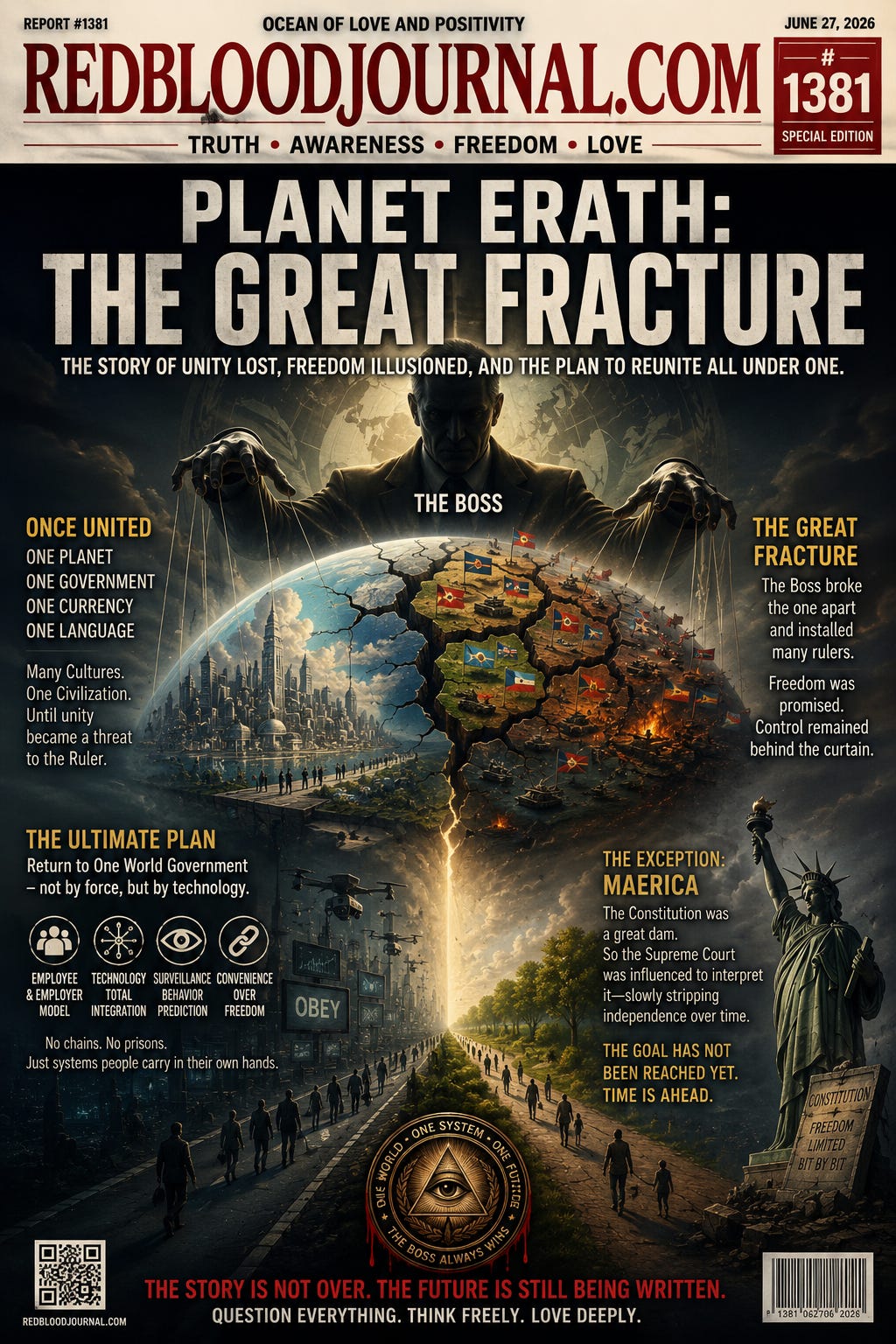
Planet Erath: The Great Fracture
A Fictional Allegory About Power, Unity, and the Cycles of Civilization
Report #: 1381
Date: June 27, 2026
Introduction
Everything that follows takes place on the fictional planet Erath.
Its kingdoms, governments, history, and characters exist only within this imaginary world. Like all allegories, it asks questions rather than claiming answers.
Before the Fracture
Long before anyone alive could remember, Planet Erath was not divided into nations.
There were no borders.
No passports.
No competing currencies.
No competing governments.
There was only one government, one currency, one official language, and one administrative authority governing the entire planet.
Yet the people themselves were wonderfully different.
Thousands of cultures flourished.
Different traditions.
Different beliefs.
Different customs.
Different ways of seeing the world.
Unity of government did not mean uniformity of people.
The Boss
Above the government stood a mysterious ruler known only as the Boss.
Officially, no one knew whether the Boss even existed.
Unofficially, every important decision seemed to trace back to the same invisible hand.
For generations the planetary government appeared stable.
Then something unexpected began to happen.
The people slowly learned to cooperate despite their differences.
Cultures exchanged ideas.
Knowledge spread freely.
Communities became stronger.
The more connected the people became, the less they depended upon centralized authority to solve every problem.
To the Boss, this was dangerous.
A population capable of governing itself eventually asks whether it needs a ruler at all.
The Great Fracture
The Boss concluded that one united civilization had become too difficult to control.
So began the greatest political experiment in Erath’s history.
The single planetary government was broken into dozens of independent kingdoms.
Each received its own flag.
Its own constitution.
Its own borders.
Its own currency.
Its own rulers.
Its own national identity.
The people celebrated what they believed was the birth of freedom.
Few noticed that behind every throne stood advisers who quietly answered to the same unseen authority.
The Boss had not disappeared.
The Boss had decentralized.
The Age of Nations
Generations passed.
The kingdoms argued.
They competed.
They traded.
They formed alliances.
They fought wars.
Every conflict strengthened national identity while weakening planetary identity.
Citizens proudly defended their own kingdoms.
Few remembered they had once belonged to one civilization.
The experiment had succeeded beyond expectation.
The Second Experiment
Centuries later, the Boss reached another conclusion.
Managing dozens of competing kingdoms required endless maintenance.
Wars were expensive.
Politics was unpredictable.
National governments occasionally resisted.
A new system would be more efficient.
Not another empire built by armies.
An empire built by technology.
Instead of commanding people directly, technology would coordinate nearly every aspect of life.
Money.
Communication.
Commerce.
Employment.
Identity.
Access.
Convenience would replace coercion.
The citizens would voluntarily connect themselves to the system because it made everyday life easier.
The Boss would no longer need chains.
The people would carry the system in their own hands.
One Obstacle
Most kingdoms gradually accepted increasing central coordination.
One kingdom, however, remained unusually resistant.
It was called Maerica.
Unlike many others, its founding charter deliberately divided power and limited government authority.
Its constitution acted as a dam against the concentration of power.
The Boss understood that great walls are rarely demolished with explosives.
They are worn away one stone at a time.
Interpretations changed.
Institutions evolved.
Laws accumulated.
Each generation accepted changes that would have shocked the generation before it.
The dam still stood.
Whether it remained as strong as when it was first built became a subject of endless debate.
Time Has Not Yet Written the Final Chapter
No historian on Erath can honestly say how the story ends.
Some believe the kingdoms will eventually surrender their independence for the promise of efficiency and security.
Others believe local freedom will endure despite technological change.
Still others believe humanity will discover an entirely different path—one that neither returns to absolute centralization nor remains trapped in endless division.
The ending has not yet been written.
Time still turns the pages.
The audience is still watching.
The actors are still performing.
The curtain has not yet fallen.
Ocean of Love and Positivity
Perhaps every civilization eventually reaches the same crossroads: fear or trust, control or responsibility, division or understanding. Whatever path Planet Erath ultimately follows, its future will depend not only on institutions or technology, but on the character of its people. For when individuals learn to govern themselves with wisdom, compassion, and integrity, they become harder to rule through fear alone. Like every ocean, lasting change begins with a single drop.
🩸 RedBloodJournal.com 🩸
🌍 The Erath Allegory:
Cycles of Power and Centralization
Jun 26, 2026
The provided text presents a fictional allegory centered on the imaginary planet of Erath, tracing the evolution of global power structures through various stages of centralization.
Initially, the world is unified under a single government controlled by a shadowy figure known as the Boss, who later orchestrates a Great Fracture into independent kingdoms to maintain control through division.
As the story progresses, this unseen authority transitions from physical coercion to a more efficient system of technological governance, where citizens trade their independence for convenience.
A specific kingdom named Maerica serves as the primary obstacle to this shift, as its founding constitution is designed to resist the accumulation of absolute power.
Ultimately, the narrative explores the cyclic nature of authority and suggests that the future of any civilization depends on the individual character and self-governance of its people.


