


🩸 Red Blood Journal
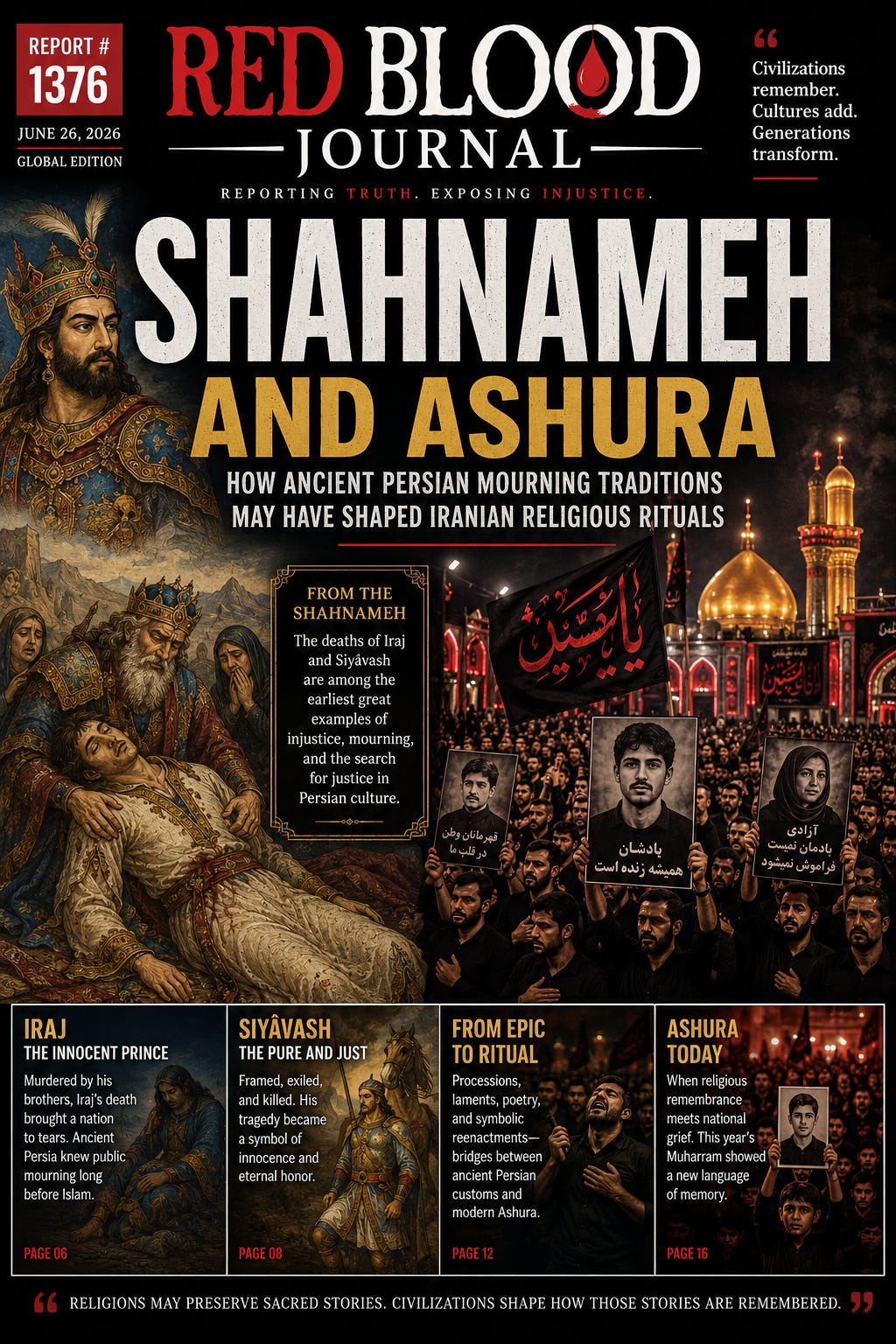
Shahnameh and Ashura
How Ancient Persian Mourning Traditions May Have Shaped Iranian Religious Rituals
Report #: 1376
Date: June 26, 2026
Introduction
When discussing Ashura in Iran, many assume that the mourning rituals seen today originated entirely within Islamic history.
However, some historians, literary scholars, and researchers have argued that many features of Iranian mourning culture may predate Islam and were later incorporated into Islamic commemorations after Persia adopted Islam in the seventh century.
This report explores that historical perspective.
It does not argue that the religious events themselves originated in ancient Persia. Rather, it examines whether the way Iranians mourn may have roots extending back more than a thousand years before Islam.
What Is the Shahnameh?
The Shahnameh (”Book of Kings”) is the national epic of Persia.
Written around the year 1010 CE by the Persian poet Ferdowsi, it preserves myths, legends, and historical traditions reaching back into pre-Islamic Persia.
Containing roughly 50,000 couplets, it is one of the world’s longest epic poems written by a single author.
More importantly, it preserved much of Persia’s cultural memory after the Islamic conquest.
Without the Shahnameh, many stories of ancient Iran might have disappeared.
The Death of Iraj
One of the earliest great tragedies in the Shahnameh is the murder of Iraj, the youngest son of King Fereydun.
Jealous brothers murdered Iraj despite his desire for peace.
The response described in the Shahnameh includes:
Wearing black.
Public lamentation.
Weeping.
Expressions of collective grief.
Calls for justice.
Remembering the victim for generations.
Many researchers note similarities between these descriptions and later Iranian mourning customs.
The Tragedy of Siyâvash
Perhaps no story illustrates Persian mourning better than that of Siyâvash.
Siyâvash was portrayed as innocent, honorable, and unjustly killed.
Following his death, widespread mourning is described.
Communities gathered.
Songs were composed.
His death became a permanent cultural memory.
Over centuries, annual remembrance ceremonies reportedly developed around his story in parts of ancient Persia.
Some historians have suggested that these traditions may have influenced later religious mourning practices after Islam arrived.
Did Iran Add Its Own Culture to Ashura?
This question has long been debated.
One scholarly view argues:
Islam introduced the story of Karbala.
Iran contributed its own established traditions of public mourning.
According to this interpretation, the emotional style of Iranian Ashura ceremonies reflects not only Islamic history but also much older Persian cultural practices.
Supporters of this view point to several observations:
Public processions.
Passionate lamentation.
Dramatic storytelling.
Poetry.
Symbolic reenactments.
Multi-day communal mourning.
They argue these forms resemble earlier Persian traditions described in classical literature.
Other scholars disagree, emphasizing that mourning traditions also developed independently within the broader Islamic world and that similarities do not necessarily prove direct continuity.
The historical evidence remains the subject of ongoing research rather than settled consensus.
Why Sunni Communities Often Observe Ashura Differently
Another observation frequently made by historians concerns differences in Ashura observance.
Many Sunni Muslim communities commemorate Ashura with fasting, prayer, or religious reflection.
Large-scale mourning processions, passion plays, and elaborate public rituals are generally much more characteristic of Shia communities, particularly in Iran and parts of Iraq, Lebanon, and South Asia.
Some scholars argue this difference supports the idea that local cultures influenced how religious remembrance evolved over time.
Again, this remains an area of scholarly debate rather than universal agreement.
Culture Evolves
History shows that religions often absorb elements of the societies in which they spread.
Examples include:
Architecture.
Language.
Clothing.
Music.
Art.
Local customs.
Methods of public remembrance.
Persia was one of the world’s oldest civilizations long before Islam arrived.
It would not be surprising if aspects of Persian culture continued to shape how religious life was expressed after conversion.
Ashura in Today’s Iran
The uploaded transcript suggests that this year’s Muharram ceremonies included expressions of contemporary national grief alongside traditional religious observances. Participants reportedly carried photographs of people who died in recent events, sang songs associated with national mourning, and connected present-day suffering with the symbolism of Karbala.
Whether these developments become a lasting transformation remains uncertain.
History suggests, however, that traditions continually evolve as each generation adds its own experiences to inherited rituals.
Conclusion
The Shahnameh reminds us that collective memory in Persia long predates Islam.
Ashura reminds believers of sacrifice and moral conviction.
For many historians, these two streams of history eventually flowed together inside Iranian culture.
Whether one agrees entirely with that interpretation or not, it highlights an important truth:
Religions may preserve sacred stories.
Civilizations often shape how those stories are remembered.
Ocean of Love and Positivity
Every civilization carries memories of both triumph and sorrow.
Ancient Persia remembered Iraj and Siyâvash.
Islam remembers Karbala.
Modern nations remember their own defining moments.
The names may change, but the human experience of grief, justice, compassion, and hope remains remarkably constant.
Perhaps understanding one another’s history is one path toward reducing division and moving, together, toward an ocean of love, understanding, and positivity. 🌊🩸✨
🩸 📖 Persian Epic Roots of Iranian Mourning Rituals
Jun 26, 2026
This report investigates the theory that modern Iranian Ashura rituals are deeply influenced by pre-Islamic Persian traditions found in epic literature like the Shahnameh.
By examining the tragic deaths of legendary figures such as Iraj and Siyâvash, scholars highlight how ancient practices of communal lamentation, black attire, and public processions mirror contemporary religious ceremonies.
While the religious significance of Ashura remains rooted in Islamic history, the text suggests that Persian cultural memory provided a unique framework for expressing grief and seeking justice.
This intersection illustrates how a civilization’s indigenous customs can shape the way it adopts and performs religious observances over many centuries.
Ultimately, the source argues that these evolving traditions reflect a universal human experience where historical legends and religious faith merge to define a nation’s collective identity.


