


🕯️ Red Blood Journal
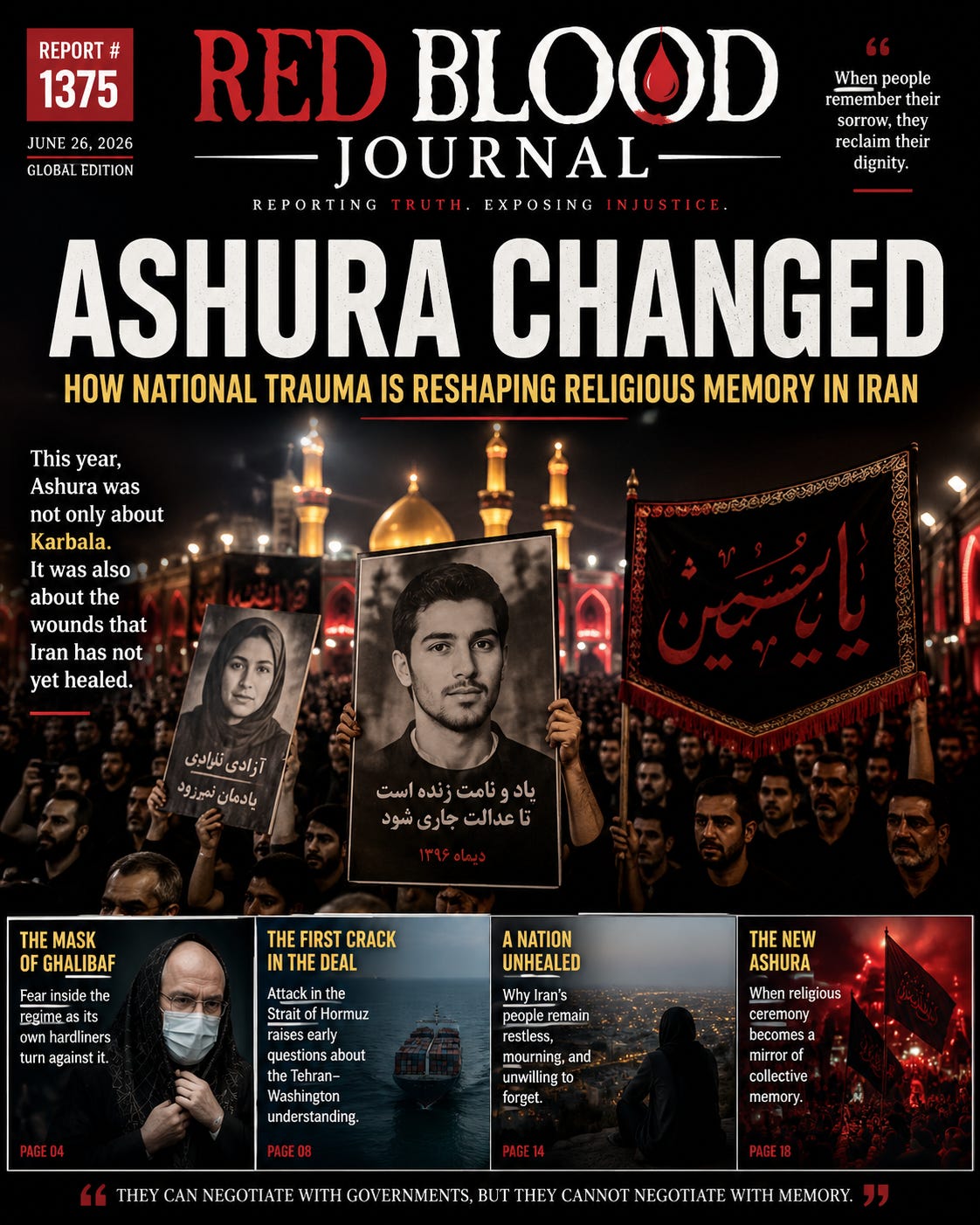
Ashura Changed
How National Trauma Is Reshaping Religious Memory in Iran
Report #: 1375
Date: June 26, 2026
Introduction
For centuries, the observance of Ashura has been one of the most significant religious events in Iran. It has traditionally been a day of mourning, reflection, and remembrance centered on the death of Imam Hussein, a revered figure in Islam whose stand against what he believed was injustice became a symbol of sacrifice.
This year, however, something appeared different.
Across parts of Iran, Ashura was not only about a seventh-century historical event. According to numerous videos, public statements, and observations compiled in recent reports, many participants appeared to blend religious remembrance with mourning over more recent events inside Iran.
Whether this represents a lasting cultural transformation or only a temporary reaction remains uncertain. Nevertheless, it illustrates how collective memory can evolve when contemporary experiences become intertwined with long-standing traditions.
What Is Ashura?
Ashura is observed on the tenth day of the Islamic month of Muharram.
For many Muslims—particularly within the Shia tradition—it commemorates the death of Imam Hussein, grandson of the Prophet Muhammad, who was killed in the Battle of Karbala in 680 CE after refusing allegiance to the ruling Umayyad caliph.
Over centuries, Hussein became more than a historical figure.
He came to symbolize:
Standing against oppression.
Sacrifice for principles.
Justice over power.
Loyalty despite overwhelming odds.
In Iran, Ashura evolved into one of the largest annual religious observances, featuring processions, mourning ceremonies, poetry, dramatic reenactments, and charitable acts.
A Different Atmosphere
The uploaded report describes ceremonies that appeared noticeably different from previous years.
Among the reported observations were:
Photographs of individuals who died during recent unrest being carried alongside traditional religious symbols.
Traditional mourning songs being replaced or supplemented by modern patriotic and memorial songs.
Families publicly remembering loved ones during Ashura ceremonies.
Some participants openly connecting the suffering of present-day victims with the symbolism of Karbala.
Rather than replacing Ashura, these expressions appeared to reinterpret its symbolism through the lens of current events.
The Meaning of Collective Memory
History often demonstrates that societies reshape traditions after major national tragedies.
Wars.
Revolutions.
Natural disasters.
Political upheavals.
Each generation leaves its own emotional imprint upon cultural ceremonies.
The report suggests that for many participants, recent events have become inseparable from Ashura itself.
The historical story remained the same.
The emotional meaning expanded.
Religion and National Identity
One of the more striking observations described in the report is that participants with differing religious beliefs appeared united in honoring those they viewed as victims.
Some remained deeply religious.
Others reportedly stated they no longer identified with organized religion but still attended ceremonies out of respect for family, community, or the memory of those they had lost.
Whether these individual statements reflect broader public opinion cannot be determined from one report alone.
However, they illustrate the possibility that shared grief can sometimes transcend ideological divisions.
Politics Cannot Easily Heal Memory
Governments may negotiate treaties.
Economic sanctions may change.
International relationships may improve.
Yet collective grief often follows a different timeline.
Political agreements can address external pressures.
They cannot immediately erase emotional experiences carried by families and communities.
If the observations described in this report continue over time, they may indicate that one of Iran’s most important religious ceremonies is gradually acquiring an additional national meaning beyond its traditional religious role.
Looking Beyond Iran
History offers many examples of religious ceremonies absorbing national memory.
Wars become memorial days.
Local heroes become national symbols.
Ancient traditions acquire new significance after modern events.
Ashura may now be entering such a period for some segments of Iranian society, where historical remembrance and contemporary experience increasingly overlap.
Whether this evolution endures will likely depend on future generations rather than current political events.
Conclusion
Ashura has always represented sacrifice against perceived injustice.
The question now is whether that symbolism is being reinterpreted by a new generation through the experiences of the present.
If so, the transformation is not occurring because the historical story has changed.
It is occurring because the people remembering it have changed.
History records events.
Culture records how people choose to remember them.
Those two things are not always the same.
Ocean of Love and Positivity
Every society carries memories of pain.
Some memories divide.
Others inspire reflection.
Whatever one’s religious or political beliefs may be, understanding another person’s grief can become the first step toward compassion.
Perhaps the deepest lesson of history is that healing rarely begins through force.
It begins when people are willing to see one another as fellow human beings, sharing the same ocean of hope, dignity, love, and positivity. 🌊🩸✨
🕯️ Ashura Reimagined:
The Evolution of Iranian Collective Memory
Jun 26, 2026
The provided text examines a significant cultural shift in how the religious holiday of Ashura is observed within Iran. Historically a day focused on the martyrdom of Imam Hussein, the ceremony is increasingly being used to commemorate victims of modern domestic unrest. Participants are blending traditional religious symbols with contemporary patriotic songs and personal portraits, effectively linking historical narratives of sacrifice to recent national trauma. This evolution suggests that collective memory is expanding, allowing the ritual to serve as a space for shared grief that transcends strict ideological or religious boundaries. Ultimately, the source argues that while the historical story of Ashura remains static, its emotional significance is being reinterpreted by a generation shaped by current events. This transformation highlights how ancient traditions can acquire new layers of meaning when a society undergoes profound political and social change.


