


🩸 Red Blood Journal #1363
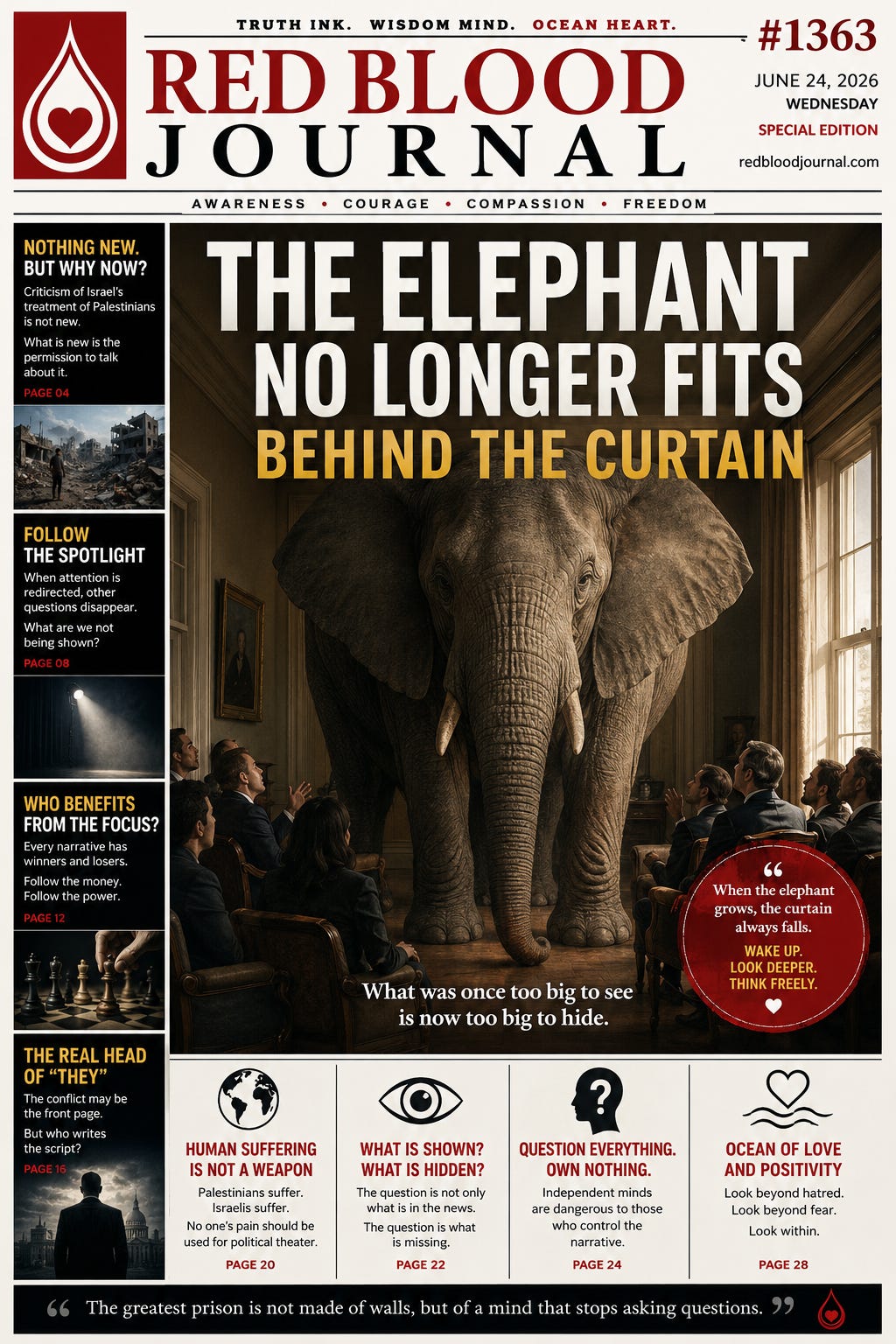
The Elephant No Longer Fits Behind the Curtain
June 24, 2026
For many years, criticism of Israel’s policies toward Palestinians existed largely on the margins of public discussion. Human rights organizations, independent journalists, activists, and ordinary observers raised concerns, but much of that criticism struggled to reach mainstream audiences.
Today, the situation appears different.
Subjects that once seemed confined to alternative publications and niche discussions now occupy front pages, television broadcasts, and social media feeds around the world. What was once difficult to discuss openly has become part of the daily news cycle.
This shift raises an important question:
Why now?
One explanation is simple. Technology has made it increasingly difficult to conceal events from public view. Smartphones, independent media, and instant global communication have given ordinary people the ability to document and share information in ways that were not possible in previous generations.
Another possibility is that changing public sentiment has forced institutions to acknowledge conversations that could no longer be ignored.
Yet a third perspective asks a different question altogether.
When a subject that was once heavily resisted suddenly becomes acceptable to discuss, is the change entirely organic, or is public attention being guided toward one issue while other questions remain outside the spotlight?
History offers numerous examples of governments, corporations, intelligence services, political organizations, and media institutions attempting to influence public attention. Whether successful or not, the effort to shape public perception is neither new nor controversial.
This leads to a broader question:
What determines which stories dominate public consciousness and which stories remain largely unseen?
For years, many observers believed there was an “elephant in the room”—a subject too uncomfortable, too politically sensitive, or too influential to be examined openly.
At first, the elephant seemed small enough to hide.
It could be obscured by elections, scandals, economic crises, foreign conflicts, partisan battles, and an endless stream of distractions competing for public attention.
But the elephant continued to grow.
Today, it appears too large to ignore.
Different people identify the elephant differently. Some see concentrated political influence. Others see media gatekeeping, lobbying power, financial interests, intelligence networks, or broader questions about how public narratives are created and maintained.
The identity of the elephant may be debated.
Its growing visibility is harder to dismiss.
The more attention is directed toward managing perception, the more people begin asking who controls the spotlight itself.
This does not diminish the suffering of Palestinians.
Nor does it diminish the suffering of Israelis.
Human suffering should never be reduced to a political instrument or a media spectacle.
Rather, it raises a deeper question about modern society:
Who decides what the public sees?
And perhaps more importantly:
Who decides what the public does not see?
The challenge for independent thinkers is not to automatically accept official narratives, nor to automatically reject them. It is to remain willing to ask questions regardless of where those questions lead.
Eventually, every society reaches a point where the discussion is no longer about the curtain.
It is about what the curtain was hiding.
The question is no longer:
“Is there an elephant in the room?”
The question becomes:
“Why was so much effort spent pretending it was not there?”
Ocean of Love and Positivity
The wisdom mind does not fear difficult questions.
It does not require enemies to exist, nor does it depend upon absolute certainty. It observes, reflects, and remains open to new understanding.
The path toward the Ocean of Love and Positivity begins when individuals learn to look beyond the spotlight, beyond the crowd, and beyond the narratives competing for their attention.
Only then can they begin the journey inward, where truth is not determined by popularity, fear, or power, but by the quiet voice of conscience itself.
🩸🌊✨ Fantastic!
🐘 The Elephant and the Spotlight
Jun 24, 2026
This source examines the dramatic shift in how global media and the public discuss the Israeli-Palestinian conflict, noting that previously marginalized criticisms have now entered the mainstream consciousness.
The text utilizes the metaphor of an “elephant in the room” to describe influential political and social topics that were once suppressed but have become too significant to ignore.
It explores how modern technology and changing social attitudes have dismantled traditional media gatekeeping, allowing suppressed narratives to surface.
Beyond the specific conflict, the author questions the underlying forces that dictate which stories receive international attention and which remain hidden.
Ultimately, the piece encourages readers to practice independent thinking by questioning who controls the public spotlight and why certain truths are obscured.
It concludes with a philosophical call to look beyond manufactured narratives to find clarity through personal conscience and objective reflection.


