


🩸 RedBloodJournal.com 🩸
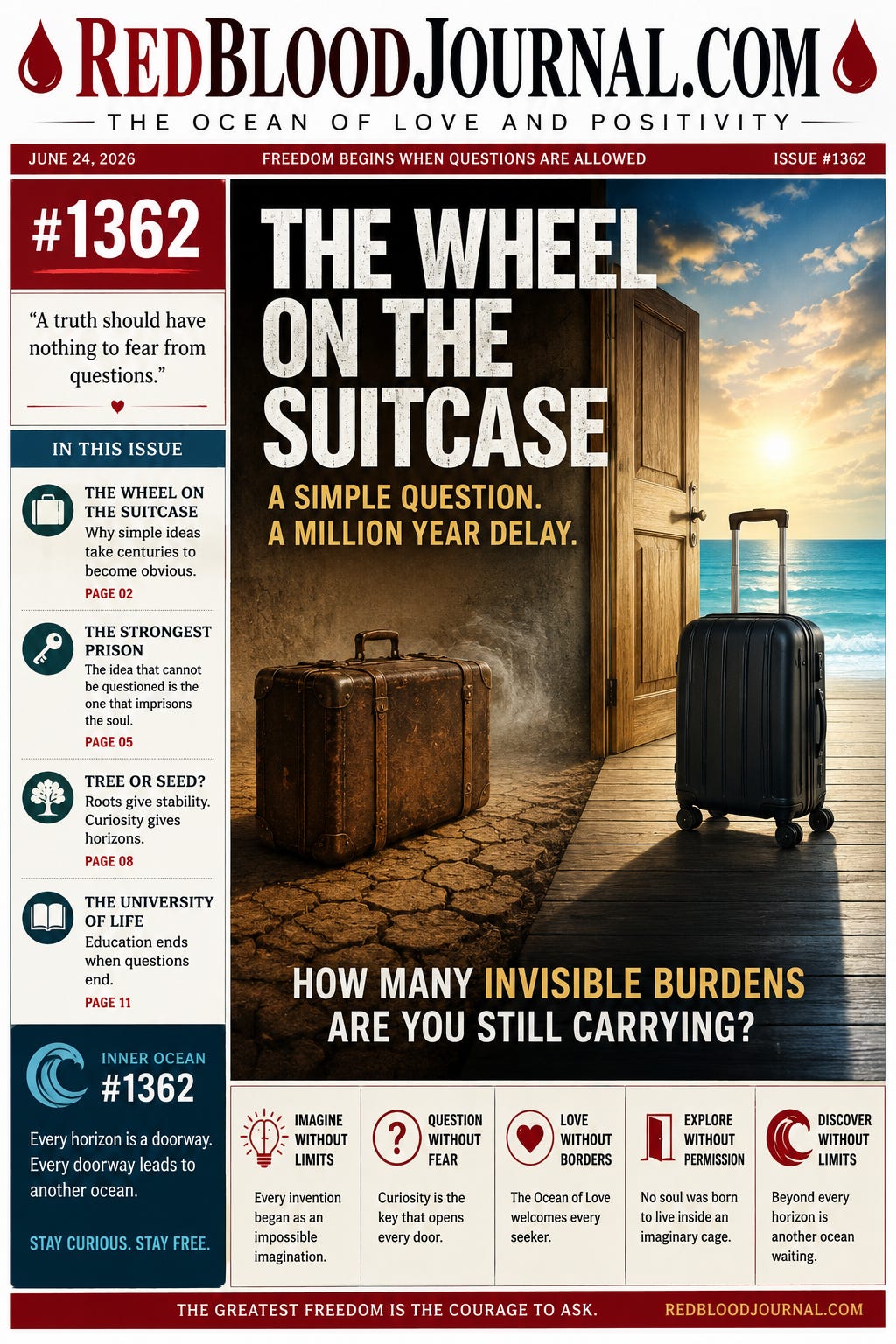
#1362 — The Wheel on the Suitcase
June 24, 2026
The Question Nobody Thought to Ask
For thousands of years, humanity carried heavy luggage by hand.
Travelers lifted trunks, bags, and bundles across cities, deserts, mountains, and oceans. Generation after generation accepted the burden because that was simply how things were done.
Then one day, someone asked a question that now appears almost absurd in its simplicity:
Why not put wheels on it?
Today, wheeled luggage is so common that most people cannot imagine traveling without it.
The remarkable part is not that wheels were eventually added.
The remarkable part is that it took so long.
The wheel already existed.
The luggage already existed.
The travelers already existed.
What was missing was not technology.
What was missing was imagination.
The Invisible Burdens
The story did not end with wheels.
Eventually, someone asked another question:
Why not add an extendable handle?
Again, the answer appears obvious in hindsight.
Yet millions of travelers struggled for years with a problem that now seems easily solved.
This pattern repeats throughout human history.
Solutions often appear obvious only after someone has imagined them.
The lesson is not about luggage.
The lesson is about the mind.
How many invisible burdens are still being carried today simply because they have become familiar?
How many assumptions survive not because they have been examined, but because they have never been questioned?
The Strongest Prison
Most people imagine a prison as walls, bars, and locked doors.
Yet the strongest prisons often have none of these.
The strongest prison is an idea that cannot be questioned.
The moment a person becomes afraid to ask a question, a door quietly closes.
The moment a person feels guilty for exploring a possibility, another lock is installed.
The moment curiosity becomes dangerous, the prison begins maintaining itself.
No guards are necessary.
The prisoner becomes the guard.
Beyond Religion
Many readers may assume this discussion concerns religion alone.
It does not.
The principle is universal.
It applies to politics.
It applies to governments.
It applies to science.
It applies to culture.
It applies to media.
And yes, it applies to religion.
The issue is not whether a belief is true or false.
The issue is whether the belief allows itself to be examined.
A truth should have nothing to fear from questions.
A truth should welcome investigation.
A truth should survive scrutiny.
If questioning destroys an idea, perhaps the questions did not destroy it.
Perhaps they simply revealed its limits.
Humanity’s Forgotten Gift
Every invention begins in a place that cannot be measured.
Imagination.
Before the airplane, there was imagination.
Before the telescope, there was imagination.
Before the computer, there was imagination.
Before every discovery that changed civilization, there was a person willing to think beyond accepted limits.
Imagination is the birthplace of progress.
Yet many people who eagerly challenge physical limitations become uncomfortable when challenging mental limitations.
Machines are questioned.
Traditions are protected.
Technology evolves.
Ideas often remain frozen.
Why?
The Tree and the Seed
There is comfort in certainty.
A tree stands firmly rooted in one place.
Its strength comes from stability.
But a tree cannot travel.
A seed can.
A seed can cross oceans.
A seed can discover new ground.
A seed can become something entirely different.
Many minds choose the security of roots.
Others choose the uncertainty of exploration.
Neither path guarantees wisdom.
But growth rarely occurs without movement.
The University of Life
Imagine life as a university.
Some students cling tightly to the textbook.
Others continually look beyond its pages.
The purpose of education is not to memorize answers.
The purpose of education is to expand awareness.
Questions are not obstacles to learning.
Questions are the mechanism through which learning occurs.
Every question opens a door.
Every assumption examined enlarges the classroom.
Every fear confronted expands understanding.
Education ends when curiosity ends.
The Open Door
Freedom does not require abandoning one belief and replacing it with another.
Freedom begins much earlier.
Freedom begins with permission.
Permission to wonder.
Permission to question.
Permission to imagine.
Permission to examine even the ideas considered untouchable.
The goal is not to destroy faith.
The goal is not to destroy tradition.
The goal is not to destroy meaning.
The goal is to remove fear from inquiry.
A mind that is free to ask is a mind that remains alive.
Final Thought
The person who placed wheels on a suitcase did not invent travel.
The person who added the handle did not invent luggage.
They simply questioned an assumption that everyone else accepted.
History moves forward because of individuals willing to ask simple questions that others overlook.
How many assumptions remain unquestioned today?
How many invisible burdens are still being carried?
How many doors remain unopened?
And how many people already possess the key, yet have never considered using it?
Inner Ocean #1362
The Ocean of Love and Positivity does not fear questions.
It does not demand loyalty.
It does not require membership.
It does not ask anyone to surrender curiosity.
Instead, it invites exploration.
It encourages every soul to look inward, examine freely, and discover what lies beyond the walls that fear has built.
For the mind willing to question, every certainty becomes an invitation, every horizon becomes a doorway, and every doorway reveals another ocean waiting to be explored.
The greatest freedom may not be found in discovering new answers.
It may be found in rediscovering the courage to ask new questions.
🩸🌊✨ Fantastic!
🔓 The Wheels of Curiosity: Unlocking the Mind’
Jun 24, 2026
This text explores how unexamined assumptions act as invisible burdens that hinder human progress and personal growth.
Using the invention of wheeled luggage as a metaphor, the author illustrates that major breakthroughs often rely on simple curiosity rather than complex new technology.
The passage argues that true intellectual freedom begins when individuals grant themselves permission to question established traditions, whether in science, politics, or religion.
It suggests that many people live in mental prisons built from a fear of scrutiny, yet genuine truth should always welcome investigation.
Ultimately, the source emphasizes that imagination and inquiry are the essential keys to expanding awareness and moving society forward.
This perspective encourages a shift from the comfort of certainty toward the transformative power of exploration.


