


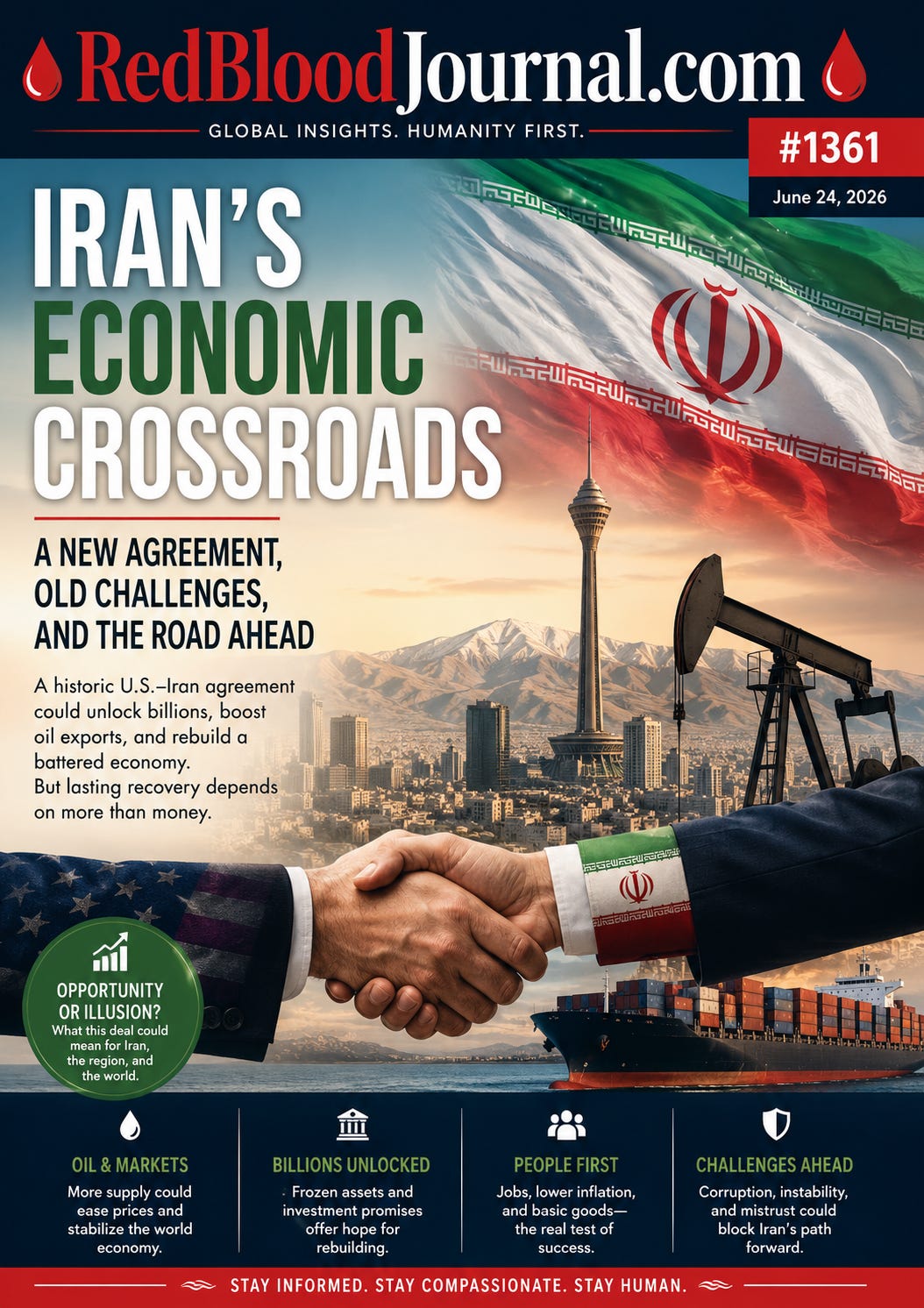
🩸 RedBloodJournal.com 🩸
#1361
Iran’s Economic Crossroads
A New Agreement, Old Challenges, and the Road Ahead
Date: June 24, 2026
For decades, Iran has lived under heavy economic sanctions. These restrictions limited the country’s ability to sell oil, trade freely with the world, and access international banking systems. The result has been inflation, declining living standards, shortages of goods, and growing economic pressure on ordinary citizens.
Now, a new interim agreement between the United States and Iran has opened the possibility of change.
Under the proposed framework, some sanctions could be eased, frozen Iranian assets could be released, and Iran could once again increase oil exports to global markets. Billions of dollars may become available for reconstruction and economic recovery.
For many Iranians, this raises an important question:
Will this agreement improve the lives of ordinary people, or will it simply provide temporary relief while deeper problems remain unresolved?
Why Iran’s Economy Matters
Iran possesses some of the world’s largest oil and natural gas reserves. Oil has historically been the engine of the country’s economy and one of its main sources of foreign income. When oil exports are restricted, government revenues decline, businesses struggle, and economic hardship spreads throughout society.
Years of sanctions, combined with internal economic mismanagement, have weakened the economy significantly. Rising prices, unemployment, and a shrinking middle class have become everyday realities for many families.
The recent conflict added even more pressure by damaging industries, infrastructure, and production capacity. Many businesses were disrupted, and millions reportedly lost their jobs.
What Could Improve
If a final agreement is reached and maintained, several positive developments could occur:
Increased oil exports could generate new revenue.
Frozen foreign assets could become accessible.
Imports of food, medicine, and industrial supplies could increase.
Foreign investment could return.
Economic stability could improve over time.
For ordinary citizens, even modest improvements in inflation, employment, and access to basic goods could provide immediate relief.
The Challenges Remain
However, money alone does not solve structural problems.
Economists interviewed in the report repeatedly emphasized that corruption, political uncertainty, and internal divisions could slow or even prevent meaningful recovery.
Large reconstruction funds and investment promises sound impressive, but many experts caution that such commitments often take years to materialize and depend heavily on political stability.
In other words, economic recovery is not guaranteed.
The agreement may open a door, but walking through that door requires competent management, transparency, and long-term stability.
What the World Gains
The effects extend beyond Iran.
A more stable Iran could increase global energy supplies, reduce pressure on oil prices, and lower uncertainty throughout international markets. Countries dependent on energy imports could benefit from a more predictable flow of oil and gas.
For that reason, investors, neighboring countries, and global markets are watching closely.
The Bigger Question
Perhaps the most important lesson is that no agreement alone can create prosperity.
Documents can be signed.
Sanctions can be lifted.
Money can be released.
But lasting improvement depends on how those opportunities are used.
History has shown that nations rise not merely because resources become available, but because people and institutions choose to use those resources wisely.
The coming months may determine whether this agreement becomes a turning point or merely another chapter in a long cycle of promises and disappointments.
Final Thought
Politics, economies, and governments constantly change.
Leaders come and go.
Agreements are signed and rewritten.
Markets rise and fall.
Yet beneath all external events remains a quieter reality that no sanction, war, or treaty can control.
The greatest stability does not come from oil, money, or political agreements.
It comes from discovering the Inner Ocean—the place within where wisdom, patience, and understanding remain untouched by the storms of the outer world.
Those who learn to navigate that ocean find something no government can grant and no crisis can take away.
🩸🌊 The Ocean of Love and Positivity 🌊🩸
🇮🇷 Iran’s Economic Crossroads: Sanctions and the Inner Ocean
Jun 24, 2026
This report examines the potential for economic transformation in Iran following a recent interim agreement with the United States aimed at easing long-standing international sanctions.
While the deal could potentially stabilize global energy markets and release billions for domestic reconstruction, the text cautions that financial influxes alone cannot fix deep-seated structural issues like corruption and mismanagement.
The source suggests that while lifting trade restrictions provides a vital opportunity for recovery, true prosperity depends on how leadership utilizes these newly available resources.
Beyond the geopolitical analysis, the article concludes with a philosophical reflection, suggesting that genuine stability is found through internal wisdom rather than external wealth or political treaties.
Ultimately, the text presents a balanced view of a nation at a pivotal crossroads, weighing the hope of renewal against the reality of historical challenges.


