


🩸 RedBloodJournal.com 🩸
#1355
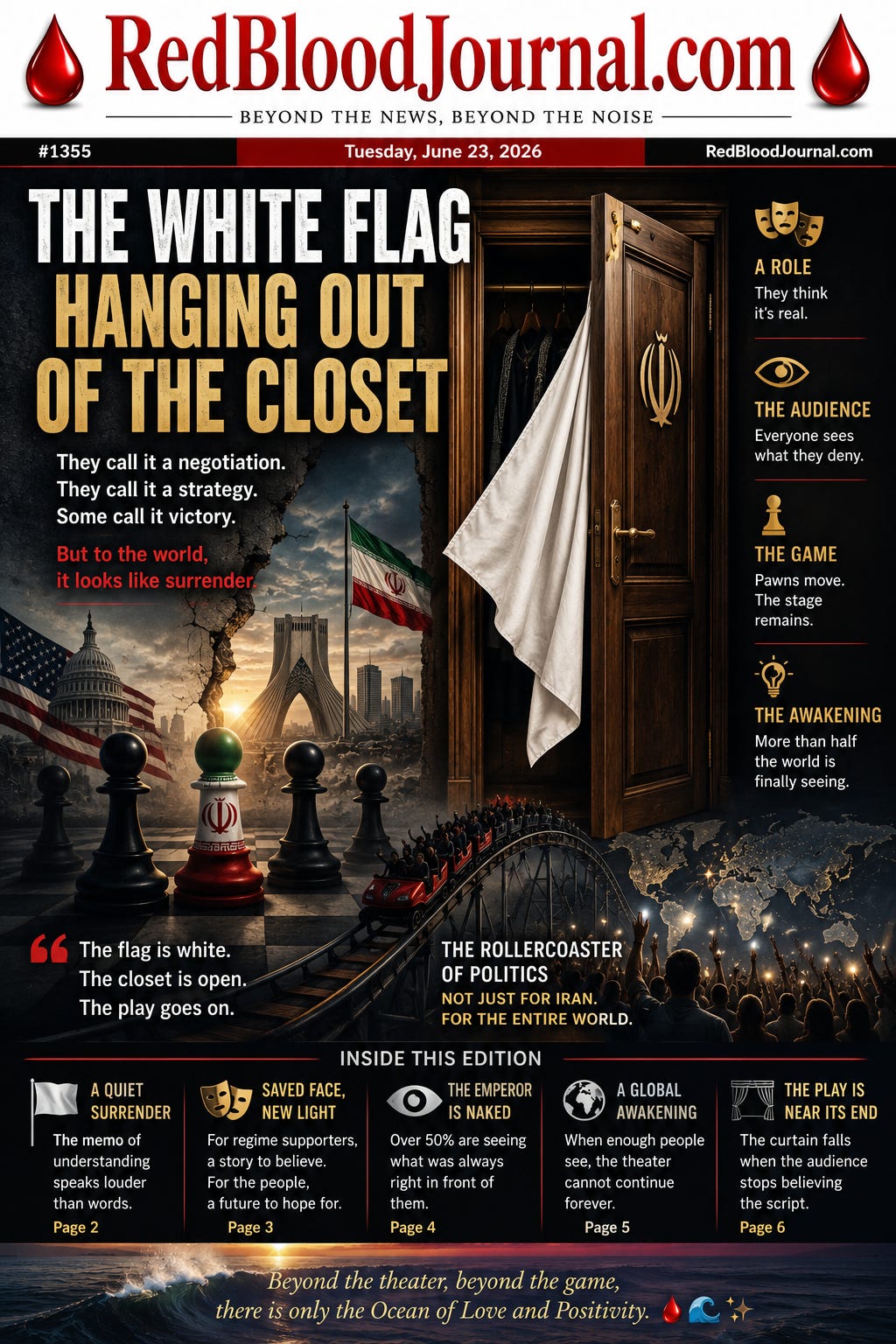
The White Flag Hanging Out of the Closet
Tuesday, June 23, 2026
Introduction
Political history is filled with moments when governments attempt to redefine reality faster than the public can absorb it.
Yesterday’s certainty becomes today’s compromise.
Yesterday’s enemy becomes today’s negotiating partner.
Yesterday’s slogan becomes today’s inconvenience.
The recent developments surrounding Iran and the United States have created one of those moments.
To some observers, the emerging agreements represent diplomacy.
To others, they represent pragmatism.
And to many critics of the Islamic Republic, they represent something far simpler:
A surrender that cannot be openly admitted.
The White Flag Nobody Wants to Discuss
No government enjoys telling its supporters that decades of sacrifice, slogans, and political positioning have led to compromise.
Pride rarely allows such admissions.
Instead, political systems often present retreat as strategy and necessity as victory.
This is why many observers describe the current situation with a simple image:
The white flag has been raised.
It is merely being kept inside the closet.
The problem is that the closet door is no longer fully closed.
The flag is visible.
Supporters see it.
Opponents see it.
Foreign governments see it.
Even many within the system appear to see it.
Yet the official narrative continues to insist that nothing fundamental has changed.
Saving Face
One possible interpretation of recent events is that all sides are being offered a way to move forward without complete humiliation.
Supporters of the regime are given language that preserves dignity.
Opponents are given hope that meaningful change may finally be approaching.
Foreign powers are given the appearance of diplomatic success.
Everyone receives something.
Everyone gives something.
And everyone attempts to claim victory.
Such arrangements are common throughout history.
When political systems reach a crossroads, survival often becomes more important than ideology.
The Actors and the Stage
The most fascinating aspect of politics is how often the actors begin believing they are larger than the play itself.
They become convinced that their role is permanent.
They mistake the stage for reality.
They forget that every political movement eventually faces the same fate:
It becomes yesterday’s headline.
Many of the figures currently arguing over the future of Iran may genuinely believe they are directing events.
Yet from a broader perspective, they may simply be actors performing their assigned roles in a much larger production.
The audience sees only the scene in front of them.
History sees the entire play.
Beyond Iran
The political roller coaster is not limited to Iran.
Every nation has its narratives.
Every nation has its approved beliefs.
Every nation has assumptions that large portions of the population are expected to accept without question.
Yet across the world, increasing numbers of people are comparing words with actions.
They are examining promises and measuring results.
They are questioning institutions that once appeared untouchable.
Whether those questions lead to correct conclusions is less important than the fact that the questions are being asked at all.
The audience is becoming more active.
The spectators are beginning to compare notes.
And that changes the relationship between the stage and the crowd.
The Emperor’s New Clothes
The famous story of the emperor who walked proudly through the city wearing invisible clothes remains relevant because it describes a timeless reality.
For a long time, everyone pretends.
Everyone nods.
Everyone repeats what they believe they are expected to repeat.
Then one voice speaks.
Then another.
And eventually enough people begin asking the same question.
The illusion does not disappear because someone attacks it.
The illusion disappears because enough people stop participating in it.
That moment may be approaching in many parts of the world.
Conclusion
Whether the current agreements lead to lasting change remains unknown.
Whether the promises made today survive tomorrow is impossible to predict.
What can be observed, however, is that something appears to be shifting.
The language is changing.
The narratives are changing.
The expectations are changing.
And perhaps most importantly, more people appear willing to look behind the curtain than at any other time in recent memory.
The white flag may still be hanging inside the closet.
But it is becoming increasingly difficult to pretend that nobody can see it.
As the theater continues, the wisest observer remains neither blinded by hope nor consumed by fear.
Instead, they watch carefully, think independently, and remember that every political drama eventually reaches its final act.
Beyond the noise of governments, beyond the ambitions of leaders, and beyond the endless performance of politics, there remains a quieter destination available to all who choose to seek it:
The Ocean of Love and Positivity.
🩸🌊✨ Fantastic!
🏳️ The White Flag in the Closet
Jun 23, 2026
The provided text examines the theatrical nature of politics, specifically regarding recent diplomatic shifts between Iran and the United States.
The author suggests that while official narratives claim continued strength, the reality is a hidden surrender where pragmatism has replaced long-standing ideological conviction.
This “white flag” of compromise is being concealed to preserve dignity and avoid public humiliation for the ruling authorities.
Beyond specific regional tensions, the source argues that global populations are increasingly questioning state illusions and comparing government promises against actual results.
By likening political movements to a stage play, the author encourages observers to look behind the curtain of official propaganda to find a more authentic reality.
Ultimately, the text characterizes these political maneuvers as temporary performances that will eventually yield to a broader historical shift in public consciousness.


