


🩸 RedBloodJournal.com 🩸
#1354
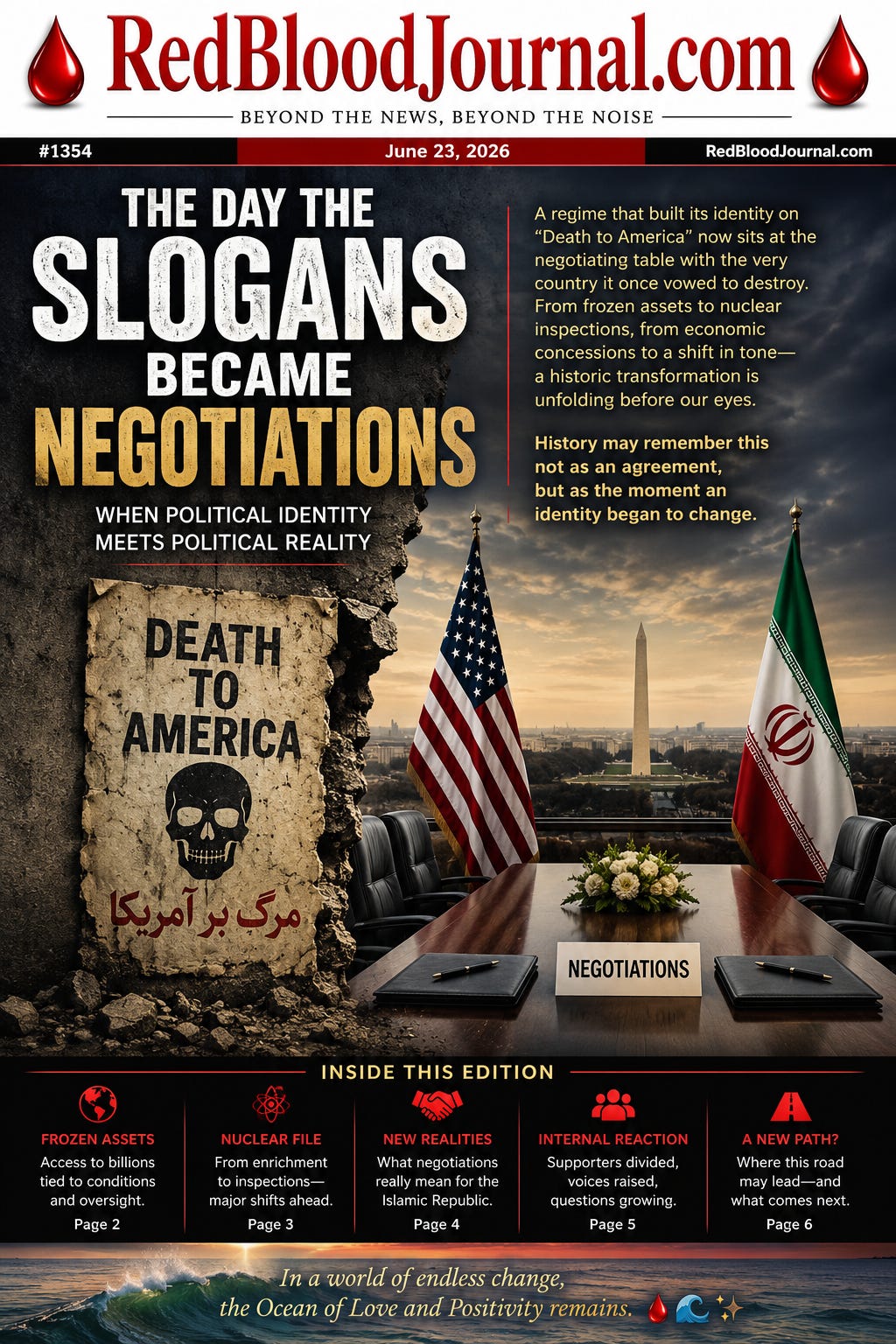
The Day the Slogans Became Negotiations
June 23, 2026
Introduction
History occasionally produces moments that appear almost impossible while they are unfolding. Events that would have been dismissed as fantasy only months earlier suddenly become reality, forcing observers to reconsider long-held assumptions about power, ideology, and political identity.
The recent developments surrounding negotiations between the United States and the Islamic Republic may represent one of those moments.
For nearly half a century, hostility toward America served as one of the defining pillars of the Islamic Republic’s political identity. It was more than a foreign policy position; it was a foundational narrative used to explain domestic challenges, justify regional policies, and unite supporters around a common adversary.
Today, however, a different picture is emerging.
From Resistance to Negotiation
Reports from ongoing negotiations suggest that discussions now extend far beyond temporary diplomatic contacts.
Topics reportedly include sanctions relief, access to frozen assets, nuclear inspections, economic arrangements, and future security understandings.
Whether every reported detail proves accurate is ultimately less important than the broader reality now visible to the public:
A government that once defined itself through resistance is now engaged in negotiations.
A movement that built legitimacy through confrontation is now discussing compromise.
A political system that spent decades presenting itself as immovable is now demonstrating flexibility where flexibility once appeared impossible.
For supporters who accepted the original revolutionary narrative, this transformation is difficult to ignore.
The Crisis of Identity
Political systems can survive economic hardship.
They can survive military setbacks.
They can survive leadership transitions.
What is far more difficult to survive is a crisis of identity.
When the ideas that once defined a government begin to change, supporters are forced to ask uncomfortable questions.
Was the previous position absolute?
Were decades of slogans permanent principles or temporary tools?
If yesterday’s impossible compromise becomes today’s practical solution, what does that reveal about the political journey that led to this moment?
These questions are now being asked openly by many who once defended the official narrative without hesitation.
Fractures Within the System
One of the most revealing aspects of the current situation is that criticism is increasingly coming from inside the political establishment itself.
Some voices argue that negotiation is necessary for stability and survival.
Others view recent developments as a surrender of principles that formed the foundation of the revolution.
The resulting debate has exposed divisions that were once hidden behind a united public front.
These disagreements are not merely policy disputes.
They represent competing visions of what the Islamic Republic should become in the years ahead.
As pressure increases, those differences become more difficult to conceal.
The End of One Chapter
History rarely announces its turning points in advance.
Most transformations are recognized only after they have already occurred.
Looking back, historians often identify a specific period when an old era quietly ended and a new one began.
The current moment may prove to be one of those periods.
Even if the existing political structure remains intact, the identity that sustained it for decades appears to be undergoing significant change.
The language is changing.
The priorities are changing.
The calculations are changing.
And perhaps most importantly, the expectations of both supporters and critics are changing.
Looking Beyond the Theater
Political movements rise.
Political movements fall.
Leaders come and go.
Agreements are signed and later forgotten.
Each generation witnesses new actors stepping onto the stage while older actors quietly exit.
The observer who becomes emotionally attached to every scene risks being carried wherever the script demands.
The observer who learns to step back and watch gains something far more valuable: perspective.
Whether these negotiations ultimately succeed or fail, they serve as another reminder that political identities are often less permanent than they appear.
The theater changes.
The costumes change.
The slogans change.
Yet the search for understanding remains the same.
Conclusion
The story unfolding today is not merely about negotiations, sanctions, or diplomacy.
It is about transformation.
It is about what happens when political reality collides with political mythology.
It is about the moment when long-standing narratives encounter the practical demands of survival.
Perhaps future historians will remember this period not as the moment an agreement was signed, but as the moment an identity began to shed its old skin.
Only time will reveal the final outcome.
Until then, the wisest position may be neither celebration nor despair, but observation.
For while governments and ideologies continue their endless dance across the stage of history, there remains another path available to every individual—the quieter path of looking inward.
Beyond the noise of politics, beyond the arguments of nations, beyond the temporary victories and defeats of the day, lies a destination untouched by power struggles and political theater:
The Ocean of Love and Positivity.
🩸🌊✨
🔄 The Metamorphosis of a Revolutionary Identity
Jun 23, 2026
The provided text explores a fundamental shift in political identity within the Islamic Republic as it pivots from a history of defiance toward the United States to a new era of diplomatic compromise.
This transition is characterized by high-stakes negotiations involving economic relief and security agreements, which directly challenge the revolutionary slogans that previously defined the state.
Such a departure from long-held principles has ignited internal fractures and ideological debates among the ruling establishment and its supporters.
The author suggests that this evolution represents a crisis of identity where the practical requirements of survival have finally collided with foundational mythology.
Ultimately, the source views these events as a sign that political narratives are inherently fluid and subject to significant transformation over time.
The narrative concludes by encouraging observers to look past the theatrics of governance to find a more stable, internal sense of peace.


