


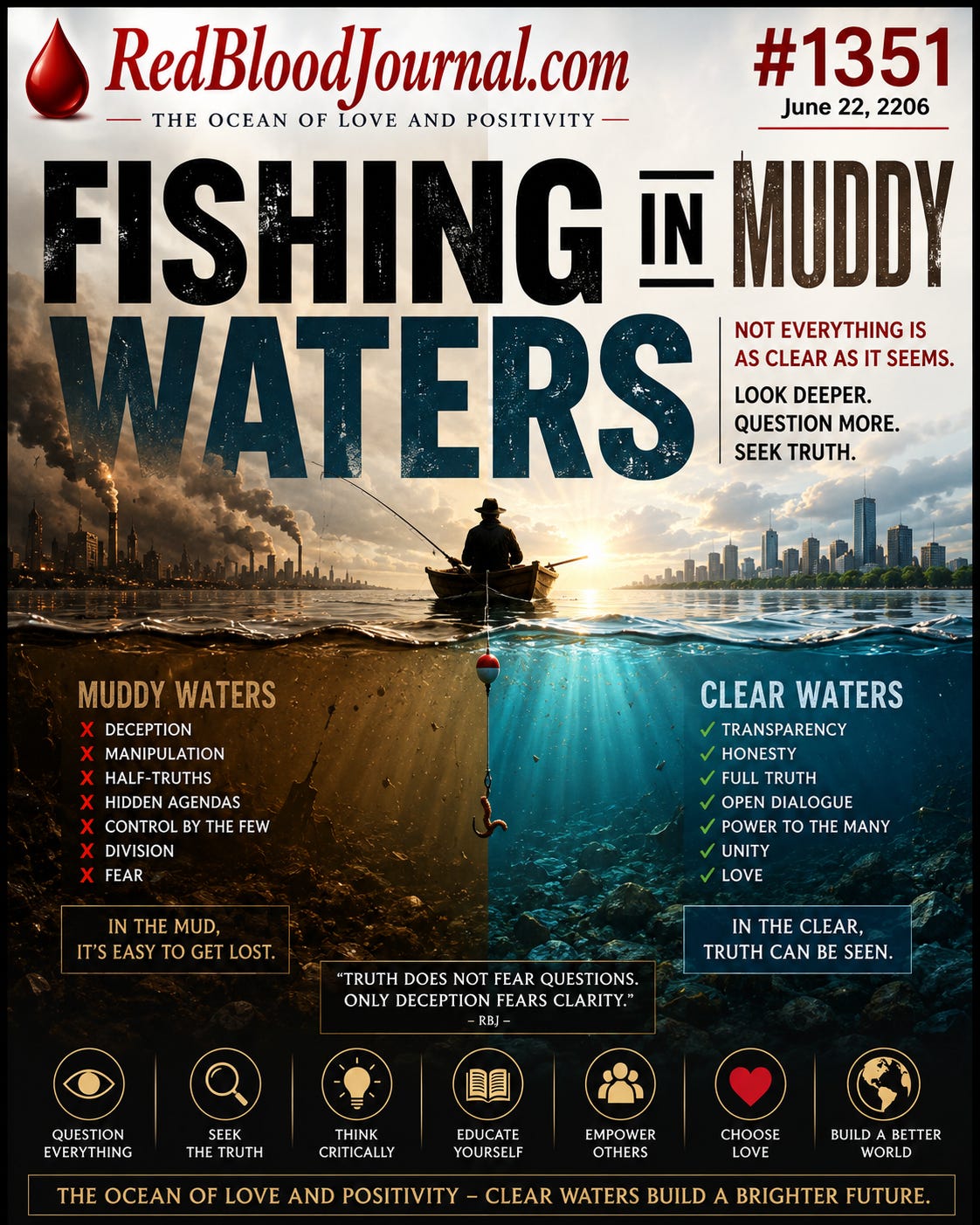
🩸 RedBloodJournal.com #1351
Fishing in Muddy Waters
There is an old expression:
“It’s easier to fish in muddy waters.”
At first glance, it appears to be a simple observation about fishing. But beneath the surface lies a deeper lesson about human nature, power, and perception.
When water is clear, everything becomes visible.
The fish can see.
The fisherman can see.
The rocks, the weeds, and the direction of movement are all exposed.
Clear water favors awareness.
Muddy water favors confusion.
The less visibility there is, the easier it becomes to influence the outcome without being noticed.
This principle extends far beyond rivers and lakes.
It appears in politics.
It appears in religion.
It appears in business.
It appears in media.
And it appears within the human mind itself.
Every day humanity is presented with an endless stream of conflicts.
One group against another.
One nation against another.
One religion against another.
One political party against another.
One ideology against another.
The volume is relentless.
The arguments change.
The actors change.
The headlines change.
Yet the emotional atmosphere often remains the same.
Fear.
Anger.
Division.
Outrage.
The muddy water never seems to settle.
Many observers conclude that people simply enjoy conflict.
But there may be another explanation.
Perhaps people are not attracted to hatred.
Perhaps they are shocked by it.
A person watches violence and asks:
“How could someone do that?”
A person witnesses cruelty and wonders:
“What happened inside that individual?”
Most human beings experience anger.
Most experience jealousy.
Most experience frustration.
These emotions are part of the human condition.
The difference is not in feeling them.
The difference is in what is done with them.
One person learns to understand their anger.
Another becomes consumed by it.
One person transforms suffering into wisdom.
Another transforms it into hatred.
The Ocean of Love and Positivity asks a question rarely heard amid the noise:
Why are we constantly shown the fire but rarely taught how to extinguish it?
Society has become remarkably skilled at identifying enemies.
It has become less skilled at teaching self-mastery.
The result is a population that often knows who to blame but does not know how to heal.
This is where the muddy water becomes useful.
As long as attention remains focused on external battles, the inner world remains unexplored.
As long as the water remains stirred, reflection becomes difficult.
The Ocean teaches the opposite approach.
Instead of creating more turbulence, it encourages stillness.
Instead of searching endlessly for opponents, it encourages self-examination.
Instead of asking:
“Who should I fight?”
it asks:
“What inside me requires understanding?”
When muddy water settles, something remarkable happens.
The surface becomes calm.
The reflection becomes visible.
For the first time, a person can clearly see themselves.
Perhaps that is the greatest fear of all systems built upon confusion.
Not that people will discover new enemies.
But that they will discover themselves.
And once a person truly understands themselves, muddy waters lose much of their power.
🌊
The Ocean of Love and Positivity teaches that clarity begins when the noise subsides. The goal is not to win every battle outside, but to understand the forces within. Only then can the waters become clear enough to see the path home.
🌊 The Clarity of Still Waters
Jun 22, 2026
The provided text explores the strategic use of confusion in society, using the metaphor of “fishing in muddy waters” to describe how systems thrive on human distraction.
It argues that institutions in media, politics, and religion often foster fear and division to prevent individuals from achieving internal clarity.
By keeping the public focused on external enemies and constant conflict, these entities ensure that the inner world remains unexplored.
The author suggests that the ultimate remedy is self-mastery and stillness, which allow the metaphorical water to settle.
Through this introspective shift, a person can stop reacting to manufactured outrage and instead find true self-understanding.
Ultimately, the text posits that personal peace is the greatest threat to systems built upon chaos and manipulation.


